As an Amazon Associate, Akermin earns from qualifying purchases. Product links on this page are affiliate links.
Fieldpiece · Fieldpiece SDMN6 Pressure Switch Tester
View on AmazonPrice and availability are shown on Amazon and can change at any time.
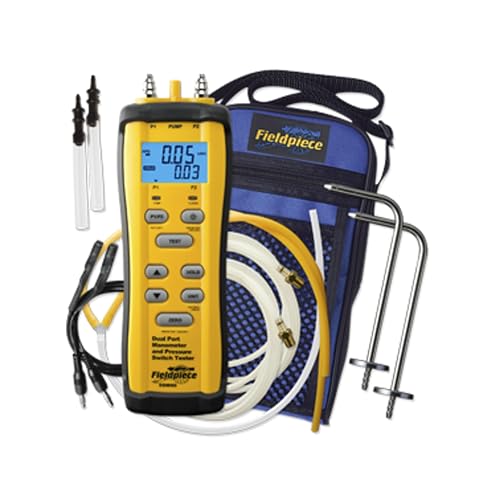
The Fieldpiece SDMN6 is a dedicated pressure switch tester. The listing states it measures gas pressure, static pressure and differential pressure, and that it is used to test and adjust pressure switches. Its dual backlit display is the feature that matters most for switch work, because you can watch supply and reference pressures together while adjusting a setpoint. It is not a general purpose HVAC manifold or a combustion analyser, and the listing does not publish a pressure range, resolution or accuracy figure, so you cannot confirm it suits a specific appliance from the bullets alone.
The dual display is the specification that decides the job
Most pressure instruments show one number at a time. A pressure switch tester has to show two, because a switch responds to the difference between the pressure pushing it one way and the reference pressure pushing it back. The SDMN6 listing states a backlit dual display. That is the line that tells you whether this instrument suits switch work at all.
If you are setting a differential switch on a gas train, you need the upstream pressure and the downstream pressure visible together. Toggling between two readings on a single display means you are comparing a number you remember with a number you are looking at, and switch setpoints are often close enough that memory is not good enough. A dual display lets you watch the gap close as you turn the adjustment screw.
The backlight is a practical addition, not a marketing one. Gas trains, draft hoods and air handlers are frequently in dim plant rooms or behind panels. A lit display is readable in places where a passive LCD is not.
What the three pressure modes actually cover
The listing states three measurement modes: gas pressure, static pressure and differential pressure. Those are not three separate sensors. They are three ways of using the same pressure ports and the same display.
Gas pressure means reading the line pressure on a gas supply, typically in the low inches of water column range on residential equipment. Static pressure means reading duct pressure, which tells you how hard the air handler is working against the duct system. Differential pressure means reading the difference between two points, which is what a pressure switch responds to and what an air filter or coil pressure drop is measured as.
The listing does not publish the pressure range, the resolution or the accuracy for any of these modes. That is a real gap. A switch tester that only reads to a few inches of water column is fine for residential draft switches and useless on a commercial gas train running at higher pressure. Without a stated range you cannot confirm the instrument covers the appliance in front of you. Ask the supplier for the range before you commit if the job is outside ordinary residential work.
Testing and adjusting a switch: what the tool is for
The listing says the SDMN6 is used to test and adjust pressure switches. That is a narrower job than general pressure measurement, and it is worth understanding why the tool exists.
A pressure switch is a safety device. It closes or opens an electrical circuit when pressure crosses a setpoint. To test one you apply pressure, watch the switch change state, and compare the pressure at which it changed with the pressure at which it should have changed. To adjust one you turn a screw that changes the spring tension and repeat the test. The SDMN6 includes quick connect leads, which the listing names, so the switch can be wired to the instrument and its state observed while pressure is applied.
The listing also includes a pump bleed accessory and a Y splitter. Those are the parts that let you apply and hold pressure and route it to more than one place. They are the difference between a pressure gauge and a switch tester, and they are in the box.
The accessories in the box, and what they imply
The listing states the SDMN6 includes two static pressure probes, two slide on gas adapters, quick connect leads, three hoses, a Y splitter and a pump bleed accessory.
The two static pressure probes are for duct work. Static pressure is read through a small probe inserted into the duct, and having two means you can read two points without moving a probe between them. The two slide on gas adapters are for gas pressure ports. The three hoses and the Y splitter let you route pressure to both the instrument and the switch under test. The pump bleed accessory lets you release pressure in a controlled way, which matters when you are finding the exact point at which a switch opens.
What the listing does not state is the maximum pressure the hoses and adapters are rated for, or the type of gas the adapters suit. Those are questions to settle before use on any fuel gas. The listing also does not state a battery type or a battery life figure, only that the instrument has auto power off.
Where the SDMN6 stops being the right instrument
The SDMN6 is a pressure switch tester. It is not a combustion analyser and it does not measure carbon monoxide, carbon dioxide or oxygen. It does not measure temperature. It does not measure airflow directly, though static pressure readings can be used alongside a duct traverse if you have the right instrument for that.
If your job is measuring airflow in ducts and vents, a hot wire anemometer is the instrument for that, and the site covers differential pressure meters for HVAC separately. If your job is checking the pressure drop across a filter or coil as part of a broader building survey, a general differential pressure meter may be more flexible than a dedicated switch tester.
The SDMN6 is also not a data logger. The listing does not state any logging or memory function. If you need a record of pressure over time, this is not that instrument. The site discusses environmental data loggers for building monitoring for that kind of work.
Build, handling and the parts that wear
The listing states a rugged rubber boot and a magnetic hanger. Those two features are about handling in the field. A rubber boot protects the instrument from knocks, and a magnetic hanger lets you stick it to a gas valve or an air handler while both hands are free for a wrench and a screwdriver. For switch adjustment, where you are holding a screwdriver and watching a display, the hanger is more useful than it sounds.
The listing states a zero adjust button. Pressure instruments drift at zero, and a zero button lets you reset the reference before a measurement. It is a maintenance feature, and it is the one the listing gives you for keeping the instrument honest.
What the listing does not state is the ingress protection rating, the operating temperature range or the warranty period. Those are the questions to ask if the instrument will live in a van or be used outdoors in cold weather.
Verdict: a switch tester first, and honest about it
The Fieldpiece SDMN6 is a dedicated pressure switch tester with a dual backlit display, three pressure modes and a full set of hoses, probes and adapters in the box. The dual display is the specification that decides whether it suits your job, because switch work needs two pressures visible at once. The listing does not publish a pressure range, resolution or accuracy, so you cannot confirm coverage of a specific appliance from the bullets alone. If you test and adjust pressure switches, the included accessories and the dual display make it a coherent tool. If you need a general pressure meter, a data logger or a combustion analyser, look elsewhere.
Recommended Tools


Products shown because their documented specifications fit this guide. Price and availability are on Amazon and can change.
Frequently Asked Questions
Does the SDMN6 measure carbon monoxide or combustion gases?
No. The listing states gas pressure, static pressure and differential pressure. It does not state any combustion gas measurement. A pressure switch tester is not a combustion analyser and should not be used as one.
What is the pressure range of the SDMN6?
The listing does not publish a pressure range. It also does not publish resolution or accuracy. If your work is outside ordinary residential gas and duct pressures, ask the supplier for the range before buying.
Can the SDMN6 be used as a general differential pressure meter?
It measures differential pressure, so it can read a pressure difference. But the listing does not state a logging function or a wide range, and the included accessories are aimed at switch testing. For filter and coil pressure drop surveys, a general differential pressure meter may be more suitable.
What is included with the SDMN6?
The listing states two static pressure probes, two slide on gas adapters, quick connect leads, three hoses, a Y splitter and a pump bleed accessory. The listing does not state a carry case or a battery type.
Does the SDMN6 have auto power off?
Yes. The listing states auto power off as a feature. It does not state the time delay before shutoff or the battery life.
Is the SDMN6 suitable for commercial gas trains?
The listing does not publish a maximum pressure, so it is not possible to confirm suitability for commercial gas pressures from the bullets. The included gas adapters are described as slide on, but the listing does not state the pressure they are rated for. Confirm with the supplier before use on any commercial gas train.
Affiliate disclosure: Akermin earns a commission from qualifying Amazon purchases made through links on this page. Our editorial picks are based on documented specifications and owner feedback, not commissions.
Related Guides
Handheld Meter vs Fixed Installed Monitor: Which Do You Actually Need?
This page explains the engineering difference between spot measurement and continuous monitoring, and how that difference decides which instrument fits the job.
Read More→Single point reading against a logged average: which number should you trust?
This page explains when a single point reading is the honest answer, when an average is, and how to tell which your instrument is actually giving you.
Read More→
Extech 407730-NIST Sound Level Meter Review: Who It Is For, and Who Should Walk Away
This review explains what the Extech 407730-NIST measures, what its specifications mean in practice, and which buyers should choose a different instrument.
Read More→