As an Amazon Associate, Akermin earns from qualifying purchases. Product links on this page are affiliate links.

Fluke · Fluke 378FC AC/DC TRMS Non-Contact Voltage Wireless Clamp w/PQ Indicator & iFlex
View on AmazonPrice and availability are shown on Amazon and can change at any time.
Verdict
The Fluke 378 FC is the 377 FC with one addition that changes what it is for. Both use FieldSense to read voltage and current through the jaw without touching a live conductor, both are True RMS AC/DC clamps rated to 1000 V and 1000 A, both include iFlex and Fluke Connect. The 378 FC adds a power quality indicator, described by the manufacturer as showing whether equipment or the power line is faulty, and it uses the simultaneous voltage and current data to display power and power factor. For a technician who is regularly asked why a motor is tripping or why a drive keeps faulting, that indicator narrows the search before an analyser is brought in. For someone who only needs voltage and current, the 377 FC is the same meter for less.
What Is Different From the 377 FC
| Item | Fluke 377 FC | Fluke 378 FC |
|---|---|---|
| FieldSense voltage and current | Yes | Yes |
| True RMS AC/DC current, iFlex included | Yes | Yes |
| Fluke Connect | Yes | Yes |
| Power quality indicator | No | Yes |
| Power and power factor display | No | Yes (manufacturer) |
| Typical buyer | Electrician taking many readings | Troubleshooter diagnosing equipment faults |
Documented Specifications
| Item | Documentation |
|---|---|
| Non-contact measurement | FieldSense voltage and current through the jaw |
| Measurement type | True RMS AC and DC |
| Current and voltage | To 1000 A and 1000 V (manufacturer) |
| Power quality | Indicator distinguishing equipment faults from supply faults |
| Flexible probe | iFlex included |
| Connectivity | Fluke Connect logging, saving and sharing |
What the Power Quality Indicator Does
When a motor overheats or a drive trips, the first question is whether the supply is distorted or the load is drawing distorted current. With voltage and current captured together, the meter can compare the two waveforms. If the voltage is clean and the current is distorted, the load is the likely cause; if the voltage itself is distorted, the problem is upstream. The 378 FC presents that comparison as an indicator rather than as a spectrum. Owners describe it as a triage tool: it tells you which direction to look and whether to escalate to a power quality analyser. It does not capture events, log harmonics or record sags and swells over time. Our guide to clamp meters for HVAC covers where that triage fits into a service call.
Power and Power Factor
A conventional clamp reads current and, separately, voltage; multiplying them gives apparent power but not real power, because the phase angle between them is unknown. FieldSense measures both at the same instant, so the 378 FC can show real power and power factor for a single-phase measurement. That is enough to check whether a motor is loaded as expected, whether a capacitor bank is doing its job, or how much a piece of equipment actually draws. The relationship between volts, amps, power factor and watts is the reason a clamp that only reads current cannot tell you real power on its own.
Shared Features
Everything else is the 377 FC: FieldSense needs a ground reference lead and an insulated, separated conductor; DC voltage uses the leads conventionally; iFlex reaches busbars and bundles; Fluke Connect logs to a phone and produces shareable reports. The body is the full-size 37x design with a backlit display and a feeder-sized jaw. See the Fluke 377 FC review for the FieldSense mechanics in detail.
Practical Notes
FieldSense readings require the conductor to be insulated and separated from its neighbours in the jaw, and a ground reference through the supplied lead. In a panel that means clipping to a grounded bar before anything else. The power quality indicator needs both voltage and current present, so it gives no answer on an idle circuit; the load has to be running. Owners report that app pairing is quick and that logging a compressor start from outside the cabinet is the feature they use most, with the indicator consulted when a reading looks wrong.
Strengths
- Points to equipment or supply as the fault source in one measurement.
- Real power and power factor from a clamp.
- All the FieldSense, iFlex and Fluke Connect advantages of the 377 FC.
Limitations
- The indicator is a pointer, not a power quality analysis.
- Highest price in the 37x range.
- Same size and FieldSense constraints as the 377 FC.
How It Compares
The Fluke 377 FC is the choice if the indicator and power readings are not needed. The Fluke 374 FC drops FieldSense for a lower price with Fluke Connect retained. The Fluke 381 has a detachable display for distance reading instead of an app.
How We Research
This review is based on the manufacturer’s published specifications, the Amazon product listing and owner reports. We did not run laboratory tests.
Recommended Tools


Products shown because their documented specifications fit this guide. Price and availability are on Amazon and can change.
Frequently Asked Questions
What does the power quality indicator show?
Per the manufacturer, it indicates whether a measured problem originates in the equipment or in the power line, using the simultaneous voltage and current data. It is a first-pass pointer, not a power quality analyser.
Does the 378 FC measure power?
Because FieldSense reads voltage and current at the same instant, the 378 FC can display power and power factor according to Fluke's documentation. The 377 FC does not provide those derived values.
Is the 378 FC a replacement for a power quality analyser?
No. It gives an indication and single-phase power figures. Harmonic spectra, event capture and long-term logging need a dedicated analyser.
Is iFlex included?
Yes. The listing includes the iFlex flexible current probe with the 378 FC.
Affiliate disclosure: Akermin earns a commission from qualifying Amazon purchases made through links on this page. Our editorial picks are based on documented specifications and owner feedback, not commissions.
Related Guides

Fluke 377 FC Review: Non-Contact Voltage and Current Measurement
A True RMS AC/DC clamp meter with FieldSense: voltage and current read through the jaw without touching a live conductor, plus iFlex and Fluke Connect.
Read More→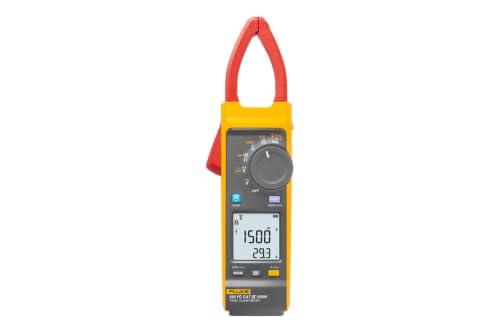
Fluke 393 FC Review: Is This 1500V Solar Clamp Meter Worth the Professional Price?
A CAT III 1500 V, IP54 True RMS clamp meter for photovoltaic work with DC power, audio polarity, visual continuity, a thin jaw and Fluke Connect.
Read More→
Fluke 325 Review: Is This Compact True-RMS Clamp Meter Still the Smart Professional Buy?
The Fluke 320 series clamp with True RMS AC and DC current to 400 A, voltage to 600 V, resistance to 40 kΩ, frequency, capacitance and temperature.
Read More→