As an Amazon Associate, Akermin earns from qualifying purchases. Product links on this page are affiliate links.

Fluke · Fluke SMFT-1000 Solar Tools Pro Kit with Multifunction PV Tester and Performance Analyzer, I-V Curve Tracer, IRR2-BT Wireless Irradiance Meter Pro, i100 AC/DC Current Clamp 100A, and TruTest Software
View on AmazonPrice and availability are shown on Amazon and can change at any time.
A professional photovoltaic test kit built around a multifunction tester and performance analyser with I-V curve tracing, stated to meet IEC 62446-1 for Category 1 and Category 2 tests, supplied with the IRR2-BT wireless irradiance meter, an i100 AC and DC 100 A current clamp, MC4 solar clamp test leads and TruTest Advanced software. The named standard is what separates this from the rest of the category. The irradiance meter is what makes its measurements comparable to a datasheet rather than merely recorded.
The irradiance meter is the measurement, not the accessory
Read the kit list quickly and you see a tester with three things bundled alongside it. That reading gets the priority wrong.
A photovoltaic module datasheet quotes its figures at standard test conditions: a defined irradiance, a defined cell temperature and a defined spectrum. Nothing on a roof is ever at standard test conditions.
So when you measure a module in the field and get a power figure below nameplate, you have learned nothing yet. The module might be faulty. Or it might be a hazy afternoon. Or the cells might be at 55 C on a hot roof, where output is legitimately well down. All three produce the same low reading.
To separate them you need to know the irradiance and the cell temperature at the moment of the test, then correct the measurement to standard conditions and compare. Without those two inputs, an I-V curve is a picture of an unknown situation.
That is why the IRR2-BT belongs in the same sentence as the tester rather than in a list of extras. The listing states it provides real time irradiance and temperature measurements and connects to the tester, which means the correction happens as part of the measurement rather than as arithmetic you do afterwards from a different instrument and a different moment.
It is the single most important thing about this kit and it is also the easiest thing to undervalue when comparing it against a cheaper tester. Our guide on measuring solar panel output works through how much a reading moves with irradiance and temperature.
Naming a standard changes what the results are worth
The first bullet states an all in one solar PV system testing solution meeting IEC 62446-1 standards for Category 1 and Category 2 tests.
Compare that with the language used elsewhere in this category: professional grade, accurate, reliable, suitable for most residential and commercial panels. None of those words constrain anything.
A standard does. IEC 62446-1 sets out what has to be verified when a photovoltaic installation is commissioned and when it is periodically reinspected, and it divides that into a baseline set of tests and a further set for more demanding cases. An instrument that meets it is an instrument whose outputs fit a documentation process someone else recognises.
The practical difference is who will accept your results. A reading from an unspecified tester is a reading you believe. A set of measurements taken to a named standard, corrected for measured irradiance and temperature, is a commissioning record.
Curve shape against two end points
The third bullet promises comparison of on location I-V curve results with manufacturer I-V curve data, and this is where the instrument class shows.
A simpler PV tester measures the significant points: open circuit voltage, short circuit current, and the maximum power point with its voltage and current. Those five numbers tell you whether a module is performing.
A curve tracer sweeps the entire load range and plots the relationship. The additional information is in the shape:
- A clean curve with a sharp knee, sitting below the datasheet line proportionally, suggests uniform degradation or simply lower irradiance than standard.
- A distinct step or notch in the curve points to a group of cells producing less than its neighbours, which is what shading, soiling or a failed bypass diode looks like.
- A rounded, sagging knee points to increased series resistance, which means connections, cabling or cell interconnects.
Those are three different faults requiring three different responses, and the end point measurements cannot distinguish them. The curve can. That is the whole argument for the extra cost over a points based tester like the one we reviewed that measures Pmax, Vmp, Imp, Voc and Isc without plotting them.
What the four bullets leave out
| Specification | Published in the listing |
|---|---|
| Standard compliance | IEC 62446-1, Category 1 and Category 2 |
| I-V curve tracing | Yes, comparable against manufacturer curve data |
| Irradiance and temperature | IRR2-BT wireless meter included and connected |
| Current clamp | i100 AC and DC, 100 A |
| Software | TruTest Advanced, for solar asset management |
| Leads | MC4 solar clamp test lead set |
| Maximum system voltage | Not stated in the listing bullets |
| Current range of the tester | Not stated in the listing bullets |
| Insulation test voltage | Not stated in the listing bullets |
| Accuracy, any measurement | Not stated in the listing bullets |
| Measurement category rating | Not stated in the listing bullets |
Four bullets is remarkably little for an instrument of this class, and the omissions are the ones a buyer needs. The maximum system voltage is the first question anyone sizing a PV tester asks, because string voltage is what the instrument has to survive and cold weather pushes open circuit voltage above nameplate.
We make the same point here that we made about a far cheaper tester whose listing contradicted itself on voltage: this figure is a safety limit on a source that cannot be switched off, and it should be on the page. The difference is that this listing omits it rather than publishing two conflicting values, and a named standard at least implies a defined envelope. Establish the figure before taking it onto an array.
The MC4 lead set deserves a positive note. MC4 is the standard photovoltaic connector, and a kit that arrives able to connect to a string without adapters is a kit you can use on the first day.
Who this is for
This is a commissioning and asset management kit for someone who installs or maintains photovoltaic systems professionally and has to produce records that stand up. The standard, the curve tracing, the integrated irradiance and temperature correction, the asset management software and the AC and DC clamp together describe a complete workflow rather than a measurement.
It is far more than a homeowner checking panels needs, and far more than a general electrician doing occasional solar work needs. For those, a points based tester answers the question at a fraction of the outlay. The dividing line is whether anyone other than you will rely on the numbers.
Recommended Tools
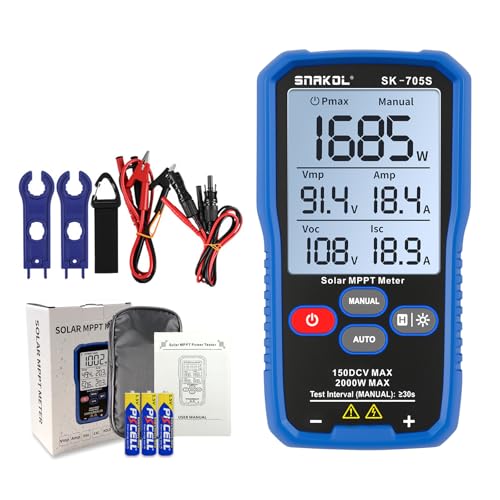
Products shown because their documented specifications fit this guide. Price and availability are on Amazon and can change.
Frequently Asked Questions
Why does the irradiance meter matter so much?
Because a panel output depends almost entirely on how much light is falling on it and how hot the cells are. Measure a module at the wrong moment and it will look faulty when it is fine, or fine when it is faulty. Datasheet figures are quoted at standard test conditions, and comparing a field measurement against them requires correcting for the actual irradiance and cell temperature at the instant of the test. The listing describes the IRR2-BT connecting for real time irradiance and temperature measurements, which is what makes the comparison valid rather than indicative.
What is IEC 62446-1 Category 1 and Category 2?
A named standard for commissioning and periodic verification of photovoltaic systems. Category 1 covers the basic tests every installation needs, and Category 2 adds the further tests required for larger or more complex systems, including I-V curve measurement. Naming a standard is substantively different from claiming professional grade, because a standard defines what has to be measured and how. It also means the output can go into documentation someone else will accept.
How is an I-V curve tracer different from a tester that reads Voc and Isc?
A tracer sweeps the load from open circuit to short circuit and records the whole relationship between current and voltage, then draws it. The shape is diagnostic. A step in the curve points to a shaded or mismatched group of cells. A rounded knee suggests increased series resistance. A reading of just the end points tells you the module is down on power without telling you why.
What is the AC/DC clamp in the kit for?
The listing includes an i100 AC and DC current clamp rated 100 A. On a photovoltaic installation the DC side is string current and the AC side is inverter output, and verifying both is how you establish whether a loss sits in the array or in the conversion. Note that this is a Hall effect type clamp, which is why it can read DC at all; flexible coil clamps cannot.
What is not in these bullets?
A great deal, for a flagship kit. There is no maximum voltage, no current range for the tester itself, no accuracy figure for any measurement and no insulation test voltage. Four bullets is very little space for an instrument of this class, and a buyer sizing it against a particular array has to look the figures up elsewhere.
Affiliate disclosure: Akermin earns a commission from qualifying Amazon purchases made through links on this page. Our editorial picks are based on documented specifications and owner feedback, not commissions.