As an Amazon Associate, Akermin earns from qualifying purchases. Product links on this page are affiliate links.

KLEIN TOOLS · Klein Tools RT390 Circuit Analyzer with Large LCD, Identifies Wiring Faults, GFCI and AFCI Tester, Voltage Drop, Displays Trip Time
View on AmazonPrice and availability are shown on Amazon and can change at any time.
Verdict
The Klein RT390 is what a receptacle tester becomes when it stops guessing. The listing states a large colour LCD showing wiring faults, AFCI and GFCI testing, voltage drop and device trip time, along with detection of dual wiring faults including open neutral and open ground. For a home inspector, an electrician doing existing-installation work or anyone commissioning receptacles, the extra information is the whole point: a three-light tester confirms a pattern, this one measures the circuit.
Documented Specifications
| Item | Manufacturer listing |
|---|---|
| Display | Large colour LCD with plain-language results |
| Wiring faults | Standard, AFCI and GFCI outlets, including dual faults |
| Dual fault detection | Open neutral and open ground identified together |
| Device testing | AFCI and GFCI, with trip time displayed |
| Circuit quality | Voltage drop measurement |
The listing does not publish voltage ranges, test current or accuracy. Check the datasheet if you need those for documentation.
Why Three Lights Are Not Enough
A conventional tester lights a pattern of neon lamps and you match the pattern to a legend. It works for the simple cases and fails in ways that matter. It cannot distinguish a properly grounded receptacle from one with a bootleg ground, where the ground terminal is strapped to neutral: the pattern reads correct and the installation is not. It can be fooled by two simultaneous faults. And it tells you nothing about the quality of the connections behind the outlet.
That last point is worth dwelling on. Most receptacle problems that cause fires are not wiring errors; they are loose or degraded connections that pass a continuity check and heat up under load. Voltage drop is how you see them, and a three-light tester has no way to measure it.
Trip Time Is the Real Test of a Protective Device
A GFCI that trips is not necessarily a GFCI that works. These devices degrade, and a slow trip is a device that will not protect someone within the time the mechanism was designed around. Pressing the test button confirms the mechanism moves; measuring the trip time tells you whether it moved fast enough. The difference between those two statements is the reason this instrument exists.
The same argument applies to AFCI devices, with the practical caution that tripping arc fault protection in an occupied building interrupts whatever is on that circuit. Warn people first, and be aware that some sensitive equipment reacts badly to an unexpected interruption.
Reading Voltage Drop Sensibly
Voltage drop is measured under load, because a poor connection only reveals itself when current flows. A circuit that reads a perfect 120 volts with nothing running can drop substantially the moment a load appears, and the size of that drop is a direct measure of resistance in the path. Excessive drop points to a loose terminal, a backstabbed connection, a damaged conductor or a run that is simply too long for its size.
Take the reading at the end of the circuit, not at the first outlet, and compare outlets on the same circuit with each other. A single bad outlet among several good ones localises the fault immediately.
Who Should Own One
- Home inspectors: it produces findings a client can understand and that a three-light tester cannot support.
- Electricians working on existing installations: dual fault detection and voltage drop find the problems that were already there.
- Landlords and property managers: a documented GFCI trip time is a defensible record.
- Homeowners: probably more instrument than needed, unless the house is old and the wiring history is unknown.
Strengths
- Trip time measurement rather than a pass or fail button press.
- Dual wiring fault detection, which simple testers can miss.
- Voltage drop, which finds degraded connections before they fail.
- Colour display with results that need no legend card.
Limitations
- No ranges or accuracy stated in the listing bullets.
- Tripping AFCI devices in occupied buildings needs care.
- Does not locate which breaker feeds the outlet; that is a breaker finder’s job.
- More expensive than a basic tester, which is adequate for a one-off check.
How It Compares
The KAIWEETS KT301P combines a simpler outlet and GFCI tester with a breaker finder, which is a different job. For tracing circuits through walls and underground, see the Ideal SureTrace and the Klein ET450. Our ranking is in the outlet tester roundup.
How We Research
All figures come from the manufacturer listing and Klein’s published documentation. We did not run laboratory tests and publish no measurements of our own.
Recommended Tools


Products shown because their documented specifications fit this guide. Price and availability are on Amazon and can change.
Frequently Asked Questions
What does trip time tell you?
How long a GFCI or AFCI device took to operate. A device that trips but takes too long is a device that has degraded, and a three-light tester cannot see that difference at all.
What are dual wiring faults?
Two faults present at once, such as an open neutral combined with an open ground. Simple testers can misread these, sometimes showing a correct wiring pattern when two errors mask each other, which is exactly the dangerous case.
Why does voltage drop matter?
It reveals a high resistance connection somewhere in the circuit. A loose terminal, a backstabbed receptacle or an undersized conductor shows up as excessive drop under load, and that is a fire risk long before anything stops working.
Does it test AFCI devices?
The listing states AFCI and GFCI testing with trip time display. Check local practice before tripping AFCI devices on an occupied installation, because some equipment does not appreciate the interruption.
Affiliate disclosure: Akermin earns a commission from qualifying Amazon purchases made through links on this page. Our editorial picks are based on documented specifications and owner feedback, not commissions.
Related Guides
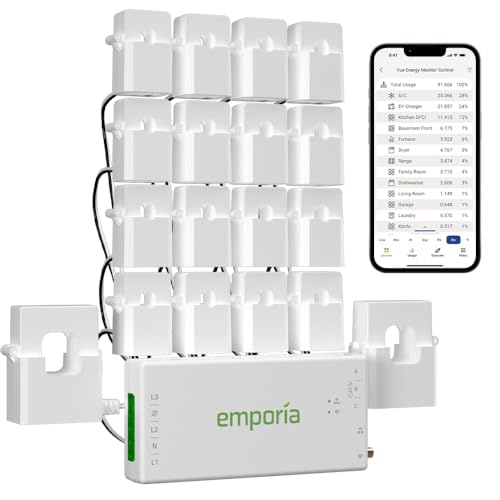
Emporia Vue 3 Review: Whole Panel Energy Monitoring With Solar and Net Metering
A UL listed panel-mounted energy monitor using clamp-on sensors, stating support for single phase, single split phase and two wire systems, with solar and net metering monitoring.
Read More→
Tempo 501 Tracker II Review: Following Buried Cable to 4,000 Feet and 7 Feet Deep
An underground wire locator stating the ability to trace buried conductors and metallic pipes over 4,000 feet and to depths of 7 feet, on active or dead systems, with depth determination.
Read More→
Klein ET450 Review: Tracing Energised and Dead Conductors, Including Underground
A circuit tracer kit stating tracing of energised or non-energised breakers, fuses and wires, adjustable receiver sensitivity for drywall, cement block, shielded cable and underground, and isolation of one wire in a bundle.
Read More→