As an Amazon Associate, Akermin earns from qualifying purchases. Product links on this page are affiliate links.

SCULPRIV · Air Quality Monitor, 8-in-1 Air Quality Monitor, for Enclosed Spaces | Measures HCHO, TVOC, AQI, Temp, Hum PM1.0, PM2.5, PM10,with a Color LED Screen Showing Specific Real-time Data Clearly.
View on AmazonPrice and availability are shown on Amazon and can change at any time.
A portable monitor with a laser sensor for particulate and two separate electrochemical cells for formaldehyde and TVOC, displaying those plus PM1.0, PM2.5, PM10, temperature, humidity and a colour coded index on an LED screen, powered by a 1500 mAh battery rated at 4 to 5 hours. Naming two separate gas cells is the strongest claim on the page. The thing to establish before buying is that there is no carbon dioxide channel at all, which rules out the most common reason people buy an indoor monitor.
Eight channels, and carbon dioxide is not one of them
The eight are listed consistently in the product name and the first bullet: formaldehyde, TVOC, the air quality index, temperature, humidity, PM1.0, PM2.5 and PM10. Count carefully and one of the eight is an index rather than a measurement, so there are seven measured quantities behind it.
Carbon dioxide is absent, and that absence decides a large share of purchases. Carbon dioxide is the standard indoor proxy for ventilation because people are the source: it accumulates when a room is occupied and poorly ventilated, and falls when fresh air arrives. No other channel on this instrument does that job. Particulate falls when you filter the air, which is not the same as exchanging it, and formaldehyde tracks what the furniture and finishes are giving off, not how often the air is replaced.
So this monitor can tell you whether there is something in the air, and not whether the room is breathing. If the question is stuffiness, sleep quality in a closed bedroom or a meeting room that gets heavy by the afternoon, this is the wrong instrument and no amount of particulate data will stand in for the missing channel. The comparison in our note on carbon dioxide against PM2.5 for ventilation questions sets out why the two are not substitutes.
Credit where it is due, though. A monitor with a volatile compound sensor on board has the hardware to derive an estimated carbon dioxide figure and print it as if it were measured. This listing does not do that. Leaving the channel out is more honest than faking it.
Two electrochemical cells instead of one shared sensor
The fourth bullet is the most informative on the page: a laser sensor for particulate, two electrochemical sensors separately measuring formaldehyde and TVOC content, and an independent temperature and humidity sensor.
The word doing the work is separately. The economical way to build a monitor of this type is to fit one broadband gas sensor, usually a heated metal oxide element, and present its output twice under two different names. Both readings then rise and fall together, because they are the same measurement with two labels, and neither is specific to anything.
An electrochemical cell works differently. The target gas reacts at an electrode and the resulting current is proportional to its concentration, which makes the response far more specific to the gas the cell was built for. Two cells therefore give you two numbers that can genuinely diverge, and divergence is the useful signal: formaldehyde rising while TVOC stays flat points at a different source than both climbing together.
The trade offs are real and none of them appears on the page. Electrochemical cells consume reagent and have a finite service life. Their output drifts. They respond to temperature and humidity. And formaldehyde cells cross respond to other aldehydes and to alcohols, which is the standard explanation for a reading that spikes during cleaning. For how that shapes what the numbers are worth, see our explainer on how consumer monitors detect formaldehyde.
The index claim that does not hold up
The second bullet says the monitor adopts colour coded visualisation that matches EPA health standards, with bright indicators giving graded reminders for measured data.
Two problems with that sentence. The first is scope. The United States air quality index is defined for outdoor ambient air, with published breakpoints for a specific list of pollutants. PM2.5 is one of them, so a colour band for PM2.5 can at least be traced back to something public. Formaldehyde and TVOC are not in that list, there are no index breakpoints for them, and a colour applied to those readings cannot be matching a standard that does not cover them.
The second is setting. An index built for outdoor air is being applied indoors, where the sources, the exposure times and the relevant guidance are all different. Using it is a convention, and a defensible one for rough interpretation, but it is a convention rather than compliance with anything.
The redeeming detail is in the product name and repeated in the first bullet: the screen shows specific real time data, not only the colours. Numbers can be compared against published guidance and tracked over time. A colour cannot. Treat the bands as a glance and the figures as the output. Our note on what a TVOC figure actually reports covers why that channel in particular resists a tidy threshold.
Nonstop tracking against four to five hours
The third bullet contains both halves of a contradiction, one sentence apart. First, that you can check air quality anywhere or leave the device running nonstop for continuous tracking. Then, that the built in 1500 mAh lithium battery lasts 4 to 5 hours on a single charge.
Four to five hours is not nonstop. Both statements can only be true if the monitor measures while connected to a charger, and the bullets never say that it does. Many portable instruments of this type do, and some suspend measurement while charging, so it is a question to settle rather than assume.
The honest part is the battery figure itself. Four to five hours is modest and the listing publishes it rather than describing the runtime as long lasting. A laser particulate sensor runs a small fan to move air past the beam and two electrochemical cells need power as well, so a short runtime is the expected consequence of this sensor set rather than a cost cut.
What does not appear anywhere is logging. No memory, no export, no application, no interval recording. Combined with the runtime, that confines the instrument to live use: it is something you carry into a room and read while you are standing there. A renovation that needs a record over three weeks needs a logger, and this is not one.
The final bullet overreaches in a different direction, claiming that using an air quality monitor indoors helps improve focus, mood and overall physical health. A monitor measures. What changes air is ventilation, filtration or removing the source, and the instrument only tells you which of those to try.
Specific about sensors, silent about tolerances
| Specification | Published in the listing |
|---|---|
| Channels | HCHO, TVOC, index, temperature, humidity, PM1.0, PM2.5, PM10 |
| Particulate sensor | Laser |
| Gas sensors | Two electrochemical cells, formaldehyde and TVOC separately |
| Temperature and humidity | Independent sensor |
| Processor | 32 bit ARM |
| Display | Colour LED, real time figures plus colour bands |
| Battery | 1500 mAh lithium, 4 to 5 hours per charge |
| Carbon dioxide | Not measured, and not claimed |
| Accuracy, any channel | Not stated in the listing bullets |
| Measurement range, any channel | Not stated in the listing bullets |
| Resolution, any channel | Not stated in the listing bullets |
| Electrochemical cell service life | Not stated in the listing bullets |
| Index breakpoints used for each channel | Not stated in the listing bullets |
| Whether it measures while charging | Not stated in the listing bullets |
| Logging, memory or export | Not stated in the listing bullets |
| Warm up time | Not stated in the listing bullets |
| Calibration route | Not stated in the listing bullets |
The shape of this table is unusual and mildly encouraging. Most monitors in this class publish channel counts and say nothing about hardware; this one names every sensor technology it uses and even the processor family, while publishing not a single range, resolution or tolerance.
Two blanks are load bearing. Without a measurement range, there is no way to know whether the formaldehyde channel resolves the low concentrations that matter indoors or only alarms at high ones. Without a cell service life, there is no way to know when the two best sensors in the device stop deserving trust, and an electrochemical cell that has aged does not announce itself; it simply reads low. The mention of a 32 bit processor, by contrast, says nothing at all about measurement quality, and should be read as filler.
Right after a renovation, wrong for a ventilation question
Buy this if your question is about emissions from materials. New flooring, fresh paint, new furniture, a room that smells of something, a car interior, a hotel room you want to check: formaldehyde and TVOC on separate cells plus three particulate fractions is the right sensor set for that, and it is a better set than a single shared gas sensor sold as two readings. The published figures on screen let you watch a new room settle over weeks, which is exactly how that measurement should be used.
Do not buy it for ventilation. There is no carbon dioxide channel, that is the measurement ventilation questions are answered with, and nothing else here substitutes. Do not buy it as a logger either, since four to five hours of battery with no stated memory and no export means every reading lives only as long as you are looking at it. And do not treat the colours as a verdict: the figures underneath them are what the instrument actually knows.
Recommended Tools


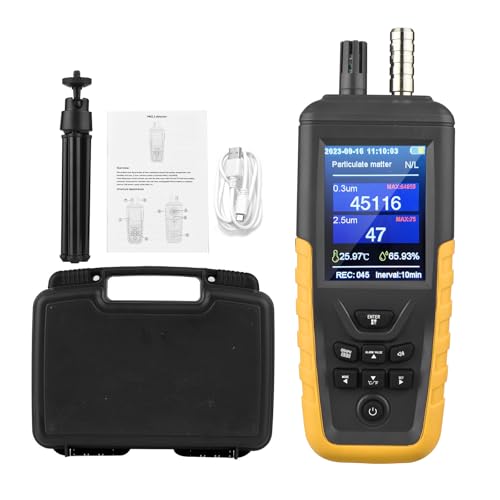
Products shown because their documented specifications fit this guide. Price and availability are on Amazon and can change.
Frequently Asked Questions
Does it measure carbon dioxide?
No. The eight channels are formaldehyde, TVOC, the air quality index, temperature, humidity, PM1.0, PM2.5 and PM10, and carbon dioxide is not among them. That is worth knowing before buying rather than after, because carbon dioxide is the usual indoor proxy for ventilation. The upside is that the listing does not substitute an estimated carbon dioxide figure derived from its gas sensor and label it CO2, which is a common move in this category and a misleading one.
Why are two electrochemical cells better than one sensor?
Because formaldehyde and total volatile organic compounds are different quantities, and a single broadband gas sensor cannot separate them. The cheap approach is to take one sensor output and present it twice, once as TVOC and once as formaldehyde, which means the two readings always move together and neither is specific. A dedicated electrochemical cell for formaldehyde responds to that compound through a chemical reaction at an electrode, so the two numbers on the screen can genuinely disagree, which is what makes them worth reading.
Can it run continuously as the listing suggests?
Only on a charger, and the listing does not say whether that is supported. One sentence invites you to leave the device running nonstop for continuous tracking and the next states a 1500 mAh battery lasting 4 to 5 hours. Both can be true at once only if it measures while plugged in. Nothing in the bullets confirms that it does, and nothing mentions logging, so continuous tracking means somebody watching the screen.
Is the colour scale really based on EPA standards?
Not in the way the wording suggests. The United States index is defined for outdoor ambient air and has published concentration breakpoints for a specific set of pollutants, of which PM2.5 is one. Formaldehyde and TVOC are not in that set and have no index band, so a colour applied to them cannot be matching that standard. Read the concentration figures, which the listing does display, and compare them against published indoor guidance yourself.
How long do electrochemical sensors last?
Not stated here, which is the significant omission. Electrochemical cells consume a reagent as they work and have a finite service life, typically specified in years by manufacturers who publish it at all, and their output drifts across that life. They are also sensitive to temperature and humidity, and formaldehyde cells cross respond to other aldehydes and to alcohols, which is why a reading can climb after cleaning with an alcohol based product. None of that appears on this page.
Affiliate disclosure: Akermin earns a commission from qualifying Amazon purchases made through links on this page. Our editorial picks are based on documented specifications and owner feedback, not commissions.
Related Guides

Temtop Handheld Particle Counter Review: Three Channels and No Published Flow Rate
A pump suction handheld particle counter reading 0.3, 0.5 and 1.0 micron channels alongside PM2.5, PM10 and TSP, with temperature and humidity sensors, 32 GB of internal storage and a 3500 mAh battery.
Read More→
VETOUCH Plug In CO2 Monitor Review: An Alarm the Bullets Never Define
A mains powered three in one monitor showing carbon dioxide, temperature and humidity on a 1.83 inch colour screen, with three brightness settings and a display that flips 180 degrees.
Read More→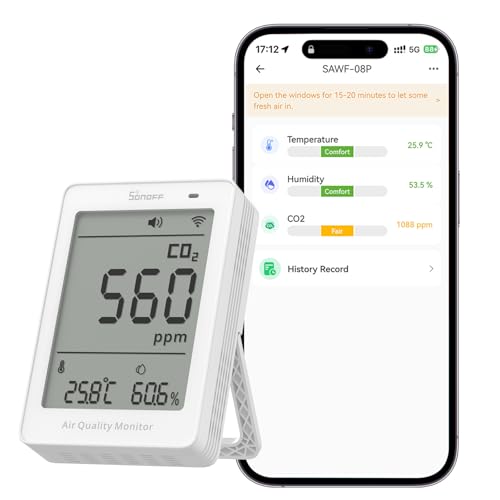
SONOFF AirGuard SAWF-08P Review: NDIR Accuracy Written as a Formula
A mains powered Matter compatible monitor showing CO2, temperature and humidity on one screen, with an NDIR sensor, 5 second updates and 12 months of history in the eWeLink app.
Read More→