As an Amazon Associate, Akermin earns from qualifying purchases. Product links on this page are affiliate links.
A vane anemometer measures air speed by how fast a small propeller spins; a hot-wire anemometer measures it by how much moving air cools a heated element. Vanes are robust, direction-sensitive, average over their own diameter and are best for grilles, ducts and outdoor wind above about 0.4 m/s. Hot-wires read very low velocities, fit through small test holes and respond fast, but are fragile, sensitive to air temperature and read the flow at a single point. Choose by the lowest speed and the smallest opening you need to measure.
How each works
Vane
A lightweight propeller, 25 to 100 mm across, turns on low-friction bearings; a magnet or optical sensor counts revolutions. Rotation speed is nearly proportional to air speed above a starting threshold. Because the propeller spans an area, the reading is an average across it, which is convenient at a grille and misleading in a narrow duct where the head blocks the flow.
Hot-wire (thermal)
A thin wire or film is heated a fixed amount above air temperature. Air passing over it removes heat; the circuit measures the power required to hold the temperature and converts it to velocity. The element is a few millimeters across on a telescopic probe, so it reads a point and fits through a 10 to 15 mm hole. Because the physics depends on the temperature difference, the instrument must measure air temperature and compensate.
Side by side
| Vane | Hot-wire | |
|---|---|---|
| Velocity range | About 0.4 to 30 m/s | About 0.05 to 20 m/s |
| Typical accuracy | ±2 to 3% of reading | ±3 to 5% of reading |
| Low-speed performance | Poor; stalls | Excellent |
| Temperature sensitivity | Low | High; compensated within a range |
| Direction | Must face the flow | Nearly omnidirectional |
| Spatial averaging | Over the vane diameter | Point measurement |
| Probe access | Needs a clear opening the size of the head | Fits through small holes; telescopic |
| Durability | Robust; dust and moisture tolerant | Delicate element; keep clean and dry |
| Response | Slow; bearings and inertia | Fast; fractions of a second |
| Cost | Lower | Higher |
Choosing by job
- Supply and extract grilles: vane. The averaging suits a large face; use a traverse for big grilles.
- Duct traverses through test holes: hot-wire. It fits the hole and reads the profile point by point.
- Fume hood and safety cabinet face velocity (0.4 to 0.6 m/s): hot-wire, because low speeds and multi-point grids are involved.
- Cleanrooms, laminar flow benches, diffuser throw: hot-wire.
- Outdoor wind, sport, drones, spraying: vane or cup.
- Bathroom fan check: either; a vane at the grille is simplest.
- Air leaks and drafts around windows: hot-wire, for the low speeds and the ability to probe a gap.
Errors to avoid
- Vane not square to the flow; readings fall with the cosine of the angle.
- Vane head blocking a small duct and reading its own obstruction.
- Hot-wire used outside its temperature compensation range, or with a dirty element.
- Hot-wire in pulsing flow reporting a fluctuating number; use the instrument’s averaging mode.
- Reading a single point on a grille and calling it the average.
Background on what the measurement is for: what an anemometer measures. Instruments are covered in the environmental monitoring category.
Recommended Tools

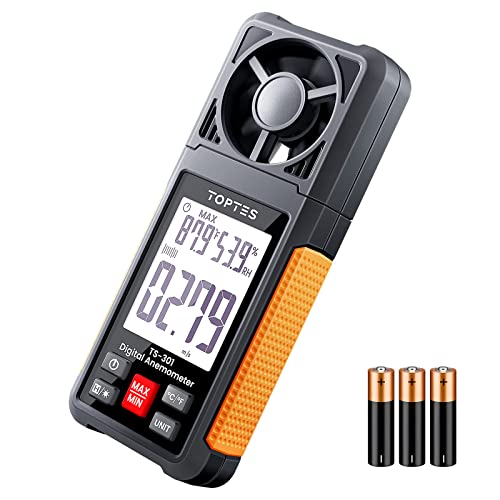
Products shown because their documented specifications fit this guide. Price and availability are on Amazon and can change.
Frequently Asked Questions
Which anemometer is better for HVAC?
For grilles and diffusers, a vane. For small ducts, fume hoods, low-velocity checks and probing through test holes, a hot-wire. Many technicians carry both.
Why does a hot-wire read differently when the air is warm?
It measures cooling of a heated element. Warm air cools it less, so the instrument must compensate; outside its compensation range it reads low.
What is the lowest speed each can measure?
Vanes stall below roughly 0.2 to 0.4 m/s. Hot-wires read down to about 0.05 to 0.1 m/s, which is why they are used for cleanrooms and hood face velocities.
Affiliate disclosure: Akermin earns a commission from qualifying Amazon purchases made through links on this page. Our editorial picks are based on documented specifications and owner feedback, not commissions.
Related Guides

CPS LS790B Leak-Seeker Review: Non Combustible Is the Deciding Word
An ion pump refrigerant leak detector individually calibrated to find a leak rate better than a quarter of an ounce per year, with ten selectable sensitivity ranges, a water vapour filter and a bar graph plus tone display.
Read More→
BW Clip BWC2-H Review: Alarm Points Set Before the Clock Starts
A single gas hydrogen sulfide detector with one button operation, hibernation mode, automatic logging of the 35 most recent gas events and bump test results, and compatibility with IntelliDoX and MicroDock II docking.
Read More→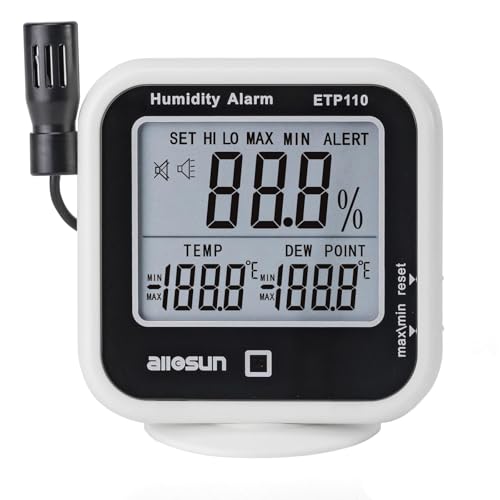
ALLOSUN Thermometer Hygrometer Review: Half a Metre of Lead and No Tolerance
A battery powered thermometer and hygrometer showing temperature, relative humidity and dew point, with a settable humidity alarm, a sensor on a lead of about 50 cm, maximum and minimum memory and a large LCD.
Read More→