As an Amazon Associate, Akermin earns from qualifying purchases. Product links on this page are affiliate links.
A lux meter measures illuminance: the amount of visible light falling on a surface, in lux (lumens per square meter). Its sensor is filtered to respond like the human eye, so the reading tracks how bright a surface looks rather than raw energy. It is the tool for checking whether a workplace, classroom, warehouse or plant shelf meets a lighting requirement, for balancing lighting between areas, and for measuring daylight.
Lux, lumens, candela and foot-candles
| Unit | Measures | Relationship |
|---|---|---|
| Lumen (lm) | Total light output of a source | On the bulb box |
| Lux (lx) | Light arriving per square meter | 1 lx = 1 lm/m² |
| Foot-candle (fc) | Light arriving per square foot | 1 fc = 10.76 lx |
| Candela (cd) | Intensity in a direction | 1 cd at 1 m gives 1 lx |
Illuminance falls with the square of distance from a point source: a lamp giving 400 lux at 1 m gives 100 lux at 2 m.
How the meter works
A silicon photodiode behind a filter that matches the eye’s photopic sensitivity curve, under a white diffusing dome that gives cosine correction so light arriving at an angle is weighted correctly. The dome is important: without it, a meter reads low for light from the side and cannot measure a room’s general illuminance properly. Better meters state their deviation from the ideal curve (f1′) and cosine error (f2); Class B and Class C meters under DIN 5032 define acceptable limits.
Typical illuminance levels
| Situation | Approximate lux |
|---|---|
| Moonlight | 0.1 to 0.3 |
| Street lighting | 5 to 20 |
| Living room evening | 50 to 150 |
| Corridor, warehouse aisle | 100 to 200 |
| Office desk (common guidance) | 300 to 500 |
| Detailed work, drafting | 750 to 1,500 |
| Overcast daylight outdoors | 1,000 to 10,000 |
| Direct sunlight | 30,000 to 100,000 |
When it is useful
- Workplace and school lighting checks against guidance such as 500 lux for offices, with uniformity across the room.
- Warehouses and car parks where minimum lux at floor level is a safety requirement.
- Retail and display where product lighting is specified.
- Horticulture, with the caveat that plants respond to a different spectrum; a lux reading is a rough proxy and a PAR meter is the proper tool for grow lights.
- Photography and film for scene exposure and balancing.
- Daylight studies comparing rooms and orientations.
- Emergency lighting verification, which often needs a low-range meter reading down to 0.1 lux.
LEDs and spectrum
A meter’s accuracy depends on how closely its filter matches the eye curve across the spectrum. Incandescent light is broad and forgiving; LEDs have spiky spectra that expose filter errors. Inexpensive meters can misread LEDs by tens of percent. Meters marketed as LED-capable, or those stating a low f1′ figure, handle them properly. Extech’s LT45 is an example of a meter designed for LED and colored light.
Measuring properly
- Hold the sensor flat on the working plane (desk height for offices, floor for corridors), dome up.
- Keep your body and shadow away from the sensor.
- Take readings on a grid and report the average and the minimum-to-average ratio for uniformity.
- Let lamps warm up; some discharge and LED fixtures change output over the first minutes.
- Note daylight contribution or measure after dark for the artificial lighting alone.
Light meters sit alongside sound and airflow instruments in the environmental monitoring category; multifunction meters combine all three.
Recommended Tools
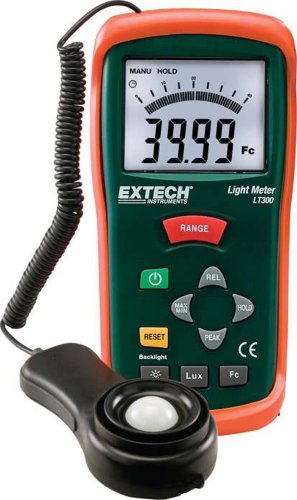

Products shown because their documented specifications fit this guide. Price and availability are on Amazon and can change.
Frequently Asked Questions
What is the difference between lux and lumens?
Lumens measure the total light a source emits. Lux measures the light arriving on a surface: one lux is one lumen spread over one square meter. A 1,000-lumen lamp gives 1,000 lux over 1 m² or 100 lux over 10 m².
How many lux do I need for a desk?
Office guidance is commonly 300 to 500 lux on the working plane; detailed tasks 750 to 1,000 lux. Corridors and general areas 100 to 200 lux.
Can a lux meter measure LED lighting accurately?
Only if its sensor is filtered to the eye's response curve (photopic V(λ)). Cheap meters calibrated for incandescent light can misread LEDs by 10 to 30 percent; meters marketed for LEDs use better filters.
Affiliate disclosure: Akermin earns a commission from qualifying Amazon purchases made through links on this page. Our editorial picks are based on documented specifications and owner feedback, not commissions.
Related Guides

CPS LS790B Leak-Seeker Review: Non Combustible Is the Deciding Word
An ion pump refrigerant leak detector individually calibrated to find a leak rate better than a quarter of an ounce per year, with ten selectable sensitivity ranges, a water vapour filter and a bar graph plus tone display.
Read More→
BW Clip BWC2-H Review: Alarm Points Set Before the Clock Starts
A single gas hydrogen sulfide detector with one button operation, hibernation mode, automatic logging of the 35 most recent gas events and bump test results, and compatibility with IntelliDoX and MicroDock II docking.
Read More→
ALLOSUN Thermometer Hygrometer Review: Half a Metre of Lead and No Tolerance
A battery powered thermometer and hygrometer showing temperature, relative humidity and dew point, with a settable humidity alarm, a sensor on a lead of about 50 cm, maximum and minimum memory and a large LCD.
Read More→