As an Amazon Associate, Akermin earns from qualifying purchases. Product links on this page are affiliate links.
PM2.5 spikes while cooking because heating oil and food above about 150 °C throws off a fine aerosol of oil droplets, fatty acids and combustion products. Frying, searing, grilling and toasting produce the most; boiling and steaming produce almost none. A particle monitor in or near a kitchen commonly reads 100 to 500 µg/m³ during a fry-up, ten to fifty times the background, and takes 30 to 90 minutes to settle. A cooker hood that vents outdoors, run on high and started before the pan gets hot, removes most of it.
Where the particles come from
- Oil aerosol. Hot oil vaporizes and re-condenses into droplets in the 0.1 to 2 µm range, squarely inside PM2.5. Smoking oil is the extreme case.
- Browning reactions. Searing meat, toasting bread and roasting vegetables release organic aerosol and, when charred, soot.
- Gas combustion. A gas flame adds ultrafine particles and nitrogen dioxide to the mix. Electric and induction hobs remove this component only.
- Burnt food and crumbs. The toaster and the oven floor.
Typical readings by method
| Method | Typical peak PM2.5 near the hob (no hood) |
|---|---|
| Boiling, steaming | Under 20 µg/m³ |
| Sautéing in a little oil | 50 to 150 µg/m³ |
| Pan-frying, stir-frying | 150 to 500 µg/m³ |
| Searing, grilling, smoking oil | 500 to over 1,000 µg/m³ |
| Toasting to dark brown | 100 to 300 µg/m³ briefly |
For scale, the WHO 24-hour guideline is 15 µg/m³ and a heavily polluted city day is 100 to 200 µg/m³. Cooking peaks are short, but a household that fries twice a day without extraction accumulates meaningful exposure. See PM2.5 vs PM10.
How far it spreads
With the kitchen door open, cooking particles spread through the home within 10 to 20 minutes; a living-room monitor typically shows a third to a half of the kitchen peak. Bedrooms with the door closed stay cleaner. Particles settle and dilute over an hour or two; opening windows halves that time.
Cutting the spike
- Vent outdoors. A hood that recirculates through a grease filter removes odor and some grease but very little PM2.5. Check where the duct goes.
- Start early, run late. Turn the hood on before the pan is hot and leave it running 10 to 15 minutes after.
- Use the back burners. Capture efficiency at the back of the hob is often double that at the front.
- Lower the heat. Oil below its smoke point produces a fraction of the aerosol.
- Close the kitchen door and crack a window for make-up air so the hood can actually move air.
- Run a purifier in the adjoining room during and after cooking if the hood is weak.
Testing your hood with a monitor
Place a particle monitor at the far end of the kitchen. Fry something with the hood off, note the peak, let it settle, and repeat with the hood on high. A good vented hood cuts the peak by 70 to 90 percent. If the two peaks look similar, the hood is recirculating or undersized. For the CO₂ side of gas cooking, see can cooking affect a CO₂ monitor reading.
Recommended Tools

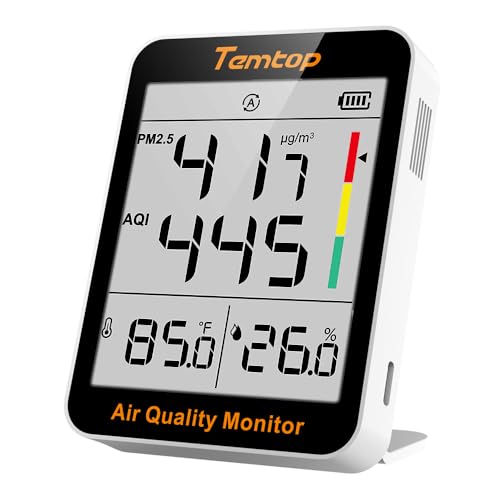
Products shown because their documented specifications fit this guide. Price and availability are on Amazon and can change.
Frequently Asked Questions
How high does PM2.5 get when frying?
Studies of home kitchens commonly measure 100 to 500 µg/m³ during pan-frying and searing, with peaks over 1,000 µg/m³ for smoking oil. Boiling and steaming produce very little.
Is cooking PM2.5 as harmful as outdoor pollution?
It is fine particulate of a similar size and behaves the same in the lungs. Short exposures a few times a day add up; kitchens without effective extraction are a significant source of household PM2.5 exposure.
Does an induction hob produce particles?
The hob itself does not, but hot oil and browning food do regardless of the heat source. Induction removes only the combustion component that gas adds.
Affiliate disclosure: Akermin earns a commission from qualifying Amazon purchases made through links on this page. Our editorial picks are based on documented specifications and owner feedback, not commissions.