As an Amazon Associate, Akermin earns from qualifying purchases. Product links on this page are affiliate links.
For most home and small professional shops, the Airthings View Plus is the pick because it is the only listing here that publishes a particle measurement alongside CO2, VOC, temperature, humidity and pressure, and it runs on battery so it can sit on a bench without a cable run. The Aranet4 is the pick if your concern is the closed finishing bay rather than the saw, because its listing is built around CO2 and ventilation decisions and it publishes an e-ink display with a battery life claim measured in years. The Amazon Smart Air Quality Monitor is the budget option if you already use Alexa and want particle and VOC readings in an app you own. None of these is a dust extraction system, and none of them is a safety alarm; they measure, they do not protect.
Dust and vapour are two different measurements, and one monitor rarely does both well
Woodworking produces two airborne hazards that behave in opposite ways. Sawdust and sanding dust are particles, mostly in the PM2.5 and PM10 size bands, and they settle out of the air over minutes to hours depending on size and air movement. Solvent vapour from lacquers, adhesives and finishes is a gas, and it disperses only when fresh air replaces the air in the room. A particle counter tells you how much dust is suspended right now. A CO2 or VOC reading tells you how much fresh air is reaching the space. They answer different questions, and a shop that only measures one of them is flying half blind.
The common mistake is to buy a CO2 monitor for a dust problem. CO2 is a proxy for occupancy and ventilation, not for dust. In a one-person shop with the extractor running, CO2 can sit comfortably low while a belt sander fills the air with fine dust. The reverse mistake is just as common: a particle monitor on a bench will show a spike every time you cut, but it will not tell you whether the finishing bay is accumulating solvent vapour, because most consumer particle sensors do not respond to gases at all.
This is why the pick here is the Airthings View Plus. Its listing publishes PM2.5 alongside CO2, VOC, humidity, temperature and pressure, which means one device can show both the dust spike from the saw and the ventilation state of the room. That is not a claim that it is accurate to laboratory standards. It is a claim that it measures both categories, which most of the alternatives here do not.
What the listings actually publish, and where they go quiet
The table below uses only figures and features stated in the supplied listings. Where a listing does not publish a figure, the cell says so. No number has been estimated, converted or filled in.
| Pick | Particle measurement | CO2 | VOC or gas | Power | Display | Published accuracy claim |
|---|---|---|---|---|---|---|
| Airthings View Plus | PM2.5 stated | Stated | VOC stated; radon stated | Battery powered (listing does not publish runtime) | Not stated in the listing bullets | Not stated in the listing bullets |
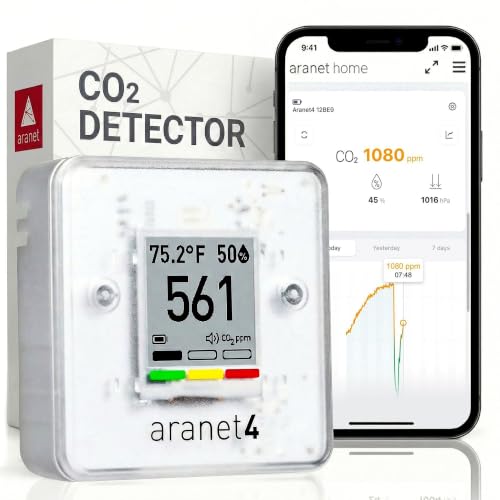
| Aranet4 | Not stated in the listing bullets | Stated | Not stated in the listing bullets | Battery, up to 4 years stated | E-ink stated | Not stated in the listing bullets |
| Sacnahe Air Quality Monitor | PM2.5, PM1.0, PM10 stated | Stated | TVOC and HCHO stated | 3000mAh battery, 7 to 15 hours stated | LCD stated | Not stated in the listing bullets |
| YNAK 16 in 1 Air Quality | PM2.5, PM1.0, PM10 stated | Stated | TVOC and HCHO stated | Not stated in the listing bullets | 7 inch LED stated | 0.001 units, described as accuracy |
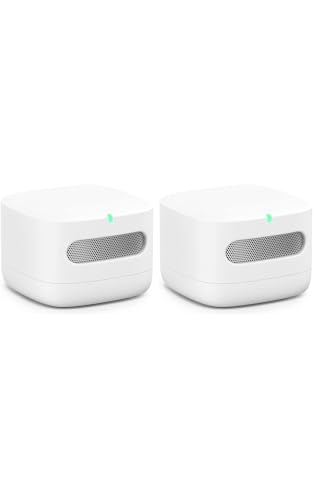
| Amazon Smart Air Quality Monitor | PM2.5 stated | Not stated in the listing bullets | VOC stated; carbon monoxide stated | Not stated in the listing bullets | Colour-coded LED stated | Not stated in the listing bullets |
Two things stand out. First, only the Airthings View Plus and the Amazon Smart Air Quality Monitor publish a particle measurement alongside a gas measurement without also claiming a formaldehyde or TVOC figure that a consumer sensor is unlikely to resolve. Second, the YNAK 16 in 1 Air Quality’s 0.001 figure is almost certainly display resolution rather than measurement accuracy, because no consumer electrochemical or optical sensor in this class resolves to one thousandth of a unit. Report it as stated, and treat it as a display detail.
If you want to compare this batch against monitors chosen specifically for particle work, the particle monitor comparison covers that ground in more detail. If your shop shares a building with living space, the basement monitor guide is the closer sibling.
The five monitors, judged on what they can see in a workshop
Airthings View Plus
The only listing in this batch that publishes particle, CO2, VOC, radon, humidity, temperature and pressure sensing in one battery-powered unit. That combination matters in a shop because it covers both the dust you make and the vapour you release.
Aranet4
A CO2-first monitor with an e-ink display and a published battery life of up to four years. Its value in a workshop is the closed-bay ventilation question, not the sawdust question.
Sacnahe Air Quality Monitor
Publishes a wide parameter list including PM1.0, PM10, HCHO and TVOC, with a rechargeable battery and app storage. Treat the breadth as a starting point, not a calibration certificate.
YNAK 16 in 1 Air Quality Monitor
A large-display bench unit with external sensors and audible AQI alerts. The listing’s accuracy claim is a resolution figure, not an accuracy figure, and should be read that way.
Amazon Smart Air Quality Monitor
The cheapest way into particle, VOC and carbon monoxide tracking if you already run Alexa. It does not measure CO2, which is a real limitation for a closed shop.
Why a workshop monitor needs a battery, and why that changes placement
Placement decides what a monitor can tell you, and placement is limited by power. A mains-powered monitor ends up near the nearest socket, which is usually the wall farthest from the saw. A battery-powered monitor can sit on the outfeed table, on a shelf above the finishing bench, or on a tripod at breathing height in the middle of the room. That freedom is the whole reason the Airthings View Plus and the Aranet4 lead this list.
The Aranet4’s listing commits to an e-ink display with a battery life of up to four years. E-ink draws power only when the screen changes, which is why the claim is plausible for a device that updates a few times a minute. The Airthings View Plus’s listing says battery powered but does not publish a runtime, so treat the runtime as unknown and plan to recharge or replace cells on a schedule you set yourself.
The Sacnahe Air Quality Monitor publishes a 3000mAh battery with 7 to 15 hours of continuous work. That is a working-day device, not a leave-it-on-the-shelf device. The YNAK 16 in 1 Air Quality does not publish a power source at all in the supplied bullets, which is a gap worth noting before you plan a permanent installation. The Amazon Smart Air Quality Monitor does not publish power details either.
The practical rule for a shop: put the monitor at breathing height, roughly where your head is when you are standing at the bench, and away from the extractor intake. A monitor sitting in the extractor’s air stream will read the air that has already been cleaned, not the air you are breathing.
The maintenance nobody mentions, and why dust kills consumer sensors
Optical particle sensors work by drawing air past a light source and counting the flashes. In a woodworking shop, that air carries dust, and the sensor’s internal fan and optical chamber accumulate deposits. Over weeks, the readings drift, usually reading low because less light reaches the detector. None of the five listings here publishes a cleaning interval or a filter replacement schedule, so the honest position is that the maintenance schedule is yours to invent. A soft brush or a can of clean air on the sensor intake every few weeks is the usual approach, and it is worth doing before you trust a reading that suddenly looks better than the room feels.
Electrochemical sensors, which is what the Airthings View Plus’s listing names for its sensor type, respond to gases and age chemically. Their output falls over months and years, and the listing does not publish a calibration interval or a replacement schedule. VOC sensors in consumer monitors are typically metal oxide types that also drift and can be affected by humidity. The listing for the YNAK 16 in 1 Air Quality warns against touching the sensors or exposing them to perfumes and strong odours, which is a useful reminder that solvent vapour in a finishing shop is exactly the kind of exposure that can upset a sensor.
If your work involves finishes and adhesives, the wider question of what a monitor can and cannot see during a renovation is covered in the renovation monitoring guide. The mechanism is the same: a consumer sensor gives you a trend, not a compliance measurement.
Where a monitor stops being the right answer in a shop
A monitor is not dust extraction. It measures the result of the dust you have already made. If a particle reading stays high while you are cutting, the fix is at the tool, not on the shelf: a properly sized extractor, a shroud on the sander, and a filter that matches the particle size you are producing. Buying a better monitor will not reduce your exposure by a single microgram.
A monitor is not a gas alarm. The Amazon Smart Air Quality Monitor detects carbon monoxide, but it is a consumer monitor that reports a score in an app, not a certified life-safety alarm with a loud local sounder. The Airthings View Plus measures radon, but its listing describes continuous monitoring and app notifications, not a certified alarm function. Neither should be your only protection in a space where a fuel-burning heater or a running engine could produce carbon monoxide.
A monitor is not a ventilation system. The Aranet4 will tell you that CO2 is rising in a closed finishing bay, which is useful, but the answer is to open a door, run a fan, or install mechanical ventilation. The monitor is the instrument that tells you whether the ventilation you installed is doing its job. That is the correct role for all five of these devices: they close the loop between what you did and what the air actually became. For the narrower question of whether CO2 or particles matter more in your specific ventilation decision, the CO2 versus PM2.5 comparison sets out the trade-off.
Recommended Tools



Products shown because their documented specifications fit this guide. Price and availability are on Amazon and can change.
Frequently Asked Questions
Can any of these monitors tell me if my dust extraction is working?
Yes, indirectly. A particle monitor placed at breathing height will show a fall in PM2.5 when extraction is running well and a rise when it is not, provided the monitor is not sitting in the extractor's own air stream. The Airthings View Plus, the Sacnahe Air Quality Monitor, the YNAK 16 in 1 Air Quality and the Amazon Smart Air Quality Monitor all publish a particle measurement. None of them measures airflow or filter loading, so they tell you about the air in the room, not about the condition of the extractor itself.
Do I need a CO2 monitor in a woodworking shop?
It depends on the space. CO2 is a proxy for how well fresh air is reaching the room. In a large shop with open doors, CO2 is rarely the limiting factor and particles matter more. In a small closed bay where you are applying finishes, CO2 can rise quickly and is a useful signal that ventilation is inadequate. The Airthings View Plus and the Aranet4 both publish CO2. The Amazon Smart Air Quality Monitor does not measure CO2 at all, which is its main limitation for shop use.
The YNAK listing says 0.001 accuracy. Is that real?
The listing states 0.001 units as an accuracy figure. That is almost certainly display resolution rather than measurement accuracy, because no consumer sensor in this class resolves to one thousandth of a unit. Report it as stated, and do not plan any decision that depends on that level of precision. The listing itself adds a note about avoiding touching the sensors or exposing them to perfumes and strong odours.
Which of these can I leave running all day without a cable?
the Aranet4 publishes the strongest claim, with an e-ink display and a battery life of up to four years. The Airthings View Plus says battery powered but does not publish a runtime. The Sacnahe Air Quality Monitor publishes 3000mAh and 7 to 15 hours of continuous work, which is a working day rather than a permanent installation. The YNAK 16 in 1 Air Quality and the Amazon Smart Air Quality Monitor do not publish power details in the supplied bullets, so their runtime is unknown from the listing alone.
Will any of these detect solvent vapour from lacquer or adhesive?
the Airthings View Plus publishes VOC sensing, the Sacnahe Air Quality Monitor and the YNAK 16 in 1 Air Quality publish TVOC and HCHO, and the Amazon Smart Air Quality Monitor publishes VOC. These are all consumer gas sensors, and they respond to a broad class of compounds rather than identifying a specific solvent. They will show a rise when you open a tin of finish in a closed room, which is useful as a ventilation signal. They will not tell you the concentration of a named chemical, and they are not a substitute for local exhaust ventilation at the work.
Is the Amazon Smart Air Quality Monitor a carbon monoxide alarm?
No. The listing states that it detects carbon monoxide among five factors and reports an air quality score in the Alexa app. That is monitoring, not life-safety alarming. A carbon monoxide alarm is a certified device with a loud local sounder, and it should be present in any space with a fuel-burning appliance or an attached garage. The Amazon monitor is a useful second layer, not a replacement.
Affiliate disclosure: Akermin earns a commission from qualifying Amazon purchases made through links on this page. Our editorial picks are based on documented specifications and owner feedback, not commissions.