As an Amazon Associate, Akermin earns from qualifying purchases. Product links on this page are affiliate links.
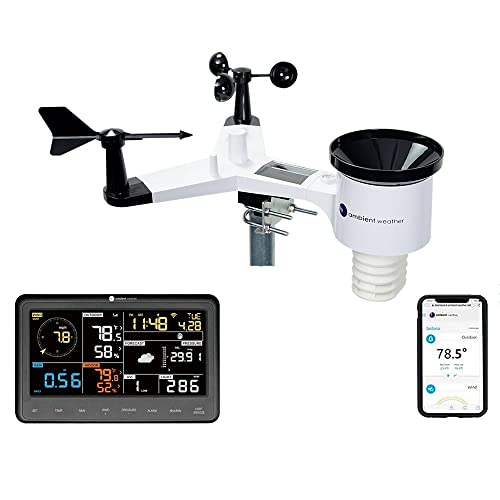
Ambient Weather · Ambient Weather WS-2902 Wi-Fi Smart Weather Station
View on AmazonPrice and availability are shown on Amazon and can change at any time.
A home weather station supplied as two pieces: an Osprey sensor array with a rain cup, and a colour LCD console. Between them the bullets claim wind speed, wind direction, temperature, humidity, rainfall, UV intensity and solar radiation, with Wi-Fi upload to the Ambient Weather Network as an optional setting, plus IFTTT, Google Home and Alexa integration. The sensor choice is well judged. The bullets publish no accuracy figure, no reporting interval and no rain increment, and one advertised feature carries the words coming soon.
The sensor set is well chosen, and one quantity is absent
Six quantities from one mast is a sensible package for a domestic installation, and the choice is not arbitrary. Wind speed and direction together let you attribute a reading to a source rather than merely record it. Temperature and humidity are the pair everything else is derived from. Rainfall is the figure a garden actually runs on. UV and solar radiation are the two that justify a mast in the open rather than a sensor by a wall.
Barometric pressure does not appear in that list. On a weather station that omission is conspicuous, because pressure is the only one of these quantities with predictive value. Temperature, humidity, wind and rain tell you what is happening. A falling barometer tells you what is about to.
The honest position is that the bullets do not address pressure at all. They describe what the sensor array measures and say nothing about what the console does. It may well be there; it is simply not published, and a buyer who wants pressure should confirm it rather than assume it.
A feature shipped with the words coming soon attached
The last bullet is an invitation to the Ambient Weather Network: customise your dashboard tiles, share hyperlocal conditions through social feeds, and create your own forecasts. Then, in brackets, the phrase coming soon.
Two readings of that are both fair. The generous one is that printing the caveat is more candid than quietly listing a feature that does not exist, and listings routinely do the latter. The practical one is that a feature in a sales bullet marked as unavailable should be treated as absent, because a roadmap is not a specification and nothing obliges anyone to deliver it.
What makes it worth a paragraph is where it sits. It is in the bullet list, which is the part of a page a buyer skims to decide, not in a support note. Anybody who reads quickly comes away believing the station makes forecasts. It does not, on the evidence of its own listing.
The adjacent claim about the largest personal weather station network is a different sort of statement. It may be true, but nothing on the page allows you to check it, and network size is not a property of the instrument you are buying.
Hyper local is the honest part of the pitch
Strip away the network talk and the second bullet makes an argument that holds up well: that monitoring your actual garden beats reading a forecast drawn from an airport several miles away.
That is not marketing, it is micrometeorology. Rainfall varies sharply over short distances, especially from convective showers, so a figure from the next town can be out by a wide margin on the day it matters. Wind at a sheltered house is a fraction of wind measured over an open runway. Frost settles in hollows and skips slopes a hundred metres away. Anybody managing an allotment, a vineyard row, an irrigation schedule or a building site is making decisions that depend on conditions at their own coordinates, and no public forecast can supply those.
The named integrations support the same case. IFTTT, Google Home and Alexa are specific platforms rather than a vague claim of smart home compatibility, which means the claim is checkable and the automation is real: a wind threshold can close something, a temperature threshold can start something. A station that can act on its own readings is doing more than displaying them.
Transmit interval and rain increment decide everything, and neither is here
Two unpublished figures govern whether the data from any station of this kind can be relied on.
The first is how often the array reports. Wind is gusty by nature, and a peak gust is only captured if the sensor happens to be sampling and transmitting when it occurs. A station reporting every few seconds and one reporting once a minute will disagree about the strongest gust of the afternoon, and both will be honest. Since a gust figure is the number most people quote from a home station, the reporting interval is arguably the single most important specification, and it is nowhere on the page.
The second is the rain gauge increment. A tipping bucket gauge counts fixed volumes of water. Rain that arrives too slowly to fill the bucket before it evaporates is never recorded, so light drizzle is systematically undercounted, and the coarser the increment the worse the effect. The listing describes a rain cup and gives no increment, which leaves the resolution of the rainfall figure unknown.
| What a buyer needs | What the bullets provide |
|---|---|
| Measured quantities | Wind speed, wind direction, temperature, humidity, rainfall, UV intensity, solar radiation |
| Hardware supplied | Osprey sensor array with rain cup, colour LCD console |
| Connectivity | Wireless array to console, Wi-Fi upload as an optional setting |
| Named integrations | IFTTT, Google Home, Alexa |
| Remote access | Through the Ambient Weather Network dashboard |
| Forecasting | Described as coming soon |
| Barometric pressure | Not stated in the listing bullets |
| Reporting interval from array to console | Not stated in the listing bullets |
| Rain gauge increment | Not stated in the listing bullets |
| Accuracy of any sensor | Not stated in the listing bullets |
| Wind speed scale and threshold | Not stated in the listing bullets |
| Units for solar radiation and UV | Not stated in the listing bullets |
| Radio frequency and range between array and console | Not stated in the listing bullets |
| Power arrangement for the array | Not stated in the listing bullets |
| Console storage if the network is unreachable | Not stated in the listing bullets |
| Mounting hardware included | Not stated in the listing bullets |
The units row matters more than it looks. Solar radiation expressed in watts per square metre is a physical measurement that can be set against a panel rating or a reference cell. An unqualified intensity figure is comparable to nothing, including to the same quantity from any other brand. Our explainer on solar irradiance covers why the unit is the whole claim, and our roundup of rain gauges goes through tipping bucket increments.
A good backyard station for somebody who wants a dashboard
This suits a householder, grower or site manager who wants their own conditions on a screen and in an app, with triggers that can act on them. Seven readings from one mast, a colour console, named smart home platforms and an optional upload is a coherent product, and the hyper local case for owning one instead of refreshing a forecast is genuinely strong.
It is the wrong purchase if a number has to be defensible. No accuracy figure for any sensor, no wind threshold, no rain increment and no reporting interval means every reading is an indication, which is fine for deciding when to water and not fine for a record that informs a planting contract, an insurance claim or a construction delay. Anyone in that position should be comparing published tolerances, and our roundup of weather stations is the place to start. And whatever you buy, discount the forecasting until it exists.
Recommended Tools

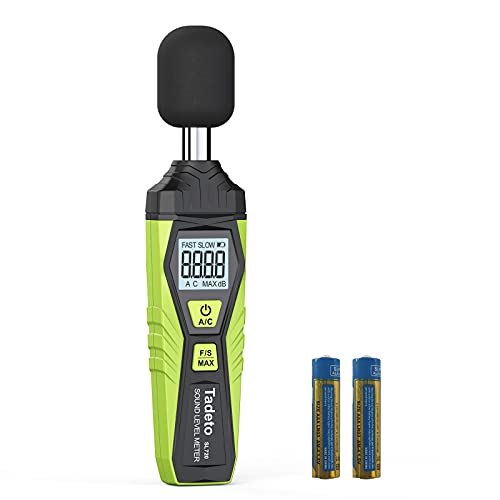
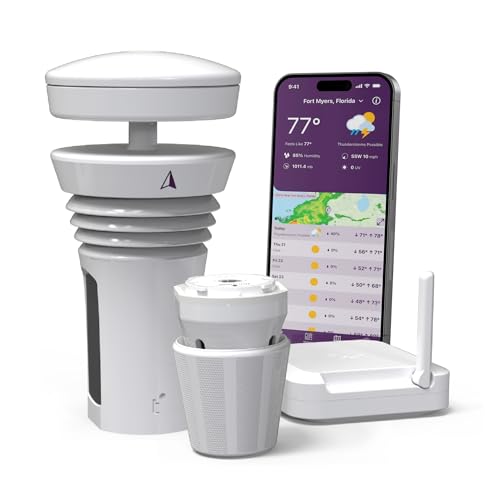
Products shown because their documented specifications fit this guide. Price and availability are on Amazon and can change.
Frequently Asked Questions
What does the station actually measure?
The second bullet names six quantities from the sensor array: wind speed, wind direction, temperature, humidity, rainfall, UV intensity and solar radiation. Barometric pressure is not among them, which is worth noticing because pressure is the quantity that lets a station anticipate rather than simply record. The bullets do not say whether pressure is sensed in the console instead, so treat it as unaddressed rather than as present.
What is the coming soon feature?
The last bullet invites you to join the Ambient Weather Network, customise dashboard tiles, share conditions through social feeds and create your own forecasts, and then attaches the words coming soon in brackets to that final item. Printing the caveat is more honest than most listings manage. The right way to read it is still that the feature does not exist, so it should carry no weight in the decision.
Which two figures matter most and are missing?
The interval at which the array transmits to the console, and the increment of the rain gauge. The transmit interval sets the shortest gust the station can possibly capture, so two stations reporting different peak gusts on the same afternoon may both be right about different things. The rain increment sets the smallest amount of rainfall the gauge can register and causes a systematic undercount in light drizzle, because water that never fills an increment is water the station never counts.
Do I have to upload my data?
No. The fourth bullet describes the Wi-Fi upload as an optional setting, which is the right way to present it. A home station publishes conditions tied to your location, so being able to keep the data local is a genuine choice rather than a footnote. Note that the dashboard, remote access and smart home triggers described in the other bullets depend on the connection, so declining the upload also declines most of what distinguishes this from a self contained station.
How useful is the solar radiation reading?
It depends entirely on what units it reports, and the bullets do not say. A reading in watts per square metre is a measurement you can compare against anything else, including a solar panel output estimate. An unqualified intensity index is a number comparable only to itself. The same caution applies to UV intensity, where an index and an irradiance are different quantities.
Affiliate disclosure: Akermin earns a commission from qualifying Amazon purchases made through links on this page. Our editorial picks are based on documented specifications and owner feedback, not commissions.
Related Guides

CPS LS790B Leak-Seeker Review: Non Combustible Is the Deciding Word
An ion pump refrigerant leak detector individually calibrated to find a leak rate better than a quarter of an ounce per year, with ten selectable sensitivity ranges, a water vapour filter and a bar graph plus tone display.
Read More→
BW Clip BWC2-H Review: Alarm Points Set Before the Clock Starts
A single gas hydrogen sulfide detector with one button operation, hibernation mode, automatic logging of the 35 most recent gas events and bump test results, and compatibility with IntelliDoX and MicroDock II docking.
Read More→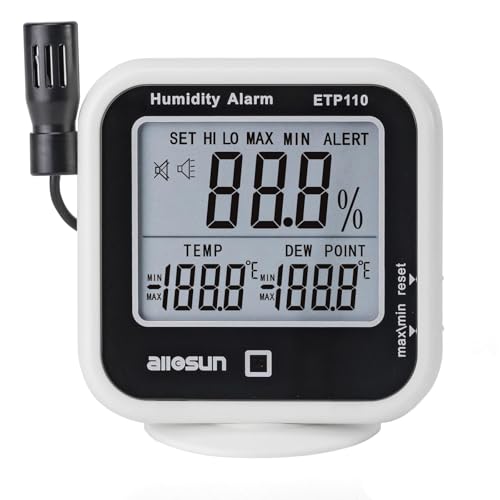
ALLOSUN Thermometer Hygrometer Review: Half a Metre of Lead and No Tolerance
A battery powered thermometer and hygrometer showing temperature, relative humidity and dew point, with a settable humidity alarm, a sensor on a lead of about 50 cm, maximum and minimum memory and a large LCD.
Read More→