As an Amazon Associate, Akermin earns from qualifying purchases. Product links on this page are affiliate links.
Start with P1 if your work includes pressure switch testing, because it is the only pick whose listing describes a built-in pump and bleed accessory for adjusting switches, not just reading them. Choose P2 if you routinely commission systems and need several static readings at once, since the listing publishes a 1000 foot wireless range and up to eight simultaneous readings with independent sensors. P5 is the straightforward handheld for differential pressure, external static pressure and duct velocity, with a stated 50 hour battery life and a compensated sensor. P3 is the same idea in wireless probe form, and P4 and P6 are the budget dual-port handhelds, both publishing 0.3 percent full scale accuracy and a 0.5 second response time.
Why a manometer is not a gauge you already own
Every technician carries a gauge manifold, and on a running system that manifold tells you the refrigerant pressures at the service ports. What it does not tell you is the pressure difference between two points that are not service ports. Static pressure before and after a filter, across an evaporator coil, or at the return and supply of an air handler are all differential measurements, and they are the ones that decide whether the blower is moving the air the system was designed for.
A manometer measures that difference directly. Two ports, one reference and one test, and the instrument subtracts. Because the numbers are small, the instrument has to be sensitive: a filter that loads up might add a few tenths of an inch of water column, and a coil that is half blocked might add more. That is why the accuracy figure matters more here than on a refrigerant gauge, and why the units matter too. The listings here publish ranges in psi, kPa and inches of water column, and the ones that publish twelve units let you work in whichever one your commissioning sheet uses.
The second job a manometer does is gas pressure. Manifold pressure on a gas appliance, the pressure a switch trips at, and the pressure drop across a gas valve are all in the same small-number territory. Some of the instruments here are aimed at that work specifically, and one of them, P1, includes the hardware to not just read a pressure switch but to change where it trips. If your day includes gas appliances as well as air side work, that distinction is worth more than any other feature on this page. For the gas detection side of the same job, see our guide to gas detectors for HVAC technicians.
What each listing publishes, and what it does not
The table below uses only what the manufacturer listings state. Where a figure is absent, the cell says so rather than carrying an estimate.
| Pick | Ports and sensing | Stated accuracy | Stated range | Wireless | Power |
|---|---|---|---|---|---|
| P1 | Dual display, two static probes and two gas adapters supplied | Not stated | Not stated | Not stated | Auto power off; battery type not stated |
| P2 | Dual port, independent sensors, up to 8 readings at once | Not stated | Not stated | 1000 ft stated range | Not stated |
| P3 | Differential, single probe | Not stated | Not stated | Wireless to app | Not stated |
| P4 | Single pipe or differential two pipe | +/-0.3% FSO at 25 C | +/-20.68 kPa / +/-2.999 psi | Not stated | Not stated |
| P5 | Dual port, temperature and air density compensated | Not stated | Not stated | Not stated | 50 hours stated battery life |
| P6 | Single pipe or differential two pipe | +/-0.3% FSO at 25 C | +/-2.999 psi | Not stated | Not stated |
Two things stand out. First, the two Testo instruments and both Fieldpiece instruments do not publish an accuracy figure in the supplied listing text, even though the technology is capable of good numbers. Absence of a published figure is not evidence of poor accuracy, but it does mean you cannot compare them numerically from the listing alone. Second, the two budget handhelds, P4 and P6, publish nearly identical accuracy, repeatability, linearity and response time figures. Their measurement cores look the same on paper, so if you are choosing between them, choose on the unit set and the physical size you prefer rather than on a difference the listings do not show.
P4 publishes a wider range than P6, plus a stated operating temperature band of 0 to 50 C and a storage band of -40 to 80 C. P6 publishes twelve selectable units, which is more than P4 states. Neither publishes a wireless range because neither has wireless.
The six manometers, and who each one suits
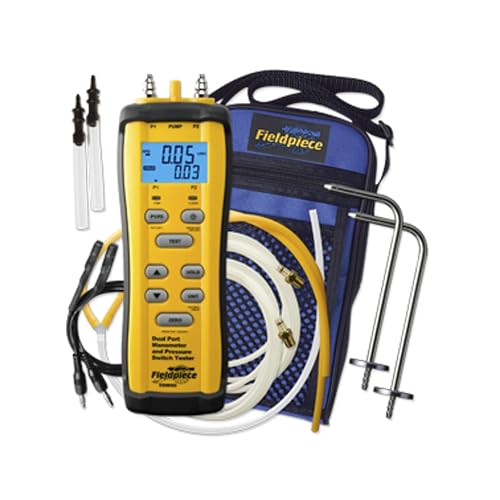
Fieldpiece SDMN6 Pressure Switch Tester
The only pick built around testing and adjusting pressure switches, with a pump bleed accessory in the box.
Fieldpiece Job Link JL3KM2 Dual Port Manometer Probe Kit
Wireless probes with a stated 1000 foot range and up to eight simultaneous readings for commissioning work.
Testo 510i Differential Pressure Manometer
A wireless probe with app-based volume flow calculation and pressure drop alarms.
Leaton Professional Air Pressure Meter
A dual-port handheld publishing a stated 0.3 percent full scale accuracy and a 0.5 second response time.
Testo 510 Digital Manometer
A rugged handheld for differential pressure, external static pressure and duct velocity, with 50 hours of stated battery life.
EHDIS Professional Air Pressure Meter
A budget dual-port handheld with twelve selectable units and a stated 0.3 percent full scale accuracy.
Hoses, probes and the distance problem
A handheld manometer with two ports is limited by its hoses. To read total external static pressure you need one hose at the return plenum and one at the supply plenum, and on a packaged unit or a rooftop those two points can be several metres apart. Long hoses add their own pressure drop and their own leak paths, and a hose that slips off a port mid-reading gives you a number that looks plausible and is wrong.
The wireless picks solve this differently. P2 places an independent sensor on each port and sends the reading back over a stated 1000 foot wireless range, and the listing says it can measure, view and record up to eight readings at once. That is the commissioning case: return static, supply static and the resulting total, plus filter and coil drops, all live at the same time. P3 takes the same untethered idea in a single probe with app-based volume flow calculation and pressure drop alarms, which is useful when you want the phone to tell you a filter has crossed a threshold rather than watching a display.
Wireless has its own failure mode. It needs pairing, it needs a charged battery in the probe, and it needs a phone or a receiver that is awake. A handheld with hoses has none of those dependencies. If you work alone on a roof in cold weather, a hose and a magnetic back can be the more reliable arrangement, which is exactly what P5 offers with its stated magnets and protective cap.
The specification that decides whether the number is usable
Full scale accuracy, usually written FSO, means the error is quoted as a percentage of the instrument’s maximum reading, not of the number on screen. A meter with a 2.999 psi full scale and 0.3 percent FSO accuracy can be off by roughly 0.009 psi anywhere in its range. Convert that to inches of water column and it is about a quarter of an inch. On a gas manifold pressure check that is usually acceptable. On a filter pressure drop that is only reading a tenth of an inch, it is a large fraction of the measurement.
This is the trap in buying a wide-range manometer for air side work. The wide range is useful for gas pressure, but it costs you resolution at the low end. Some instruments handle this by offering selectable ranges, and P6 states that its range is selectable. Others handle it with a compensated sensor: P5 states its pressure sensor is temperature and air density compensated, which matters because air density changes with altitude and temperature, and duct velocity calculations depend on it.
Repeatability and linearity are the other two numbers the budget listings publish, and they are worth reading together. P4 and P6 both state repeatability of +/-0.2 percent, maximum +/-0.5 percent FSO, and linearity and hysteresis of +/-0.29 percent FSO. Those are the figures that decide whether two readings taken five minutes apart on the same port will agree. For trend work, where you are comparing a filter before and after, repeatability matters more than absolute accuracy.
Where a manometer stops being the right answer
A manometer measures pressure. It does not measure flow, and it does not measure air quality. If you need volume flow, you need a pitot tube or a flow hood as well, and the Testo listings say so directly: P3 states that volume flow requires a pitot tube that is not included. P2 and P5 both list duct velocity or airflow as a measurement, but the accessory that turns a pressure difference into a velocity is a separate purchase in every case here.
A manometer is also not a leak detector, not a combustible gas detector and not a carbon monoxide instrument. A pressure reading tells you the gas is at the right pressure, not that it is burning safely or that the heat exchanger is intact. Those are different instruments, and our guide to gas detectors for HVAC technicians covers that half of the job.
Finally, a manometer is not a data logger. Some of these instruments record readings, and P2 states it can record up to eight readings at once, but none of the listings here describe long-term unattended logging with timestamps and export. If your job is to prove how a system behaved over a week, you want a logger, which is a different category. For the air side of the same building, our comparison of differential pressure meters for HVAC overlaps heavily with this page and is worth reading alongside it.
Recommended Tools


Products shown because their documented specifications fit this guide. Price and availability are on Amazon and can change.
Frequently Asked Questions
Do I need a wireless manometer or will a hose model do?
It depends on how far apart your two test points are and whether you work alone. Hoses are simple and have no pairing or battery dependency. Wireless probes let you place a sensor on each port and read them together, which is what P2 is built for with its stated 1000 foot range and eight simultaneous readings. If your static pressure taps are within a hose length of each other and you have a magnetic surface to hang the meter on, a handheld is enough.
Why do some listings not publish an accuracy figure?
The supplied listing text for P1, P2, P3 and P5 does not state an accuracy figure. That is a gap in the listing, not a statement about the instrument. The two budget handhelds, P4 and P6, do publish accuracy, repeatability and linearity, which makes them the only ones you can compare numerically from the listing alone. If a published accuracy figure is a requirement for your paperwork, that narrows the field to those two.
Can I measure duct airflow with any of these?
Only with a pitot tube, and none of the listings state that a pitot tube is included. P3 says explicitly that volume flow measurement requires a pitot tube that is not included. P2 and P5 list duct velocity or airflow as a capability, but the pressure to velocity conversion needs the pitot tube and its factor entered into the instrument. Budget for the accessory separately.
What does full scale accuracy mean in practice?
It means the error is a percentage of the instrument's maximum reading, not of the value on screen. P4 and P6 both state +/-0.3 percent FSO at 25 C over a 2.999 psi full scale, which works out to roughly 0.009 psi anywhere in the range. On a gas pressure check that is fine. On a small filter pressure drop it is a significant share of the reading, so for low-pressure air side work a narrower range instrument gives you a better number.
Is the pressure switch tester just a manometer with extra parts?
P1 is listed as a pressure switch tester and its listing states it is used to test and adjust pressure switches, with a pump bleed accessory, two gas adapters and a Y-splitter in the box. That combination is what lets you change the pressure at the switch and observe where it trips, rather than only reading the pressure at a port. If switch adjustment is part of your work, that is a functional difference from the other five.
Which of these should I avoid if I only do air side work?
None of them is unsuitable, but the wide-range gas-oriented handhelds give up resolution at the low end. If your day is filters, coils and external static pressure, a narrower range instrument with a compensated sensor, like P5, or a wireless probe that eliminates hose runs, like P2 or P3, will serve you better than a wide range meter used at the bottom of its scale.
Affiliate disclosure: Akermin earns a commission from qualifying Amazon purchases made through links on this page. Our editorial picks are based on documented specifications and owner feedback, not commissions.