As an Amazon Associate, Akermin earns from qualifying purchases. Product links on this page are affiliate links.
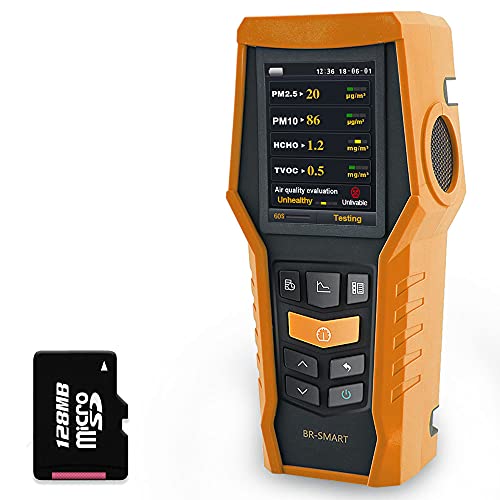
BLATN · BLATN Smart 126s Air Quality Monitor Indoor TVOC Tester PM2.5 Dust Meter Formaldehyde HCHO Detector PM1.0 PM10 VOCs Particle Test Pollution Home AQI Indicator Data Record
View on AmazonPrice and availability are shown on Amazon and can change at any time.
The BLATN 126s is a handheld multi-parameter air monitor built around a laser particle counter, an electrochemical formaldehyde sensor and a semiconductor TVOC sensor, with a one-minute data log that the listing says can be expanded to 8G and hold up to 400 days of records. It is the right instrument for someone who wants to watch particle and chemical readings move over time in a room, and who accepts that the listing publishes no accuracy figures, no measurement ranges and no calibration interval. It is not a substitute for a calibrated reference instrument, a CO2 meter or a confined-space gas detector, and the listing does not claim otherwise.
The first hour: what the 126s does before you trust a number
The listing describes a handheld monitor with a silent fan that pulls room air through a stereo convection sampling path. That fan matters more than any single sensor. A particle counter only reports the air that reaches its laser chamber, and a chemical sensor only reports what diffuses to its electrode. In the first hour the practical job is to let the instrument sit in moving room air long enough for its readings to settle, then watch whether they respond plausibly when you move it.
The 126s supports automatic and manual calibration for the formaldehyde channel. The listing does not publish what the automatic routine uses as a reference, how long it takes, or how often it should run. That is the first honest gap: a calibration function exists, but the listing does not say what it calibrates against. Treat the first reading as a relative one until you have watched the instrument respond to a known change in the room.
Data logging runs once every minute, and the listing says storage can be expanded to 8G and hold up to 400 days of records. The arithmetic is worth doing: 400 days at one record per minute is 576,000 records. The listing does not publish the file format, the export method or whether the clock survives a battery change, so the log is only as useful as the export route you can actually open on a computer. If a long record matters to you, read how to choose an air quality data logger before you rely on this one.
Six particle channels and three mass channels: what the numbers mean
The laser sensor reports six particle-count channels in particles per litre: PM0.3, PM0.5, PM1.0, PM2.5, PM5.0 and PM10. It also reports three mass channels in micrograms per cubic metre: PM1.0, PM2.5 and PM10. These are different measurements. The count channels tell you how many particles of each size passed the laser; the mass channels estimate how much material those particles represent. A room can have a high count of very small particles and a modest PM2.5 mass, or the reverse.
For most indoor work the mass channels are the ones you will compare against guidance, and the count channels are the ones that show you a source switching on. A laser printer, a candle or a vacuum cleaner will usually move the small-particle counts first. The listing does not publish the particle-size accuracy, the coincidence limit at high concentrations, or whether the mass figures are derived from the counts using an assumed density. Those are exactly the numbers a buyer would want, and the listing is silent on them.
The listing also does not publish a zero or reference check for the particle sensor. General practice for laser particle counters is to compare a clean-air reading against a filtered-air or outdoor baseline, but the listing gives no procedure. If particle work is your main reason for buying, the dedicated six-channel counter on this site, the Generic 6-Channel, is the more focused instrument, and the comparison is set out in best air particle monitors.
Formaldehyde and TVOC: two chemical channels with different physics
The formaldehyde channel is described as electrochemical, with a double platinum catalytic electrode and automatic and manual calibration. Electrochemical cells are the standard approach for low-level formaldehyde because they respond to the gas itself rather than to total organic carbon. The listing claims strong anti-interference ability but publishes no cross-sensitivity data, no lower detection limit and no range.
The TVOC channel is a semiconductor sensor. Semiconductor sensors respond to a broad family of volatile organic compounds, and the listing names benzene, toluene, xylene, aromatic hydrocarbons, aldehydes and hydrogen sulphide. That breadth is the point and the limitation: a semiconductor TVOC reading tells you that something volatile is present and changing, not which compound it is. The phrase about capturing change at the thousandth level is a resolution claim, not an accuracy claim, and the listing does not publish either figure in units a buyer can check.
This is the channel most likely to be misread. A rising TVOC number after new furniture arrives is useful evidence of a source; the same number does not tell you whether the risk is formaldehyde, a solvent or a fragrance. The site explains the distinction in what is TVOC on an air quality monitor and in how to check whether an air quality monitor measures real VOCs. The 126s gives you both a broad TVOC channel and a specific HCHO channel, which is more than a single semiconductor sensor can offer, but the listing does not publish how the two are separated in the firmware.
The 2200 mAh battery, the soft shell and the parts the listing leaves out
The listing gives a 2200 mAh rechargeable lithium battery and an anti-fall PE soft shell. It does not publish runtime, charge time, or whether the logger keeps recording while the unit charges. For a monitor that is meant to sit in a room and log for days, runtime is the specification that decides whether the product fits the job, and it is absent. The honest reading is that the 126s is a handheld spot-check instrument with logging capability, not a permanently installed logger.
The listing also does not publish an operating temperature and humidity range. Electrochemical and semiconductor chemical sensors are sensitive to both, and a formaldehyde cell that is accurate in a warm dry room may drift in a cold humid one. Without a published range, the buyer cannot know the conditions in which the readings are meaningful. The same gap applies to storage and to the effect of the fan on the chemical sensors.
What the listing does publish is the sampling arrangement: stereo air convection and an active air interactive system with a silent fan. That is a real design choice, because it shortens the response time compared with a diffusion-only sensor. It also means the fan is a wear item, and the listing gives no filter, no replacement interval and no cleaning instruction. A dusty fan will change both the particle and the chemical readings, and the listing does not mention it.
Where the 126s fits, and where a different instrument is the honest answer
The 126s is a reasonable choice for a homeowner or technician who wants one handheld box that shows particles, formaldehyde and total VOCs together, with a one-minute log for later review. It is useful for watching a renovation, checking a room after new furniture, or comparing rooms in a building. The site’s guide to air quality monitoring for renovation projects sets out the jobs this kind of instrument can and cannot do.
It is not the right instrument for three jobs. First, it does not measure carbon dioxide, so it cannot tell you about ventilation adequacy in a occupied room; a CO2 monitor is the correct tool, and the site explains the choice in how to choose a CO2 monitor for home use. Second, it is not a safety device: it does not detect carbon monoxide, it is not a combustible gas sniffer, and it is not a confined-space entry instrument. Third, it is not a calibrated reference: the listing publishes no accuracy figures, so it cannot be used to certify a space or to settle a dispute.
Against the other products on this site, the 126s sits between the broad multi-parameter the AirWhisper 16-in-1 and the dedicated particle counter the Generic 6-Channel. The AirWhisper 16-in-1 covers more parameters but the listing does not make the 126s redundant, because the 126s publishes its particle channels explicitly and its HCHO sensor type. The Generic 6-Channel is the better particle instrument if particles are the whole job. The FABISENSE PM25 is a simpler PM2.5 and PM10 monitor for buyers who do not need the chemical channels. The 126s is the pick when you want particles and chemicals in one handheld with a log, and you accept the missing accuracy figures.
The verdict on the BLATN 126s
The BLATN 126s is a genuinely multi-channel handheld monitor: six particle counts, three particle masses, an electrochemical formaldehyde cell, a semiconductor TVOC sensor and a one-minute log that the listing says can hold 400 days of records. That combination is unusual in one box and is the reason to consider it. The reason to hesitate is equally clear. The listing publishes no accuracy figures, no measurement ranges, no calibration interval, no runtime and no operating conditions, and those are the numbers that decide whether a reading is meaningful. Buy it as a relative instrument for watching a room change over time, not as a reference meter. If you need a certified number, a CO2 reading or a safety alarm, this is the wrong product and the listing does not pretend otherwise.
Recommended Tools


Products shown because their documented specifications fit this guide. Price and availability are on Amazon and can change.
Frequently Asked Questions
Does the BLATN 126s measure carbon dioxide?
No. The listing names particles, formaldehyde and TVOC only. There is no CO2 channel in the published specification, so the 126s cannot tell you whether a room is adequately ventilated in the way a CO2 monitor can.
How accurate is the formaldehyde reading?
The listing does not publish an accuracy figure, a range or a lower detection limit for the HCHO channel. It states that the sensor is electrochemical with a double platinum catalytic electrode and supports automatic and manual calibration, but it does not say what the calibration is against. Without those figures the reading should be treated as relative, useful for spotting change rather than for certifying a level.
What does the 8G storage and 400 days of records actually mean?
The listing says logging runs once every minute and that storage can be expanded to 8G, holding up to 400 days of records. It does not publish the file format, the export method or whether the clock is retained when the battery is removed. Check that you can open the exported file on your computer before you rely on a long record.
Can I leave the 126s running in a room for days?
The listing gives a 2200 mAh rechargeable battery but does not publish runtime or whether logging continues while charging. That gap means you cannot plan a multi-day unattended log from the published specification alone. For permanent room logging, a mains-powered logger is the safer choice.
Is the TVOC reading a formaldehyde reading?
No. The TVOC channel uses a semiconductor sensor that responds to a broad family of volatile compounds, and the listing names benzene, toluene, xylene, aromatic hydrocarbons, aldehydes and hydrogen sulphide. The separate HCHO channel is the formaldehyde-specific one. A rising TVOC number tells you a volatile source is present, not which compound it is.
Does the 126s detect carbon monoxide or act as a safety alarm?
The listing does not name carbon monoxide as a measured gas and does not describe the product as a safety alarm. It is an indoor air quality monitor, not a CO alarm or a confined-space gas detector. For those jobs you need a certified safety instrument, not this product.
Affiliate disclosure: Akermin earns a commission from qualifying Amazon purchases made through links on this page. Our editorial picks are based on documented specifications and owner feedback, not commissions.
Related Guides

Airthings Corentium Pro Radon Monitor Review: The Consumable Question
A listing-led review of the Airthings Corentium Pro that leads with the maintenance and consumable question the specification bullets do not answer.
Read More→
Extech VFM200 Review: One Handset, Six Readings, and the Trade-off That Comes With It
A buying review of the Extech VFM200 covering its sensor technologies, datalogging, display, and the practical limits of a multi-parameter handset.
Read More→
TEKCOPLUS CO2 Meter Review: One NDIR Sensor, Three Readings
A mechanism-first review of the TEKCOPLUS portable CO2 meter, its NDIR sensor, alarm threshold and stated accuracy limits.
Read More→