As an Amazon Associate, Akermin earns from qualifying purchases. Product links on this page are affiliate links.

BTMETER · BTMETER BT-100 Handheld Anemometer, Digital Wind Speed CFM Meter Gauge Air Flow Velocity Tester for HVAC Shooting Drone, Wind Chill, 14℉-113℉ Wind Temperature
View on AmazonPrice and availability are shown on Amazon and can change at any time.
Verdict
The BTMETER BT-100 is a well specified handheld vane anemometer. The listing states a wind speed range of 0.67 to 67.1 mph at plus or minus 2 percent of reading, a resolution of 0.1 metres per second, eight vanes and two temperature sensors described as giving sensitivity to very low airflow, five speed units, wind temperature from -10 to 60 C at plus or minus 2 C, wind chill, a backlit display and a threaded tripod mount. For HVAC airflow checks and outdoor use it covers both jobs properly.
Documented Specifications
| Item | Manufacturer listing |
|---|---|
| Wind speed range | 0.67 to 67.1 mph |
| Wind speed accuracy | Plus or minus 2 percent of reading |
| Resolution | 0.1 m per second |
| Speed units | m/s, km/h, ft/min, knots, mph |
| Temperature | -10 to 60 C (14 to 113 F), plus or minus 2 C, 0.2 C resolution |
| Sensor design | Eight vanes, two temperature sensors |
| Other | Wind chill, backlit LCD, low battery indicator, tripod thread |
The Starting Speed Is the Specification That Matters
A vane anemometer works by letting air spin a small propeller. Friction in the bearing sets a threshold below which the vane will not turn at all, and below that threshold the instrument reads zero regardless of what the air is doing. Manufacturers rarely advertise this number, which is unfortunate because indoor airflow lives right at that boundary.
Air leaving a ceiling diffuser, passing a return grille or moving through a crawl space vent is frequently in the range of one to three miles per hour. A meter that starts at 0.67 mph measures all of that. A meter that starts at two or three miles per hour reads zero and tells you a working system is dead. The BT-100 listing publishing 0.67 mph, and attributing the low threshold to an eight vane design, is the strongest single argument for it.
Turning Velocity Into Volume
An anemometer measures speed, not flow. Volume flow is speed multiplied by the area the air passes through, and that is where most errors creep in. Two rules keep it honest. First, use the free area of a grille, not its outside dimensions, because the louvres block a substantial fraction. Second, take several readings across the face and average them, because velocity is never uniform and a single centre reading typically overstates flow considerably.
Keep units consistent. Feet per minute multiplied by square feet gives cubic feet per minute directly, which is why ft/min is the unit most HVAC work uses.
Two Temperature Sensors and Wind Chill
Wind chill is a calculated value combining air temperature and air speed, and it needs both measured at the same point at the same time. For outdoor use it is the number that actually describes conditions, since 5 C in still air and 5 C in a strong wind are different experiences. For HVAC use the plain air temperature matters more, particularly when checking supply against return, and having it on the same instrument saves a second tool.
The Tripod Thread Deserves Credit
Two things happen when you mount an anemometer instead of holding it. You stop disturbing the airflow with your own body, which matters more than most people expect at a grille. And you can watch a trend rather than take a reading, which is how you catch a system cycling or a variable speed fan modulating. It is a small metal hole that changes what the instrument can do.
Strengths
- Publishes a low starting speed, which decides indoor usefulness.
- Stated accuracy and resolution for both speed and temperature.
- Five units including ft/min for direct CFM work.
- Tripod mounting for hands-free recording.
Limitations
- No humidity sensor, unlike some competitors.
- A vane is physically larger than a hot wire probe, so it will not fit small ducts or test ports.
- No logging or data export stated.
- Vane bearings wear, and a dropped instrument may read low afterwards with no visible damage.
How It Compares
The TopTes TS-301 adds humidity and a larger screen without publishing speed accuracy. The Testo 405i uses a hot wire probe on a telescopic shaft, which reaches inside ducts where a vane cannot go. The head to head is at BT-100 versus TS-301, and the ranking is in the anemometer roundup.
How We Research
All figures come from the manufacturer listing. We did not run laboratory tests and publish no measurements of our own.
Recommended Tools
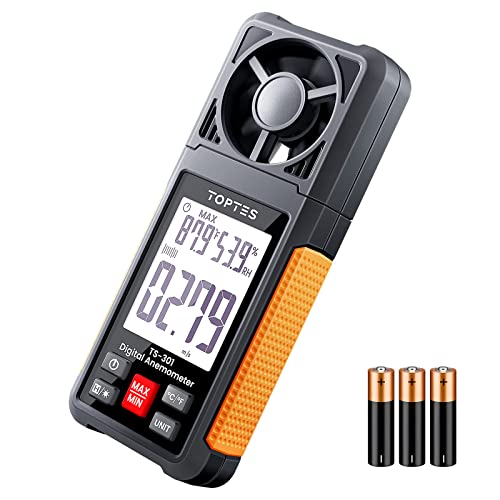

Products shown because their documented specifications fit this guide. Price and availability are on Amazon and can change.
Frequently Asked Questions
Why does the low end of the range matter?
Because most indoor airflow is slow. Air from a ceiling diffuser or through a return grille often moves at a few miles per hour, and a vane that does not start turning until a stronger breeze arrives simply reads zero.
What accuracy does it state?
Plus or minus 2 percent of reading for wind speed, with a resolution of 0.1 metres per second. Temperature is stated as -10 to 60 C at plus or minus 2 C.
Can I calculate CFM with it?
The listing gives the relationship: airflow equals wind speed multiplied by duct cross sectional area. Measure the free area rather than the outside dimensions and keep your units consistent.
What is the tripod hole for?
Mounting the meter so it records continuously with your hands free. The listing suggests drone flying and long distance shooting, and it is equally useful for leaving the instrument in an airstream while you work.
Affiliate disclosure: Akermin earns a commission from qualifying Amazon purchases made through links on this page. Our editorial picks are based on documented specifications and owner feedback, not commissions.