As an Amazon Associate, Akermin earns from qualifying purchases. Product links on this page are affiliate links.

Testo · testo 405i Anemometer Handheld for Air Celocity, In-Duct Airflow and Temperature – CFM Meter with Extendable up to 15" Telescopic Shaft - Wind Meter with Bluetooth and App Operation
View on AmazonPrice and availability are shown on Amazon and can change at any time.
Verdict
The Testo 405i is a professional in-duct anemometer. The listing states measurement of air velocity, temperature and in-duct airflow with volume flow calculated from entered duct dimensions, a hinged telescopic shaft extending to 15 inches, Bluetooth app operation on iOS and Android, and a compact form intended for HVAC servicing. Its reason to exist is access: measuring air where it is moving rather than where it has already dispersed.
Documented Specifications
| Item | Manufacturer listing |
|---|---|
| Sensor type | Hot wire |
| Measures | Air velocity, temperature, in-duct airflow |
| Calculates | Volume flow from entered duct dimensions |
| Shaft | Hinged telescopic, extends to 15 inches |
| Operation | Bluetooth app, iOS and Android |
| Display | On the phone or tablet, no onboard screen |
The listing does not publish velocity range, accuracy or resolution. Those are on the datasheet and are worth reading if you are commissioning systems against a specification.
Why Hot Wire and Not a Vane
A vane anemometer has a propeller that must overcome bearing friction, so it stops reading below a threshold and it is physically large. A hot wire sensor has no moving parts: a heated element loses heat to the passing air, and the power required to hold its temperature indicates the air speed. That gives two advantages. It responds to much lower velocities, and the sensing element is small enough to pass through a test port or a louvre.
Those two advantages point at the same application: measuring inside ducts, at grilles and in confined spaces, where a vane cannot reach and where velocities are often low. The trade is that hot wire sensors are more sensitive to direction and to contamination, so the probe has to be oriented correctly and kept clean.
The Shaft Is Half the Instrument
A fifteen inch telescopic shaft with a hinge is what lets the sensor get to the right place while your hand stays outside. Duct velocity varies across the cross section, with the highest speeds near the centre and slower flow near the walls, so a measurement taken just inside the opening is not representative. Reaching properly into the duct, and traversing across it, is how a defensible number is produced.
The hinge matters for the same reason: it lets the probe turn into the airstream after entering through an opening that is not aligned with the flow.
Volume Flow Done Once, Correctly
Entering duct dimensions and reading volume flow directly removes a calculation step that people get wrong under time pressure. Two cautions still apply. Enter the internal dimensions, not the external ones, and remember that insulation inside a duct changes the free area substantially. And take several readings across the duct rather than one, because a single point in a varying profile can be well off the average.
The App Is Part of the Tool
There is no onboard display, which is what keeps the probe small and cheap enough to carry several. The consequence is that your phone is now a required instrument: its battery, its screen in sunlight and the state of its app updates all become part of whether you can take a measurement. On the positive side, readings can be captured, combined with other Testo probes and put into a report without transcription, which for a commissioning engineer is a genuine saving.
Strengths
- Hot wire sensor reaches low velocities a vane cannot.
- Telescopic hinged shaft for real in-duct measurement.
- Volume flow calculated from entered dimensions.
- Small enough to carry alongside other probes for a combined report.
Limitations
- No range or accuracy figures in the listing bullets.
- No onboard display; a phone is required.
- Hot wire sensors are direction sensitive and degrade if contaminated.
- Not suited to outdoor wind measurement, where a vane is more robust.
How It Compares
The BTMETER BT-100 and the TopTes TS-301 are vane instruments with their own displays, better suited to outdoor use and to measuring at a grille face. The Extech RH300 covers the humidity side of the same surveys. Our ranking is in the anemometer roundup.
How We Research
All figures come from the manufacturer listing. We did not run laboratory tests and publish no measurements of our own.
Recommended Tools

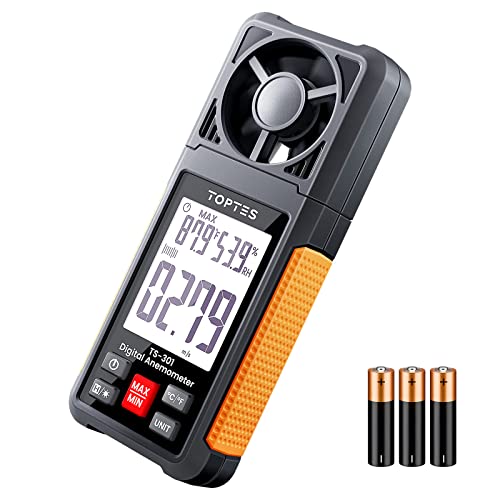
Products shown because their documented specifications fit this guide. Price and availability are on Amazon and can change.
Frequently Asked Questions
What is a hot wire anemometer?
It heats a fine element and measures the power needed to keep it at temperature as air carries heat away. Because there are no moving parts, it responds to much lower air speeds than a vane and fits into a far smaller opening.
How far does the shaft extend?
The listing states a hinged telescopic shaft extending up to 15 inches, which reaches into ducts, vents and awkward spaces during HVAC inspections.
Does it calculate volume flow?
Yes. The listing states it can calculate volume flow when duct dimensions are provided, so you enter the duct size once and read airflow directly instead of multiplying afterwards.
Does it have its own display?
No. It is operated through the Testo app over Bluetooth, which is what keeps the probe small. That means a phone or tablet is part of the instrument.
Affiliate disclosure: Akermin earns a commission from qualifying Amazon purchases made through links on this page. Our editorial picks are based on documented specifications and owner feedback, not commissions.