As an Amazon Associate, Akermin earns from qualifying purchases. Product links on this page are affiliate links.
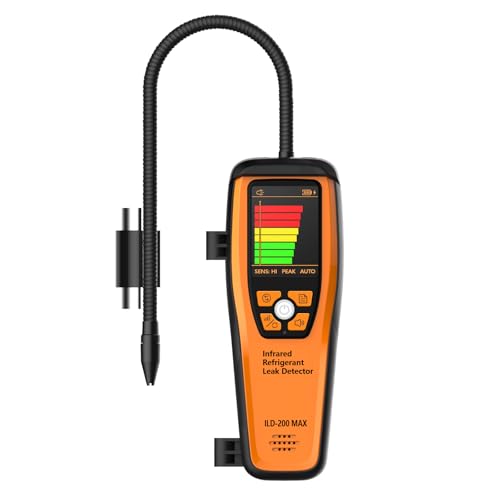
Elitech · Elitech Infrared Refrigerant Leak Detector ILD-200 max High-Precision HVAC/R Leak Detection, 10-Year Sensor Lifetime, 1g/a Ultra-Low Detection, 4 Sensitivity Levels, TFT Display & Sound Alarm
View on AmazonPrice and availability are shown on Amazon and can change at any time.
An infrared refrigerant leak detector with a stated minimum detectable leak rate of 1 g/a, four sensitivity steps each labelled with its own rate, a ten year sensor life, a 2.8 inch TFT display with audible and visual alarms, a 3000 mAh battery giving eight hours, and a working envelope of minus 10 C to 52 C at up to 90 percent humidity. The sensor technology is the better one for this job, and the listing publishes the sensitivity figure that most of its competitors leave out entirely.
The sensitivity figure is the point
Across this category, listings talk about high sensitivity, professional detection and advanced sensors, and almost none of them tell you how small a leak they can actually find. Without that number the words mean nothing, because every detector is sensitive compared with your nose.
This listing gives the figure in grams per year, the standard unit, and then gives it four times.
| Sensitivity setting | Stated detection rate | What it is for |
|---|---|---|
| Super | 1 g/a | Pinpointing a confirmed leak at a joint |
| High | 3 g/a | Close work along suspect pipework |
| Medium | 7 g/a | General sweeping of a system |
| Low | 14 g/a | Finding a substantial leak without chasing background |
That table is a working method rather than a feature list. The usual mistake with a sensitive detector is to leave it on maximum, at which point the whole area around a real leak responds and you cannot tell where the gas is coming from. Starting coarse and stepping finer is how you converge on a joint, and a detector with unlabelled settings cannot be used that way because you do not know what you have changed.
For context on how rare this is: one competitor in this category publishes a full gas list and the correct sweep technique but no sensitivity figure, and another publishes only five bullets with no range or sensitivity of any kind. Our guide to choosing a refrigerant leak detector sets out why this number should be the first thing you look for.
Why infrared is the better sensor for this job
The listing states infrared spectrum absorption technology and claims greater stability and durability than traditional heated diode sensors.
The physics supports the claim. Infrared sensing works by passing light through a sample stream and measuring how much of a particular wavelength the refrigerant absorbs. Nothing is consumed and nothing reacts. The measurement is optical.
The alternatives work chemically at a heated element. A heated diode cracks halogenated molecules at a hot surface and measures the resulting ion current. A metal oxide semiconductor changes its conductivity when gas reaches a hot film. Both are genuinely sensitive and both have the same family of weaknesses: the element ages, the baseline drifts, other vapours can poison or confuse it, and it needs time at temperature before it is working properly.
That last point is worth connecting to something specific. A competing metal oxide detector in this category publishes an unusually honest warning that its sensor reaches full sensitivity only after running for several hours, and tells you to leave it switched on in clean air before a job. That instruction is correct for its technology. An infrared sensor does not carry the same requirement, which removes a real source of missed leaks for anyone who does not plan ahead.
Infrared is not free of limitations. The optical path and its sampling pump are moving parts in a sense, the instruments tend to be larger, and sensitivity at the very finest end is where heated diode detectors have traditionally competed. But for stability over years of use, it is the stronger choice.
What the rest of the specification tells you
| Specification | Published in the listing |
|---|---|
| Sensor type | Infrared absorption |
| Minimum detectable leak | 1 g/a |
| Sensitivity steps | Four, at 1, 3, 7 and 14 g/a |
| Sensor life | Ten years |
| Gas coverage | CFCs, HFCs, HCFCs, HFOs |
| Display and alarm | 2.8 inch TFT, audible and visual |
| Battery | 3000 mAh, eight hours, four hour charge |
| Operating conditions | Minus 10 C to 52 C, up to 90 percent humidity |
| Weight | 415 g, 14.6 oz |
| Warm up requirement | Not stated in the listing bullets |
| Response and clearing time | Not stated in the listing bullets |
| Correct sweep speed | Not stated in the listing bullets |
The operating envelope is a specification most listings skip and it matters on real jobs. Minus 10 C to 52 C covers a plant room in summer and a rooftop in winter. Ninety percent humidity tolerance matters because leak hunting often happens around sweating pipework, and a detector that objects to humidity is a detector that alarms at condensation.
Two omissions are worth naming even on a strong listing. There is no response time or clearing time, which on a pump driven infrared instrument tells you how fast the reading tracks the probe and how long you wait before the next test. And there is no stated sweep speed, which is the technique figure a competitor does publish, and it remains important no matter how good the sensor is. At 415 g this is also the heavier end of this category, which the long battery and the display explain.
Who should buy it
This suits a working refrigeration or air conditioning technician who needs to find leaks reliably rather than occasionally, and who would rather own one instrument for a decade than replace a drifting sensor. The published sensitivity ladder, the stable sensor type, the eight hour battery and the real operating envelope all point at daily professional use.
It is more instrument than a homeowner topping up a car air conditioner needs, and at 415 g it is not the thing you leave in a pocket. It will not identify which refrigerant it found, so it is not an analyser. And although infrared removes the warm up problem, it does not remove the need to move the probe slowly, which is still where most missed leaks come from.
Recommended Tools


Products shown because their documented specifications fit this guide. Price and availability are on Amazon and can change.
Frequently Asked Questions
What does 1 g/a mean and why does it matter?
One gram per year, the rate at which refrigerant is escaping. It is the standard way leak detector sensitivity is expressed and it is the only figure that lets you compare two instruments honestly. A detector that finds a 14 g/a leak will find a system that is visibly losing charge. A detector that finds 1 g/a finds a weeping fitting before the system notices. Most listings in this category do not publish any figure at all.
How is an infrared sensor different from a heated diode or a metal oxide one?
It measures a different thing. Infrared sensing passes light through a sample and measures how much the refrigerant absorbs, so the response is to the gas itself. Heated diode and metal oxide sensors react chemically at a heated element, which makes them sensitive but also prone to drift, to poisoning by other vapours, and to needing a warm up period before they reach full sensitivity. The listing claims greater stability and durability than heated diode, which is the usual and reasonable argument for infrared.
Do the four sensitivity levels actually help?
Yes, and this listing does it properly by naming a rate for each: Super at 1 g/a, High at 3, Medium at 7 and Low at 14. That turns a vague switch into a working method. Sweep an area on Low so only a substantial leak responds and you are not chasing background, then step up through the levels to narrow down. A detector with unlabelled High and Low settings cannot be used that deliberately.
Is a ten year sensor life believable?
It is consistent with the technology. An infrared sensor has no consumable chemistry at a heated element, so there is less to age than in a heated diode cell. Whether the figure holds in practice we cannot say, but it is the right kind of claim for this sensor type, and a published service life is valuable because a dead gas sensor reports clean air rather than reporting a fault.
Will it tell me which refrigerant it found?
No. The listing states detection of CFCs, HFCs, HCFCs and HFOs, which is coverage rather than identification. Infrared absorption responds to the halogenated family broadly. For service work that is normally fine because you know what is in the system. It is not an identifier.
Affiliate disclosure: Akermin earns a commission from qualifying Amazon purchases made through links on this page. Our editorial picks are based on documented specifications and owner feedback, not commissions.