As an Amazon Associate, Akermin earns from qualifying purchases. Product links on this page are affiliate links.
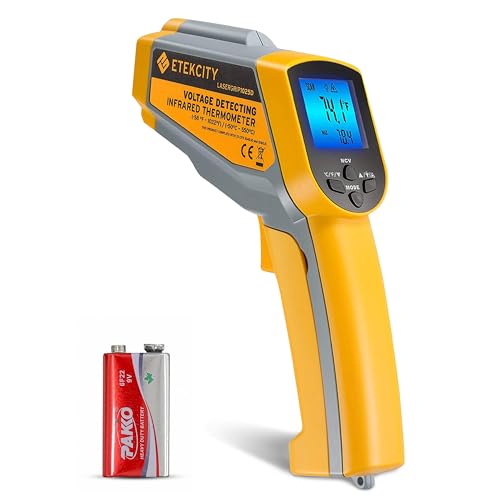
Etekcity · Etekcity Dual Laser Infrared Thermometer Temperature Gun, -58°F ~1022°F | Pizza Oven, Griddle, BBQ, Meat, HVAC, Engine, Electricians, Non-Contact Voltage Detection, Adjustable Emissivity
View on AmazonPrice and availability are shown on Amazon and can change at any time.
A dual laser infrared thermometer reading minus 58 F to 1022 F with a 12 to 1 distance to spot ratio, emissivity adjustable from 0.1 to 1.0, a response time under 500 ms, maximum and automatic data hold, a large backlit display, a 9 V battery included and a Class 2 laser at 0.3 to 0.49 milliwatts. Two things set the listing apart: it states the distance at which the instrument is most accurate, and it warns in capitals that the readings do not apply to people.
The optimal distance is a disclosure almost nobody makes
The distance to spot ratio tells you how the measurement circle grows with distance. At 12 to 1, a target twelve inches away is measured over a one inch circle.
What the ratio does not tell you is that infrared optics are focused, and there is a distance at which the spot is actually tightest. Nearer or further than that, the optics are not at their best and the effective spot is larger than the simple arithmetic implies.
This listing states it: for best accuracy, the distance between the thermometer and the object should be approximately 14.17 inches, which is 36 cm.
That oddly precise figure is a converted metric value, and the conversion is the giveaway that it comes from a real specification rather than a marketing round number.
The practical use is immediate. Stand about a foot and a bit from what you are measuring. Not six inches, where the optics are inside their focus, and not across the room, where the circle has grown and is averaging the surroundings. Most people using an infrared thermometer stand wherever is convenient, and a stated distance replaces convenience with a method.
Our page on choosing an infrared thermometer covers why the spot geometry matters more than the display resolution.
Two lasers show the circle rather than the centre
The single most common infrared measurement error is assuming the reading belongs to the dot. It does not. It belongs to a circle, and a single laser marks the middle of that circle, which looks exactly like a point measurement.
Two lasers change what you see. Converging beams mark the extent of the area being averaged, so the instrument shows you that it is measuring a region rather than a spot.
The listing frames this as being easier and faster to read and more accurate than a single laser. The accuracy claim needs care, because two lasers do not change what the sensor collects. What they change is whether you point it correctly, and pointing correctly is where most of the error lives. A more expensive instrument in this project solves the same problem with a bullseye laser that draws the whole circle.
So the honest statement is that dual lasers improve your technique rather than the instrument optics, and improving technique is worth more than it sounds.
The NOT FOR HUMAN warning is published against interest
The first bullet opens with it in capitals: temperature readings from this device are for inanimate objects, and measured temperatures for humans or animals will not be correct.
That sentence costs the seller sales and it is correct. A surface infrared thermometer measures skin, which sits below core temperature and varies with air movement, sweat and where on the body you point it. Instruments intended for people are calibrated for human tissue emissivity and for a specific measurement site, and they are regulated differently.
During periods when people were looking for anything that read a temperature, instruments like this were widely bought for screening and widely misused. A manufacturer stating the limitation plainly, as the first thing in the first bullet, deserves to be noted.
The same bullet also gives the laser class and optical power: Class 2 at 0.3 to 0.49 milliwatts. Class 2 means a visible laser where the blink reflex is considered adequate protection against brief accidental exposure. It should still not be pointed at anyone eyes, and there are two beams here rather than one.
The specification and the missing tolerance
| Specification | Published in the listing |
|---|---|
| Range | Minus 58 F to 1022 F, minus 50 C to 550 C |
| Distance to spot ratio | 12 to 1 |
| Optimal measuring distance | About 14.17 inches, 36 cm |
| Emissivity | Adjustable, 0.1 to 1.0 |
| Response time | Under 500 ms |
| Lasers | Dual, Class 2, 0.3 to 0.49 mW |
| Readout | Max measurement hold, automatic data hold, backlit LCD |
| Power | 9 V battery included, low battery indicator, auto off |
| Human or animal use | Stated as not suitable |
| Measurement accuracy | Not stated in the listing bullets |
| Repeatability | Not stated in the listing bullets |
| Minimum and maximum scan averaging | Not stated in the listing bullets |
The absent accuracy tolerance is the real weakness, and it is conspicuous because the bullet that should carry it is headed BETTER ACCURACY and then discusses the spot ratio and the range instead. A competing instrument in this project states plus or minus 1.5 percent. Without any figure, you know how to point this thermometer but not how much the number is worth.
Adjustable emissivity from 0.1 to 1.0 is the specification that does the most for real accuracy, because polished metal radiates so poorly that a fixed setting produces readings tens of degrees low. Having the adjustment, and knowing the best distance, puts most of the controllable error in your hands.
The 9 V battery is worth a practical note: a single rectangular cell is easy to find anywhere, but it is also a larger and heavier power source than the AAA cells some competitors use.
Who should buy it
Buy this as a general purpose surface thermometer for cooking surfaces, HVAC vents, engine components and home maintenance, where you can get within arm reach of the target. The stated optimal distance, the dual lasers showing the measured circle and the emissivity adjustment give you the three things that make readings consistent.
Do not use it on people or animals; the listing says so and it is right. Do not expect to read a small target from across a room, because at 12 to 1 the circle grows faster than intuition suggests. And if you need to state a tolerance on a reading you are recording for someone else, note that this listing does not publish one, while a comparable instrument does.
Recommended Tools


Products shown because their documented specifications fit this guide. Price and availability are on Amazon and can change.
Frequently Asked Questions
Why does a stated optimal distance matter?
Because infrared optics are focused, and the measurement spot is tightest at one particular distance. Closer or further, the spot is larger than the ratio alone suggests and the reading drifts toward the surroundings. The listing states that for best accuracy the distance should be approximately 14.17 inches, or 36 cm. Almost no competing listing publishes this, and knowing it changes how you stand.
What do two lasers do that one does not?
They mark the edges of the measurement circle rather than its centre. A single dot looks like a point measurement and encourages the most common infrared error, which is assuming you measured the small thing the dot landed on. Two converging beams show you the width of what is being averaged, which is the same problem a bullseye laser on a more expensive instrument solves.
Why does the listing say NOT FOR HUMAN?
Because people bought instruments like this for body temperature screening and got wrong answers. A surface infrared thermometer measures skin, which is not core temperature, and it is calibrated for an emissivity you set rather than for human tissue. The listing states plainly that measured temperatures for humans or animals will not be correct. That is an honest warning, published against commercial interest.
Is there an accuracy figure?
Not stated in the listing bullets. The second bullet is headed BETTER ACCURACY and then gives the spot ratio and the range rather than a tolerance. A competing instrument in this project publishes plus or minus 1.5 percent. Without a figure you cannot judge how much to trust a reading, which is the gap in an otherwise informative listing.
What does Class 2 laser mean?
A low power visible laser, here stated as 0.3 to 0.49 milliwatts, where the blink reflex is considered protection enough for brief accidental exposure. It still should not be aimed at eyes, and on a dual laser instrument there are two of them. Publishing the class and the power is a detail most listings skip.
Affiliate disclosure: Akermin earns a commission from qualifying Amazon purchases made through links on this page. Our editorial picks are based on documented specifications and owner feedback, not commissions.