As an Amazon Associate, Akermin earns from qualifying purchases. Product links on this page are affiliate links.
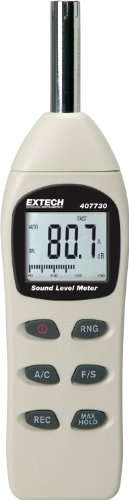
Extech · Extech 407730-NIST Digital Sound Level Meter 40-130dB with NIST
View on AmazonPrice and availability are shown on Amazon and can change at any time.
The Extech 407730-NIST is built for the buyer who needs a sound level reading that can be written down, filed, and defended later. Its 2dB accuracy and 0.1dB resolution give a usable number for walk-through surveys, HVAC noise checks, and workplace noise screening. The NIST certificate adds a paper trail that a plain consumer meter lacks. It is the wrong instrument for anyone who needs Class 2 compliance data, because 2dB accuracy is not tight enough for regulatory noise assessments. It is also wrong for someone who just wants to know whether a room is loud, because a basic meter will tell them that for far less.
The certificate is the product: what NIST traceability buys you
The 407730-NIST is a variant of a standard handheld sound level meter. The letters after the model number are the point of this version. NIST traceability means the meter comes with a certificate linking its calibration to a national standard. That certificate does not make the meter more accurate. It makes the meter’s accuracy documented.
That distinction matters when you hand a reading to somebody else. A facilities manager writing a noise report, a contractor proving a ventilation system meets a specification, or a safety officer recording a screening measurement all face the same problem: the number is only as good as the instrument that produced it. A certificate answers the question “how do you know this meter was reading correctly?” before it is asked.
The listing does not publish the calibration interval, the certificate format, or the uncertainty statement. If your client or regulator requires a specific certificate layout, ask before buying. The listing also does not state whether the certificate is supplied as a printed document or a digital file.
Reading 2dB accuracy and 0.1dB resolution together
These two numbers are often confused, and the confusion leads people to buy the wrong instrument. Resolution is the smallest change the display can show. Accuracy is how close the displayed value is to the true sound level. The 407730-NIST has 0.1dB resolution and 2dB accuracy.
In practice, that means the meter will show you 64.3 dB and 64.4 dB as different readings, but neither reading is guaranteed to be within less than 2 dB of the actual sound pressure level. The fine resolution is useful for watching a trend or spotting a small change between two locations. It is not evidence of fine accuracy.
Two decibels is a meaningful margin. A change of 2 dB is roughly the difference between two slightly different air conditioning units at the same distance. If your work requires distinguishing noise sources that close together, or proving a level is below a regulatory limit with little headroom, this meter’s accuracy is not sufficient. The listing publishes no tolerance for the analog output either.
A and C weighting: which one to use, and what the listing does not say
The meter offers both A-weighting and C-weighting. A-weighting filters low frequencies to approximate how human hearing responds at moderate levels. It is the standard choice for environmental noise, workplace noise screening, and general sound level work. C-weighting keeps more low-frequency content and is used when the low end matters, such as checking music levels or assessing machinery with strong bass content.
Having both is genuinely useful because it lets you compare the two readings. A large gap between the A-weighted and C-weighted numbers tells you the sound has significant low-frequency energy. That is a useful diagnostic when a room sounds loud but the A-weighted number looks modest.
The listing does not state the frequency range over which the meter meets its accuracy specification. It also does not publish the weighting tolerances. That is common for a general purpose meter, but it means you cannot assume the A-weighting curve is tight enough for formal compliance work.
Max and Min recording, and the analog output: useful for surveys, not for logging
The 407730-NIST can record maximum and minimum values over time. This is a manual peak-hold style function, not a data logger. You start a recording, the meter tracks the highest and lowest levels it sees, and you read them off the display. It is useful for capturing a short event, such as a door slam or a compressor start, that you might miss while watching a live number.
The AC analog output is a connector that sends the live signal to another device, such as a recorder or an analyzer. The listing does not state the output voltage range, the connector type, or the output impedance. If you plan to feed the signal into a data acquisition system, those details matter and you will need to confirm them with the supplier.
What the meter does not do is record a time history on its own. There is no built in memory for logging readings over hours or days. If you need a continuous record, this instrument is the wrong choice and you should look at a logging sound level meter instead.
The microphone, the case, and the maintenance nobody mentions
The listing specifies a 0.5 inch (12.7 mm) electret condenser microphone. That is the standard size for this class of meter, which means standard acoustic calibrators will fit it. That matters because the certificate is only the starting point. A sound level meter needs periodic calibration checks, and a 0.5 inch microphone accepts the common calibrator couplers.
The listing does not publish the microphone’s frequency response, its sensitivity, or whether the capsule is removable. It also does not state the meter’s operating temperature range or battery type. Those are gaps a buyer should note, especially if the meter will be used outdoors or in hot plant rooms.
What the listing does not mention at all is wind. A sound level meter used outdoors without a windscreen will read the wind as noise. The listing does not state whether a windscreen is included. If you plan to use this meter outside, budget for a foam windscreen and check that one is available for the 0.5 inch microphone.
Where the 407730-NIST is the wrong instrument
This meter is wrong for compliance noise assessments. If a regulation or a client specification requires a Class 2 sound level meter to IEC 61672, the 2 dB accuracy figure here is not the same thing as a Class 2 rating. The listing does not claim a class. If you need a meter that states its class, look at a model that publishes it, such as the sound level meters we compare for compliance work.
It is also wrong for long term monitoring. There is no logging memory. For that, a data logger or a meter with a logging function is the correct tool. If you are monitoring a building over time, see our guide to environmental data loggers for building monitoring.
And it is wrong for the casual buyer who just wants to know if a room is too loud. The fine resolution and the certificate are wasted on that job. A simple consumer meter will give a rough number for far less, though it will not carry the same documentation. If you are unsure what the numbers mean, start with what dBA means on a sound meter.
The buyer this meter is built for
The Extech 407730-NIST is for the person who needs a defensible sound level reading, not a perfect one. Its 2 dB accuracy is enough for screening, walk-through surveys, and checking that a noisy machine is roughly as loud as it was last time. The NIST certificate is what makes the reading presentable to somebody else. If your work requires Class 2 compliance data, continuous logging, or fine accuracy, this is not the instrument. If you need a documented general purpose meter and you understand its limits, it is a sensible choice.
Recommended Tools


Products shown because their documented specifications fit this guide. Price and availability are on Amazon and can change.
Frequently Asked Questions
Does the NIST certificate mean the meter is calibrated to a higher standard?
No. It means the meter's calibration is documented and traceable to a national standard. The accuracy specification is still 2 dB. The certificate adds evidence, not precision.
Can I use this meter for workplace noise assessments?
It can be used for screening. It is not a Class 2 compliance meter, and the listing does not claim a class. If your assessment must meet a regulatory standard, check whether that standard requires a class rated instrument.
Does it log readings over time?
It records maximum and minimum values over a period, but it does not store a time history. There is no built in logging memory described in the listing.
What is the analog output for?
It sends the live sound signal to another device, such as a recorder or analyzer. The listing does not publish the output voltage range or connector type, so confirm those details if you plan to use it.
Is a windscreen included?
The listing does not state whether a windscreen is included. If you use the meter outdoors, a windscreen is necessary to avoid wind noise affecting the reading.
Can I calibrate it myself?
The listing does not describe a calibration procedure or state whether a calibrator is included. The 0.5 inch microphone is a standard size, so a compatible acoustic calibrator should fit, but confirm this with the supplier.
Affiliate disclosure: Akermin earns a commission from qualifying Amazon purchases made through links on this page. Our editorial picks are based on documented specifications and owner feedback, not commissions.
Related Guides

Dr.meter Digital Illuminance Light Meter Review: One Meter, One Range
A review of the Dr.meter digital illuminance meter covering its 0-200,000 lux range, FC/LUX switching, peak recording, the 9V battery alert, and the specification gaps a buyer should know before ordering.
Read More→Handheld Meter vs Fixed Installed Monitor: Which Do You Actually Need?
This page explains the engineering difference between spot measurement and continuous monitoring, and how that difference decides which instrument fits the job.
Read More→Single point reading against a logged average: which number should you trust?
This page explains when a single point reading is the honest answer, when an average is, and how to tell which your instrument is actually giving you.
Read More→