As an Amazon Associate, Akermin earns from qualifying purchases. Product links on this page are affiliate links.
Short answer: take the LT300 for indoor work, where 40,000 lux is ample and the remote sensor removes shading errors. Take the LT45 if you need to measure bright daylight or high output lighting, where the stated 400,000 lux ceiling is the reason to choose it.
What Each Listing States
| Item | Extech LT300 | Extech LT45 |
|---|---|---|
| Stated range | Up to 40,000 lux | Up to 400,000 lux, per the title |
| Units | Lux and foot candles | Lux and foot candles, per the title |
| Sensor | Remote sensor on a lead | Not stated reliably in the bullets |
| Modes | Peak, relative, min and max, data hold, zero adjust | Not stated reliably in the bullets |
| Display | Large backlit LCD, one handed operation | Not stated reliably in the bullets |
| Stated focus | Workplaces, studios, labs | Colour LED lighting, per the title |
A note on sourcing: the bullet points currently shown on the LT45 listing describe a True RMS clamp meter with a flexible jaw, which clearly belongs to another product. We have quoted only the product title for that model and recommend confirming the specification on the manufacturer datasheet.
Where 40,000 Lux Runs Out
Indoor lighting rarely exceeds a few thousand lux even in a brightly lit workshop, so the LT300 has generous headroom for offices, classrooms, studios, laboratories and workplaces where lighting levels are being checked against a standard. Daylight is a different matter. An overcast day outdoors can be several thousand lux, and full sunlight exceeds 100,000. If your measurements include direct sun, horticultural lighting at close range or high output fixtures, the lower range meter will simply read over.
The Remote Sensor Solves a Real Error
Light measurement has an obvious problem that people repeatedly forget: the person taking the reading is standing in the light. Holding a meter at desk height while leaning over it puts your own shadow across the sensor and gives a reading that is too low. A sensor on a lead lets you place it where the measurement belongs, at the working plane, on the bench, at the plant canopy, and step aside to read the display.
It also enables measurements that are otherwise awkward, such as inside an enclosure or at the back of a shelf, and makes repeated measurements at the same point far more consistent.
Peak and Relative Are the Modes That Get Used
Relative mode is the fastest way to compare lighting across a space. Set the reference at one desk, then walk the room and read differences directly rather than writing down absolute numbers and subtracting later. Peak mode captures the maximum value seen, which is how you measure a flash, a strobe or an intermittent source that you cannot hold a reading on.
Lux and Foot Candles Are the Same Measurement
Both meters report both. One foot candle is approximately 10.76 lux. Standards and specifications in some countries are written in foot candles and in others in lux, so a meter that displays both saves conversion mistakes. Neither unit tells you anything about colour temperature or spectrum, which is a separate measurement requiring a different instrument.
Who Buys Which
- Office and workplace lighting assessments: LT300, for the remote sensor and relative mode.
- Photography and studio work: LT300, for peak capture.
- Outdoor daylight or high output fixtures: LT45, for the stated range.
- Horticultural lighting: check whether you need PAR rather than lux, since lux is weighted for human vision rather than plants.
How We Research
Specifications come from the manufacturer listings, and where a listing’s bullets clearly belong to another product we say so rather than quoting them. We did not run laboratory tests and publish no measurements of our own. Ranking in the light meter roundup.
Recommended Tools
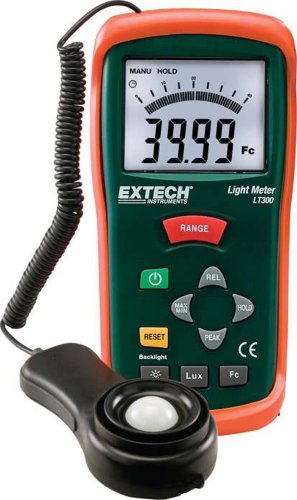


Products shown because their documented specifications fit this guide. Price and availability are on Amazon and can change.
Frequently Asked Questions
Which has the wider range?
The LT45, whose title states 400,000 lux against 40,000 lux for the LT300. Direct sunlight can exceed 100,000 lux, which puts it beyond the LT300 range and inside the LT45 range.
What is a remote sensor for?
It separates the light sensing head from the display on a lead, so the sensor can sit on a desk, a bench or a plant canopy while you read the value without your own body shading the measurement.
What is relative mode?
It sets the current reading as a reference and shows the difference from it, which is how you compare one point with another quickly. Peak mode captures the highest value seen, useful for flashes and intermittent sources.
Note on the listing text
The bullet points currently shown on the LT45 listing describe a clamp meter with a flexible jaw, which does not match a light meter. Only the title specification is quoted here, and the datasheet should be checked before purchase.
Affiliate disclosure: Akermin earns a commission from qualifying Amazon purchases made through links on this page. Our editorial picks are based on documented specifications and owner feedback, not commissions.