Best Light Meters: 9 Reliable Picks for Precise Lux Measurement
Lux is a measure of how much visible light falls on a surface, weighted for human vision, and it is the number behind workplace lighting standards, photography setups and plant growing decisions alike. This hub compares nine current light meters on the ranges and tolerances their manufacturers publish, and links down to the measurement guides on this site.
Independent Research
Verified Specifications
Honest Recommendations
Measure at the Task
Cosine Matters
Same Angle Twice
As an Amazon Associate, Akermin earns from qualifying purchases. Product links on this page are affiliate links.
Our Top Picks
Meters were compared on what each listing states: the illuminance range in lux and foot candles, the stated accuracy, the resolution, the refresh rate and whether the sensor is fixed, rotating or on a separate lead. We did not run laboratory tests, did not compare any meter against a reference lamp and publish no light measurements of our own.
Best Overall
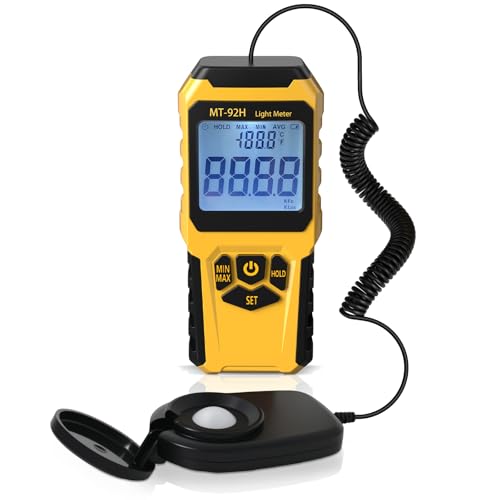
URCERI MT-92H Light Meter with Split Sensor
Published accuracy, 0.1 lux resolution and a sensor you can place where the light matters.
Stated range 0 to 200,000 lux with plus or minus 3 percent accuracy
Values come from each manufacturer own listing. The DANOPLUS unit measures photosynthetic photon flux density rather than illuminance, so its figures are not comparable with the lux readings above it. One foot candle is approximately 10.76 lux.
How to Choose a Light Meter
Four decisions before you look at price:
Lux or PAR
Lux is weighted for human vision and peaks in the green. Plants use photons across 400 to 700 nm. A lux meter under a purple grow light gives a number that means nothing horticulturally.
Range and Range Count
Bright sun is around 100,000 lux and reflective outdoor work exceeds it. A meter split across several ranges keeps useful resolution at the low end as well.
Sensor on a Lead
A split or rotating head lets you put the sensor flat on the work surface without your own body shadowing the reading. It is the single most useful feature in real use.
Published Accuracy
Most listings publish none. Where a figure exists, such as plus or minus 3 percent, it is a commitment the rest have avoided making.
What is the difference between lux and foot candles?
They measure the same thing in different units. One lux is one lumen per square metre; one foot candle is one lumen per square foot, which works out at approximately 10.76 lux. Lighting standards in most of the world are written in lux, while a good deal of North American practice uses foot candles. Several meters here switch between the two, which removes an easy source of error.
Can I use a lux meter for plant growing?
Not reliably. Lux is weighted for the human eye, which peaks in the green and barely registers deep red and blue. Plants respond to photon count across roughly 400 to 700 nm, measured as PPFD in micromoles per square metre per second. Under a white light the two correlate loosely; under a purple or red-heavy LED fixture a lux reading can be badly misleading. The DANOPLUS PAR meter in this list measures the horticultural quantity directly.
Why do two light meters disagree under LED lighting?
Because their spectral responses differ. A meter is supposed to weight incoming light to match the human eye response curve, and cheaper sensors approximate that curve poorly. Under a continuous source like daylight or halogen the error is small; under a narrow-band LED the same error becomes large. That is why the Extech LT40 is sold specifically as a white LED meter.
How should I hold the meter when taking a reading?
With the sensor flat against the plane you care about, which for workplace lighting means the work surface rather than the air above it, and with your body out of the light path. Meters with a separate or rotating sensor head make that far easier. Take several readings across the area rather than one, because illuminance falls off sharply with distance from a luminaire.
What does cosine correction mean?
A sensor should respond to light arriving at an angle in proportion to the cosine of that angle, which is how a flat surface actually receives illumination. Without cosine correction, usually a small diffusing dome over the sensor, a meter over-reads light arriving from the side and under-reads at steep angles. None of the listings in this group states cosine correction, which is a specification worth asking the manufacturer about for precise work.
Reviews
URCERI MT-92H Light Meter with Split Sensor Best Overall
This is the meter that publishes the three figures the others leave out. URCERI states a 0 to 200,000 lux range, accuracy of plus or minus 3 percent and resolution down to 0.1 lux, together with a half second refresh. Take those together and you have an instrument that can describe a dim corridor and a sunlit workbench with the same device and tell you honestly how far the number might be off.
The split sensor is the practical advantage. When the sensing head is on a lead rather than built into the body, you can lay it flat on the desk, the bench, the floor or the specimen while holding the display where you can read it, and you can do that without your own body shadowing the measurement. On a fixed-head meter, getting a true reading at a work surface often means crouching awkwardly and casting a shadow over the very point you are measuring.
The half second refresh is worth more than it sounds when you are sweeping a room to find the dark spot rather than taking one reading: a slow meter forces you to pause at every point. What the listing does not state is the cosine correction or spectral response, which are the specifications that decide how honestly a meter handles light arriving at an angle or from LED sources.
Strengths
Range, accuracy and resolution all published
Split sensor avoids shadowing the measurement point
0.5 second refresh suits sweeping a room
Covers indoor levels and bright sun on one instrument
Extech EA30 EasyView Wide Range Light Meter Best for Bright Light
Direct sunlight at midday sits in the region of 100,000 lux, and reflective surfaces, glasshouse roofs and industrial luminaires can push a meter well past that. Most of the instruments on this page top out at around 200,000 lux, which is enough for almost everything indoors and marginal outdoors. The EA30 states 400,000 lux across five ranges and 40,000 foot candles across four, which removes the ceiling entirely.
The multiple range structure is not just a bigger number. Splitting the span across five ranges is how a meter keeps useful resolution at the bottom while still reaching the top, rather than having a single coarse scale that reads a dim room as zero. That is what makes a wide-range meter usable for both jobs instead of only the bright one.
Extech publishes no accuracy figure or resolution on this listing, so those cells read Not stated, and the price sits above the general-purpose meters here. Buy it when the work genuinely includes bright outdoor or high-intensity industrial measurement; for offices and workshops, a 200,000 lux meter with a published tolerance is the better value.
The UT383 is the meter to buy when you need a defensible reading occasionally rather than daily. UNI-T states 0 to 199,900 lux and 0 to 18,500 foot candles, with a switch between the two units, which covers everything an office, a workshop, a classroom or a retail space will present.
The unit switch matters more in practice than it should. Lighting standards in Europe and much of the world are written in lux; a good deal of North American lighting practice and a lot of photography and horticulture material is written in foot candles. One foot candle is about 10.76 lux, and doing that conversion in your head at every measurement point is how mistakes get made. A meter that shows both removes the arithmetic.
The compact integrated body is the compromise. It is quick to deploy and hard to break, but the sensing head is part of the meter, so getting a true reading at a desk surface means holding the whole instrument flat and standing clear of your own shadow. No accuracy figure or resolution is published, so treat the readings as comparative unless the manufacturer datasheet fills in the gap.
Short answer: the URCERI MT-92H is the best all-round light meter here because it publishes range, accuracy and resolution and puts the sensor on a lead; the Extech EA30 reaches 400,000 lux across five ranges for bright outdoor and industrial work; and the UNI-T UT383 is the value choice, with a full published span in both lux and foot candles.
What a lux meter is actually weighting
Illuminance is not raw light energy. It is light energy weighted by how sensitive the human eye is to each wavelength, a curve that peaks in the yellow-green around 555 nm and falls away steeply towards deep red and violet. That weighting is built into the sensor through a filter, and how well the filter matches the standard curve is the main thing separating a good meter from a poor one. It is also why the same physical amount of light can produce two very different lux readings depending on its colour. Under daylight or an incandescent lamp, most meters agree closely. Under a narrow-band LED, the disagreement can be large, which is exactly why Extech sells the LT40 as a white LED light meter rather than a general one.
Range, and why the number of ranges matters as much as the top figure
Bright midday sun delivers roughly 100,000 lux on a horizontal surface, and reflective surfaces, glasshouse roofs and high-bay industrial lighting push past that. Most meters here state around 200,000 lux, which covers almost everything; the Extech EA30 states 400,000 lux across five ranges, and the TopTes TS-710 states a floor of 0.1 lux at the other end. The multiple range structure is the part buyers overlook. A meter with one flat scale to 200,000 lux has coarse steps everywhere, so a dim corridor reads as an uninformative small number. Splitting the span across ranges keeps fine steps at the bottom while still reaching the top, which is what makes an instrument usable for a stairwell and a rooftop on the same day.
Accuracy, resolution and the meters that publish neither
Only two listings here commit to a tolerance. The URCERI MT-92H states plus or minus 3 percent and a resolution of 0.1 lux. The Mcbazel states plus or minus 3 percent plus 10 digits below 10,000 lux and plus or minus 4 percent plus 10 digits above it, which is the more honest format because it acknowledges that the error grows with the reading and includes a fixed digit count. Everything else states nothing, which is why that column is mostly Not stated. Be careful not to confuse the two ideas: resolution is the smallest step the display can show, accuracy is how far the reading can be from reality, and a meter showing 0.1 lux steps with a three percent tolerance is showing far more precision than it possesses. The same trap is covered in our guide on resolution in a digital meter.
Sensor design and the shadow problem
The most useful feature on a light meter costs the manufacturer almost nothing. If the sensor sits on a lead, as on the URCERI MT-92H, or on a rotating head, as on the TopTes TS-710 with its stated 180 degree probe, you can place the sensing element flat on the desk, the bench, the floor or the leaf canopy while holding the display somewhere you can read it. On an integrated meter like the UNI-T UT383, taking a true reading at a work surface means holding the whole body flat and leaning over it, which is exactly how you shadow your own measurement. For a single reading it hardly matters. For a survey of twenty workstations it changes the results.
Growing light is a different measurement entirely
The DANOPLUS quantum meter in this list does not measure lux at all. It measures photosynthetic photon flux density, the number of photons in the 400 to 700 nm band arriving per square metre per second, stated at 0 to 5000 micromoles per square metre per second with a cut-on at 400 nm and cut-off at 700 nm to a tolerance of 10 nm. That is the quantity plants respond to, and it counts a deep red photon and a blue photon equally, whereas a lux meter weights both close to zero. Under a white LED the two measurements correlate roughly enough to be useful; under a purple horticultural fixture a lux reading is close to meaningless. If the question is about growing, buy the PAR meter and ignore the lux figures entirely.
Taking readings that mean something
Illuminance falls off sharply with distance from a source, so where you hold the sensor is as consequential as which meter you bought. Measure in the plane that matters, which for workplace lighting is the working surface, not head height. Take a grid of readings across the area rather than one at the brightest point, because lighting standards are written around minimum and average levels across a task area. Record the time of day and whether daylight is contributing, since a room measured at noon and at dusk is a different room. And take repeat readings from the same position and angle: the biggest source of variation in practical light measurement is not the instrument, it is the operator moving between readings. Our how to choose a light meter guide covers the specification side of the same decision.
Meters were compared on manufacturer listing text: stated illuminance range in lux and foot candles, stated accuracy, resolution, refresh rate, sensor design and unit switching. Horticultural meters were compared separately on photon flux range and wavelength band. Owner feedback was reviewed for recurring comments on readings under LED sources. We did not run laboratory tests, did not compare any meter against a reference lamp and publish no measurements of our own. Amazon data supplies images, availability and links only.
Ten pH meters compared on stated range, accuracy, calibration method and probe type, covering hydroponics pens, pool testers, a food spear probe and a soil kit.
Twelve water quality testers compared on the parameters stated, probe materials and form, from four-in-one TDS pens to pool meters reading chlorine and ORP.
Ten EMF meters compared on the fields measured, stated frequency ranges, calibration certificates and power, from three-in-one units to RF instruments.