As an Amazon Associate, Akermin earns from qualifying purchases. Product links on this page are affiliate links.
Choose a light meter with a silicon sensor filtered to the photopic curve (look for a stated f1′ error, ideally under 6 percent, or an explicit LED rating), a white cosine-correcting dome, a range from at least 0.1 to 100,000 lux with 0.1 lux resolution at the low end, and a remote sensor on a lead so you can hold the meter out of the light path. Add data hold, min/max and logging for surveys. For grow lights, buy a PAR meter instead; lux does not describe what plants use.
Step 1: Spectral response
The sensor’s filter should match the eye’s sensitivity curve, V(λ). The mismatch is stated as f1′; Class B meters (DIN 5032) are under 6 percent, Class C under 9 percent. Cheap meters calibrated on incandescent light can misread LEDs and daylight by 10 to 30 percent. Meters marketed for LED (Extech LT45 and similar) have better filters or corrections. See what a lux meter is.
Step 2: Cosine correction
Light arriving at an angle should be weighted by the cosine of that angle, which is what a flat surface receives. A white translucent dome over the sensor achieves this; a bare sensor or a flat window reads angled light low. For room illuminance, where most light arrives obliquely from ceiling fixtures and windows, this matters as much as the filter.
Step 3: Range and resolution
| Measurement | Level | Needed resolution |
|---|---|---|
| Emergency lighting | 0.5 to 5 lux | 0.01 to 0.1 lux |
| Corridors, storage | 50 to 200 lux | 1 lux |
| Offices, classrooms | 300 to 500 lux | 1 lux |
| Detailed work, retail display | 750 to 2,000 lux | 1 to 10 lux |
| Daylight | 2,000 to 100,000 lux | 10 to 100 lux |
Auto-ranging meters handle the spread; check the resolution on the lowest range if emergency lighting is on the list.
Step 4: Form factor
- Remote sensor on a lead: lets you place the sensor on the working plane and read the display without shadowing it. Preferred for surveys.
- Integrated sensor: compact; fine for spot checks; watch your own shadow.
- Data logging and PC output for lighting surveys and reports (Extech 407026 and similar).
- Foot-candle and lux switching for mixed specifications.
Step 5: Special cases
- Horticulture: a PAR (quantum) meter measuring µmol/m²/s. Lux is a poor proxy, especially for red-blue LED grow lights.
- Photography and film: incident light meters reading in exposure values; different instrument.
- UV and blue-light hazard: specialist radiometers; a lux meter does not respond correctly.
- Colored or narrow-band lighting: only a well-filtered or spectrometer-based meter reads accurately.
Using it
Sensor flat on the working plane, dome up, body and shadow away, lamps warmed up, readings on a grid, average and uniformity reported. Guidance levels are commonly 300 to 500 lux for offices and classrooms. Light meters, alone or within multifunction environmental meters, are in the environmental monitoring category; see how to choose an environmental meter.
Recommended Tools
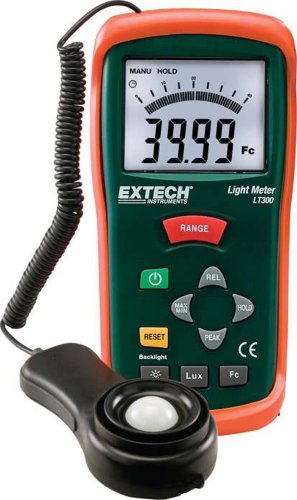


Products shown because their documented specifications fit this guide. Price and availability are on Amazon and can change.
Frequently Asked Questions
What is the difference between a lux meter and a PAR meter?
A lux meter weights light by the human eye's response. A PAR meter measures photosynthetically active radiation (400 to 700 nm) in µmol/m²/s, the quantity plants respond to. For grow lights, use PAR.
Can I use a phone as a light meter?
Phone light sensors are uncalibrated, poorly cosine-corrected and buried behind glass. Apps are useful for relative comparison and useless for measurements against a standard.
What range do I need?
0.1 to 200,000 lux covers emergency lighting through direct sunlight. Most indoor work sits between 50 and 2,000 lux; a meter with good resolution there matters more than the top of the range.
Affiliate disclosure: Akermin earns a commission from qualifying Amazon purchases made through links on this page. Our editorial picks are based on documented specifications and owner feedback, not commissions.
Related Guides

CPS LS790B Leak-Seeker Review: Non Combustible Is the Deciding Word
An ion pump refrigerant leak detector individually calibrated to find a leak rate better than a quarter of an ounce per year, with ten selectable sensitivity ranges, a water vapour filter and a bar graph plus tone display.
Read More→
BW Clip BWC2-H Review: Alarm Points Set Before the Clock Starts
A single gas hydrogen sulfide detector with one button operation, hibernation mode, automatic logging of the 35 most recent gas events and bump test results, and compatibility with IntelliDoX and MicroDock II docking.
Read More→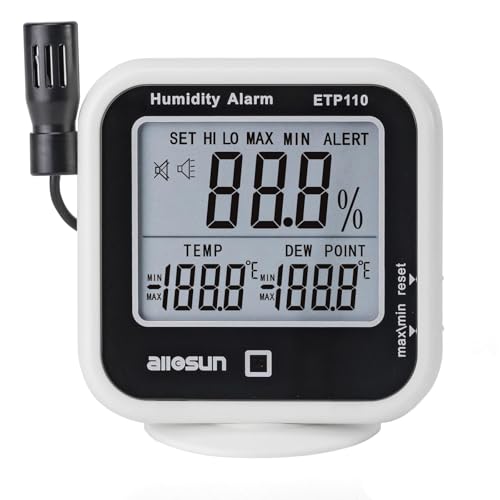
ALLOSUN Thermometer Hygrometer Review: Half a Metre of Lead and No Tolerance
A battery powered thermometer and hygrometer showing temperature, relative humidity and dew point, with a settable humidity alarm, a sensor on a lead of about 50 cm, maximum and minimum memory and a large LCD.
Read More→