As an Amazon Associate, Akermin earns from qualifying purchases. Product links on this page are affiliate links.
A pin moisture meter pushes two metal probes into the material and measures the electrical resistance between them; wet material conducts better, and the meter converts resistance to a moisture percentage at that point and depth. A pinless meter presses a flat sensor pad against the surface and measures the change in an electromagnetic field caused by water in the material beneath, scanning quickly without marks but giving a reading averaged over the pad area to a fixed depth. Pinless finds the moisture; pins measure it.
How each works
Pin (resistance)
Water dissolves salts in wood and gypsum, making them conductive. Two pins spaced 25 to 30 mm apart pass a small current; the meter reads the resistance and, using a calibration for the material, displays percent moisture content (wood) or a relative scale (drywall, masonry). Reading depth is the pin length, 8 to 10 mm on standard pins, deeper with hammer probes. The result is local: move the pins 20 mm and a different reading may appear.
Pinless (capacitance / dielectric)
A pad on the back of the meter creates a radio-frequency field that penetrates 15 to 40 mm into the material. Water has a very high dielectric constant, so wet material changes the field and the meter reports the change. The reading is an average over the pad area and depth, sensitive to density and to anything conductive in range. Sliding the meter across a surface maps moisture in seconds.
Side by side
| Pin | Pinless | |
|---|---|---|
| Measures | Resistance at the pin tips | Dielectric change under the pad |
| Output | % moisture content (wood), relative scale (others) | Relative scale; some models estimate % for wood |
| Depth | Pin length; adjustable with longer probes | Fixed, typically 15 to 40 mm |
| Area | Point | Pad area, about 50 × 70 mm |
| Surface damage | Two small holes | None |
| Speed | Slow; one point at a time | Fast; scan a wall in a minute |
| Best on | Framing, subfloor, flooring stock, confirming a suspect area | Finished walls, floors, ceilings, locating and mapping |
| Fooled by | Surface moisture, salts, treated wood | Metal, wiring, pipes, density changes, tile |
Reading the numbers
For wood, moisture content in percent is meaningful: 6 to 12 percent is dry interior joinery, 12 to 16 percent is framing in a normal house, over 20 percent supports decay. Pin meters need a species or group correction for accuracy. For drywall, plaster and masonry, both meter types give a relative scale; the useful comparison is against a known-dry area of the same material nearby. See why moisture meter readings vary by material.
Using them together
- Scan with pinless to find the wet area and its edges.
- Take a pinless reading on a known-dry area of the same material as the baseline.
- Confirm the wettest point with pins, where marks are acceptable, to get a real number and the depth.
- Re-scan after drying or repair to check progress.
Combination meters with both a pad and pins (such as the Extech MO265) suit inspectors who want one tool. Thermal cameras find candidate areas faster still, and a meter confirms them; see can thermal imaging find water leaks. For the question of mold, see can a moisture meter detect mold.
Recommended Tools

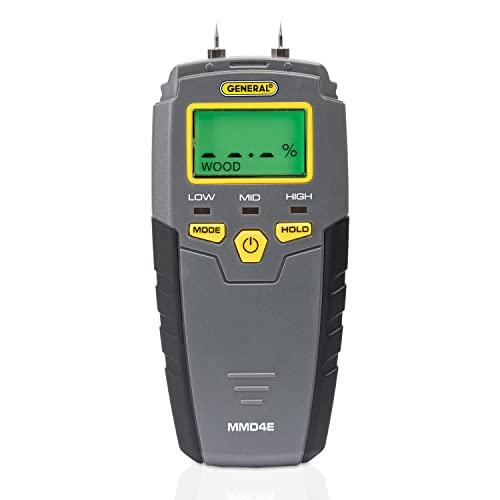

Products shown because their documented specifications fit this guide. Price and availability are on Amazon and can change.
Frequently Asked Questions
Which is more accurate, pin or pinless?
Pin meters on wood with the correct species correction give the more trustworthy absolute percentage. Pinless meters are better at finding where moisture is and comparing areas, and less reliable as an absolute number.
Does a pinless meter work through paint and tile?
Through paint, wallpaper and thin coatings, yes. Through tile it reads the tile, adhesive and substrate together and the number is only comparative. Metal behind the surface gives a false high.
Do pin meters leave marks?
Two small holes, a millimeter or so across. Acceptable on framing and subfloor, usually not on finished surfaces, which is the main reason pinless meters exist.
Affiliate disclosure: Akermin earns a commission from qualifying Amazon purchases made through links on this page. Our editorial picks are based on documented specifications and owner feedback, not commissions.
Related Guides

PHOEBUS LINK RCX100 Review: 40 mK Is the Figure This Job Needs
A handheld thermal camera with a 160 by 120 infrared detector, a 320 by 240 enhanced image, 40 mK sensitivity, a focus free 40 by 30 degree field of view, a 25 Hz refresh rate and still JPG image capture.
Read More→
Fluke 62 MAX+ Review: The Cold End Is Printed Three Different Ways
A non contact infrared thermometer for electrical, mechanical, HVAC and automotive surfaces, with dual rotating lasers that mark the edges of the measurement area, minimum, maximum, difference and average readings, and an IP54 rating.
Read More→
General Tools MMD7NP Review: Percent on Wood, Relative on Drywall
A pinless non invasive moisture meter that reads up to three quarters of an inch into a surface, with scales of 0 to 53 percent for softwood, 0 to 35 percent for hardwood and relative readings on wallboard, drywall and masonry.
Read More→