Best Low-Impedance Multimeters: Powerful Picks for Eliminating Ghost Voltage
A standard multimeter reads a few dozen volts on a conductor that carries nothing, because its 10 megohm input picks up capacitive coupling from live wires nearby. A low-impedance (LoZ) mode loads that phantom away. These picks all state LoZ on the listing and were compared on voltage rating, category rating, ruggedness and the rest of the function set.
As an Amazon Associate, Akermin earns from qualifying purchases. Product links on this page are affiliate links.
Our Top Picks
Every pick states a low-impedance mode on its listing. Meters were compared on that mode, maximum voltage, category rating, TRMS, resistance range, ruggedness and battery life from manufacturer listings and owner feedback. We did not run laboratory tests and publish no measurements of our own.
Best Overall
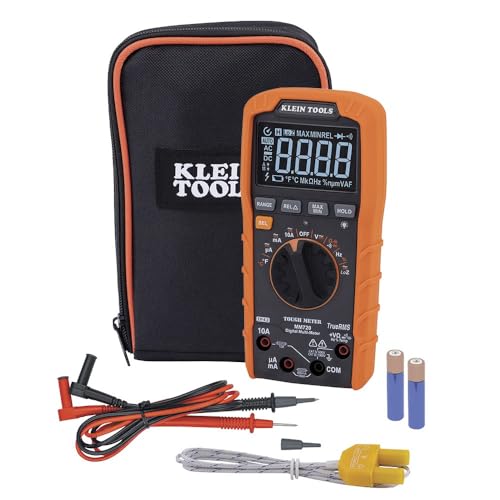
Klein Tools MM720 Digital Multimeter
LoZ, 1000 V AC/DC, 60 megohm and TRMS in a trade-brand body.
LoZ mode for identifying and eliminating ghost or stray voltages
Measures AC/DC voltage to 1000 V, 10 A AC/DC current, 60 megohm resistance
Auto-ranging TRMS; continuity, temperature, capacitance, frequency, duty cycle and diode test
Reverse-contrast LCD, test lead holders, kickstand, optional magnetic hanger
Figures are from each manufacturer's Amazon listing at the time of research. "Not stated" means the listing does not give the value, not that the meter lacks it; the 87V MAX and 177 are included because buyers cross-shop them, and their LoZ capability should be confirmed in the manual.
How to Choose a Low-Impedance Multimeter
LoZ is one line on the spec sheet; four others decide the purchase:
LoZ Stated, Not Implied
Look for the words LoZ or low input impedance on the listing or manual. TRMS and auto-ranging do not imply it.
Category Rating
CAT III 1000 V or CAT IV 600 V for panels and service equipment. Never use a meter above its CAT or voltage rating.
TRMS
Drives, dimmers and switching supplies distort the waveform. A true-RMS meter reads them correctly; an averaging meter does not.
Ruggedness and Runtime
A stated drop rating, an ingress rating and a long battery life matter for a meter that rides in a bag every day.
What is ghost voltage and why does my meter show it?
Ghost or phantom voltage is a reading on a conductor that is not connected to a source. It is induced by capacitive coupling from live conductors running alongside it, and a standard digital multimeter with about 10 megohm input impedance draws so little current that the induced charge is enough to register as tens of volts. It cannot deliver current, but it can make a dead circuit look live.
How does LoZ mode get rid of it?
LoZ places a much lower impedance across the test leads. A capacitively coupled ghost voltage collapses under that load and reads near zero, while a real source holds its voltage. That is why a LoZ reading is the one to trust when deciding whether a conductor is dead.
Should I leave the meter in LoZ mode all the time?
No. The low impedance draws current from the circuit, which can load sensitive electronics, and it is not the mode for millivolt or high-resistance work. Use LoZ to confirm live or dead and to test for ghost voltage, then switch back to the standard voltage function for measurement.
Is a non-contact voltage tester the same thing as LoZ?
No. A non-contact tester senses the electric field around a conductor and can be fooled by the same induced voltage. LoZ is a contact measurement that loads the conductor. The Fluke 117 offers both, which is why electricians favor it: the non-contact check first, the LoZ reading to confirm.
Do the Fluke 87V MAX or 177 have LoZ?
Their Amazon listings do not state it, so we have marked them Not stated in the table. Both are widely used industrial meters; if LoZ matters to you, confirm it in the manual for the specific model before buying rather than assuming.
Reviews
Klein Tools MM720 Digital Multimeter Best Overall
The MM720 is the most complete LoZ meter in this group on paper. Klein states the low-impedance mode plainly, for identifying and eliminating ghost or stray voltages, alongside a 1000 V AC/DC voltage range, 10 A AC/DC current and a 60 megohm resistance range that is wider than the MM700's 40 megohm. Auto-ranging TRMS covers the non-sinusoidal loads that a panel full of drives and LED drivers produces.
The function list is the full trade set: continuity, temperature, capacitance, frequency and duty cycle, and diode test. The reverse-contrast display, white digits on a dark background, is easier to read in a dim panel than a conventional LCD, and the back of the meter has test lead holders and a kickstand, with an optional magnetic hanger (Klein 69445 or 69417) for hands-free work.
What the listing does not state is the category rating or a drop rating, both of which the lower-tier MM700 does state. Check the manual for the CAT figure before service entrance work. For an electrician or HVAC technician who wants LoZ plus the widest function set, it is the pick.
Strengths
LoZ and 1000 V rating stated together
60 megohm resistance range
Reverse-contrast display for dark panels
Lead holders, kickstand and magnetic hanger option
Fluke 117 Digital Multimeter Best for Electricians
The 117 is the meter most residential and commercial electricians reach for, and its listing names the two features that make it suit the job: low input impedance to prevent false readings from ghost voltage, and VoltAlert non-contact detection, so you can check whether a box is live before the leads go in. AutoVolt picks AC or DC automatically, which removes one more knob position from the routine.
Fluke states TRMS for non-linear loads, a DC millivolt range of 600.0 mV at 0.1 mV resolution, a large white LED backlight, an operating range of -10 to +50 C and a typical battery life of 400 hours without the backlight. Owners consistently cite the ergonomics and the continuity beeper as reasons they keep it.
The listing does not state the maximum voltage range, the category rating or the display count, so those come from the manual. It has no temperature input, which both Klein meters offer, and it sits at the premium tier for its function set. Our full Fluke 117 review goes through it in detail.
Strengths
LoZ and non-contact detection in one meter
AutoVolt AC/DC selection
Bright backlight and long stated battery life
Wide trade following and support
Limitations
Maximum voltage and CAT rating not stated on the listing
The MM700 is the value pick because it states the safety figures the MM720 leaves off its page: a CAT IV 600 V rating and a 2 m drop rating. For a meter that lives in a tool bag and works on panels and disconnects, those numbers matter as much as the LoZ mode, which Klein states in the same words as on the MM720.
The measurement set is close to its sibling: auto-ranging TRMS, 1000 V AC/DC, 10 A AC/DC current, temperature, capacitance, frequency and duty cycle, diode test and continuity. The resistance range is 40 megohm rather than 60, and the display is a conventional LCD rather than reverse contrast. Klein notes a low battery indicator and an accessible battery and fuse compartment.
Klein describes it as intended for residential, business and light-industrial locations, so it is not the meter for a drive room. Display count and backlight are not stated. For an apprentice, a maintenance technician or a homeowner who wants a LoZ meter with a stated CAT rating, it is the sensible buy.
Strengths
CAT IV 600 V and 2 m drop stated
LoZ at the budget tier
Temperature input included
Accessible fuse compartment
Limitations
Intended for residential to light-industrial environments
Short answer: the Klein Tools MM720 is the pick for most trades: it states LoZ, 1000 V AC/DC, TRMS and a 60 megohm resistance range with a reverse-contrast display that reads well in a dark panel. Electricians who want non-contact detection in the same meter should choose the Fluke 117, which pairs low input impedance with VoltAlert and AutoVolt. On a tighter budget the Klein MM700 gives LoZ, a stated CAT IV 600 V rating and a 2 m drop rating for less than either.
Where ghost voltage comes from
Run a de-energized conductor in the same conduit or cable as a live one and the pair form a small capacitor. A digital multimeter has an input impedance of about 10 megohm, so the tiny current that capacitor can pass is enough to show a reading, often 20 to 90 volts on a circuit that carries nothing. The reading is real in the sense that the meter is not lying; it is meaningless in the sense that the conductor cannot source any current. Electricians see it on abandoned lighting runs, spare conductors in a shared raceway and switched legs with the switch off. How to measure AC voltage with a multimeter covers the basic technique this page builds on.
What LoZ does
A low-impedance mode switches a much smaller resistance across the input. The capacitive coupling cannot sustain a voltage across that load, so an induced reading collapses to near zero, while a genuine source holds up. It is a decision tool: live or dead, real or ghost. It is not a precision measurement mode, it draws current from the circuit, and the meter should go back to its standard voltage function afterwards. All three picks state the mode on their listings, and the words to look for on any other meter are LoZ, low input impedance or low-Z. TRMS, auto-ranging and a high display count do not imply it.
The three picks, compared
The Klein MM720 and MM700 share the same LoZ description and the same 1000 V AC/DC and 10 A ranges. The MM720 adds a wider 60 megohm resistance range and a reverse-contrast display; the MM700 states the safety figures the MM720 listing omits, a CAT IV 600 V rating and a 2 m drop rating, and Klein positions it for residential, business and light-industrial environments. The Fluke 117 is a different design: a compact electrician’s meter with VoltAlert non-contact detection and AutoVolt AC/DC selection, TRMS, a 600.0 mV DC millivolt range and a stated 400-hour battery life, but no temperature input and, on the listing, no stated maximum voltage or CAT rating. Buyers weighing the 117 against its stablemate should read the Fluke 179 review as well.
The meters that do not state LoZ
Three meters in the table are there because buyers cross-shop them. The UNI-T UT196 does state a low impedance mode, along with a low-pass filter, 1700 V DC, CAT III 1000 V and CAT IV 600 V, IP65 and a 2 m drop rating; it is aimed at solar work and is covered in the 1500 V DC multimeter guide. The Fluke 87V MAX and Fluke 177 do not state LoZ on their Amazon listings. Both are respected industrial meters, and the 87V MAX states CAT III 1000 V, CAT IV 600 V, IP67 and a 4 m drop rating, but we will not claim a feature the listing does not; confirm it in the manual.
Category ratings and the limits of the meter
A CAT rating describes the transient overvoltage the meter is built to withstand, and the higher the category the tougher the environment: CAT IV covers the service entrance and outdoor conductors, CAT III the distribution panels and feeders inside a building. CAT III 1000 V and CAT IV 600 V appear together on the UT196 and the 87V MAX; the MM700 states CAT IV 600 V. Never use a meter above its CAT or voltage rating, and treat a listing with no stated rating as a reason to read the manual before the meter goes near a panel. What a CAT rating means and CAT II, III and IV explained cover the categories in detail.
Choosing for your work
A residential or commercial electrician who checks boxes and panels all day is best served by the Fluke 117: non-contact first, LoZ to confirm, AutoVolt so the dial rarely moves. An HVAC or controls technician who also needs temperature, capacitance and a wide resistance range should choose the Klein MM720, and pair it with a clamp from the HVAC clamp meter guide. An apprentice, a maintenance technician or a serious homeowner who wants LoZ with a stated CAT rating at the lowest outlay should choose the MM700. Anyone whose day involves variable-speed drives should look instead at the VFD multimeter guide, where a low-pass filter matters more than LoZ. The general buying framework is in how to choose a digital multimeter.
How We Research
Meters were compared on manufacturer listings: whether a low-impedance mode is stated, maximum voltage, category rating, TRMS, display count, resistance range, additional functions, drop and ingress ratings and battery life. Owner feedback was reviewed for reliability and display readability. We did not run laboratory tests and publish no measurements of our own. Amazon data supplies images, availability and links only.
A voltage range describes what an instrument will read, a measurement category describes where it may be connected, and a listing that gives one without the other leaves the safety question unanswered.
A meter fuse protects the current input path and its interrupting capacity has to match the fault energy the category implies, but the category itself comes from clearances and input protection rather than from the fuse.
Exceeding a measurement category usually ends in a flashover across internal clearances rather than a blown display, and the most common outcome is an instrument that still reads correctly with its safety margin gone.