As an Amazon Associate, Akermin earns from qualifying purchases. Product links on this page are affiliate links.
Short answer: the Klein ET140 is the better tool for a trade that needs a quick, dependable wet or dry answer with nothing to learn. The Extech MO265 is the better instrument for anyone who has to document moisture or measure materials where a pinless reading alone is not trustworthy.
What Each Listing States
| Item | Extech MO265 | Klein ET140 |
|---|---|---|
| Method | Pinless plus remote pin probe | Pinless only, electromagnetic field |
| Stated depth | Not given in the bullets | Up to three quarters of an inch |
| Reading type | Not specified in the bullets | Relative moisture content |
| Display | Backlit LCD with tri-colour LED bargraph | Not detailed in the bullets |
| Stated materials | Wood and other building materials | Drywall, wood and masonry |
Relative Moisture Is an Honest Label
The Klein listing repeatedly uses the phrase relative moisture content, and that deserves credit. A pinless meter does not measure a percentage of water by weight; it measures a bulk electrical property and maps it onto a scale. The number is meaningful when you compare one spot with another in the same material, and much less meaningful as an absolute figure to write on a certificate. Meters that quote confident percentages for every material are making a claim that the physics does not support as cleanly as it appears.
This matters for how you use either tool. Take a reading on known-dry material of the same type first, then compare. A wall that reads twice its dry baseline is wet regardless of what the number says in absolute terms.
The Case for One Method
A meter with one button and one reading gets used correctly. A meter with two methods gets used in whichever mode the last person left it in, and produces confusing numbers when a pin reading is compared with a pinless one as if they were the same scale. For an electrician, plumber or general contractor who checks moisture occasionally, the ET140 is the safer purchase precisely because there is nothing to get wrong.
The Case for Two
If a reading has to go in a report, a pinless number on its own is weak. Pins give a value at a stated depth at a marked point, which can be repeated, and repeated readings are what prove a building is drying. The MO265 remote probe also reaches into places the meter body cannot go. For restoration, insurance work and inspection reports, that is the difference between evidence and an opinion.
Who Buys Which
- Electrician, plumber, general trade: ET140.
- Restoration, drying and insurance work: MO265.
- Home inspector: MO265, because clients expect numbers.
- Homeowner: ET140, or a simple pin meter if marking is acceptable.
How We Research
Specifications come from the manufacturer listings. We did not run laboratory tests and publish no measurements of our own. Our ranking is in the how to choose a moisture meter.
Recommended Tools


Products shown because their documented specifications fit this guide. Price and availability are on Amazon and can change.
Frequently Asked Questions
How deep does the Klein ET140 read?
The listing states non-destructive detection up to three quarters of an inch below the surface using electromagnetic field technology.
Does the ET140 give a percentage?
The listing describes relative moisture content rather than an absolute percentage. That is an honest description of what a pinless meter measures, and it means readings are best used for comparison between locations rather than as an absolute figure.
Why would I want the pin probe?
To record repeatable readings at a fixed point, and to measure materials where a pinless sensor is unreliable, such as thin panels with something metallic behind them.
Which is simpler to use?
The ET140. One method, one reading, nothing to configure. That simplicity is exactly why many trades prefer it over a more capable instrument they will never fully use.
Affiliate disclosure: Akermin earns a commission from qualifying Amazon purchases made through links on this page. Our editorial picks are based on documented specifications and owner feedback, not commissions.
Related Guides

Thermal Master P1 Review: 17 Grams, 0.32 Watts, and a 160 by 120 Detector Underneath
A 17 gram USB-C thermal attachment stating 320 by 240 after X3 processing from a 160 by 120 detector, with 0.04 C sensitivity, isotherm mode and adjustable emissivity.
Read More→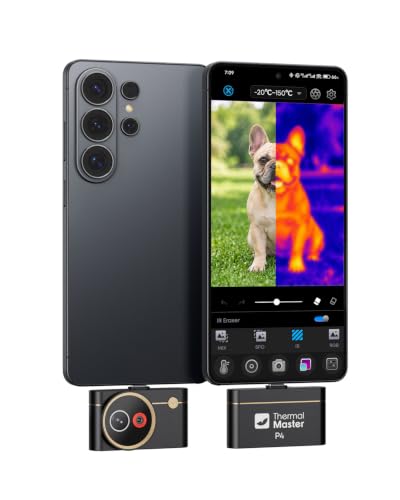
Thermal Master P4 Review: A 256 by 192 Detector Behind a 512 by 384 Headline
An Android phone attachment with a 256 by 192 detector upscaled to 512 by 384, NETD below 35 mK, a 56 by 42 degree field of view and no battery of its own.
Read More→
Soliluxelink Borescope Review: The Title Says Articulating, the Bullets Describe Something Else
A 1080P borescope with a 4.3 inch screen, a 16.4 foot semi rigid IP67 probe, eight LEDs and an accessory kit. Reviewed from a listing whose own bullets contradict its title.
Read More→