As an Amazon Associate, Akermin earns from qualifying purchases. Product links on this page are affiliate links.
Choose a moisture meter by the job. For finding hidden damp in walls, ceilings and floors without marks, a pinless meter with a 20 to 40 mm depth and a reference (relative) mode. For measuring wood moisture content for flooring, joinery or firewood, a pin meter with species groups and a stated ±1 to 2 percent accuracy. For inspection work, a combination meter that does both. In every case, require a material or scale selection, a hold function, and a way to check the meter (a built-in calibration check or a test block). Then adopt the habit of always reading a known-dry reference first.
Step 1: Pin, pinless or both
| Pinless | Pin | Combination | |
|---|---|---|---|
| Finds moisture fast without marks | Yes | No | Yes |
| Accurate wood percentage | Approximate | Yes with species correction | Yes |
| Depth control | Fixed by design | Pin length; deeper with hammer probes | Both |
| Fooled by | Metal, wiring, density changes | Salts, treatments, surface water | Both, but cross-checks |
| Typical users | Homeowners, inspectors, restoration | Woodworkers, flooring, firewood | Inspectors, restoration professionals |
See pin vs pinless moisture meters.
Step 2: Materials and scales
- Wood: percent moisture content with species groups or a specific gravity setting.
- Drywall and plaster: a dedicated scale or a relative scale; some meters offer a drywall percentage.
- Masonry and concrete: relative scale only from handhelds.
- Flooring: laminate, bamboo and engineered products often have their own settings on flooring-oriented meters.
The reason scales matter is in why moisture meter readings vary by material.
Step 3: Depth and range
Pinless meters read to a fixed depth, commonly 20 mm (shallow, for flooring) or 40 mm (deeper, for walls); some offer both. Pin meters read to the pin tip; insulated pins read only at the tip for depth profiling, and hammer probes reach 30 to 50 mm into timber. Wood ranges of 6 to 40 percent cover everything from furniture to wet framing; the useful resolution is 0.1 percent.
Step 4: Features
- Reference or relative mode: zero on a dry area and read the difference; the most useful pinless function.
- Hold and max: for scanning ceilings and reading the meter afterwards.
- Audible tone rising with moisture, for scanning without looking.
- Temperature compensation on pin meters; warm timber reads high otherwise.
- Calibration check: a built-in self-test or a supplied test block; the way to know the meter is still right.
- Backlit display, auto-off, replaceable pins.
Step 5: Picks by use
| Use | Choose | Examples |
|---|---|---|
| Homeowner checking damp | Pinless with reference mode | Klein ET140, Extech MO257 |
| Woodworking, firewood, timber | Pin with species groups | General MMD4E, Extech MO50 class |
| Flooring installation | Pin with flooring settings plus pinless for scanning | Combination meters; separate slab testing |
| Home inspection, restoration | Combination pin and pinless | Extech MO265, MO290 class |
| Deep timber (beams, posts) | Pin meter with hammer probe | Professional pin meters with probe accessory |
Using it well
- Select the material or scale.
- Read a known-dry area of the same material first; that is the baseline.
- Read the suspect area; report the difference and the scale.
- Confirm pinless finds with pins where marks are acceptable.
- Check the meter on its test block periodically.
Procedures for specific materials: how to use a moisture meter on drywall and how to use a moisture meter on wood. The place of the meter in a wider kit is in how to choose a measurement tool for home inspection.
Recommended Tools

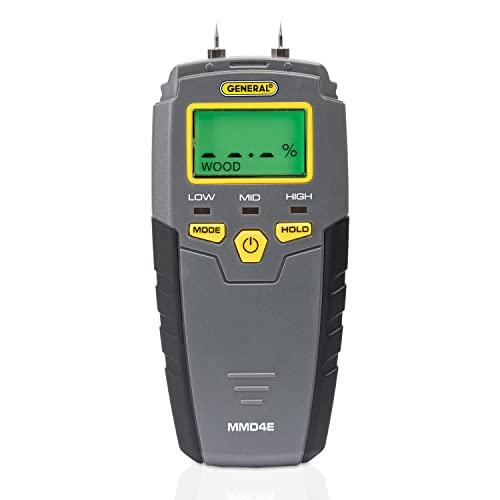

Products shown because their documented specifications fit this guide. Price and availability are on Amazon and can change.
Frequently Asked Questions
Should I buy a pin or pinless moisture meter?
Pinless if you mostly scan finished surfaces for hidden damp; pin if you need accurate wood moisture percentages or depth. A combination meter covers both for inspectors.
What moisture meter do flooring installers use?
A pin meter with species correction for wood subfloor and flooring stock, plus a pinless meter for scanning. Concrete slabs need in-situ RH probes or calcium chloride tests, not a handheld meter.
How much should a good moisture meter cost?
Reliable pinless or pin meters from established makers sit in the mid-range; combination meters cost more. Very cheap meters often lack material scales and drift.
Affiliate disclosure: Akermin earns a commission from qualifying Amazon purchases made through links on this page. Our editorial picks are based on documented specifications and owner feedback, not commissions.
Related Guides

PHOEBUS LINK RCX100 Review: 40 mK Is the Figure This Job Needs
A handheld thermal camera with a 160 by 120 infrared detector, a 320 by 240 enhanced image, 40 mK sensitivity, a focus free 40 by 30 degree field of view, a 25 Hz refresh rate and still JPG image capture.
Read More→
Fluke 62 MAX+ Review: The Cold End Is Printed Three Different Ways
A non contact infrared thermometer for electrical, mechanical, HVAC and automotive surfaces, with dual rotating lasers that mark the edges of the measurement area, minimum, maximum, difference and average readings, and an IP54 rating.
Read More→
General Tools MMD7NP Review: Percent on Wood, Relative on Drywall
A pinless non invasive moisture meter that reads up to three quarters of an inch into a surface, with scales of 0 to 53 percent for softwood, 0 to 35 percent for hardwood and relative readings on wallboard, drywall and masonry.
Read More→