As an Amazon Associate, Akermin earns from qualifying purchases. Product links on this page are affiliate links.
Set the meter to the wood species or specific gravity. With a pin meter, push the pins fully in along the grain at several points, avoiding knots and ends, and average the readings; use insulated pins or a hammer probe for depth. With a pinless meter, press the pad flat on a clear area of at least the pad’s size on wood thicker than the meter’s minimum, and take several readings. Correct for temperature if the wood is far from 20 °C. Compare with the target for the job: 6 to 9 percent for interior flooring and furniture, 12 to 16 percent for framing, under 20 percent for firewood.
Step 1: Species and density
Pin meters are calibrated to a reference species (often Douglas fir) and offer species groups or a table of corrections. Pinless meters respond to density and offer a specific-gravity setting. Setting the wrong species can shift a reading by 2 to 4 points. See why moisture meter readings vary by material.
Step 2: Pin meter procedure
- Push both pins fully into the wood, aligned along the grain (parallel to the fibers), not across it.
- Avoid knots, splits, ends and any glue line.
- Take three to five readings along the piece and average.
- For depth, use insulated pins (which read only at the tips) at increasing depths, or a hammer probe for thick stock. The core of a board dries last.
- Note the wood temperature; many meters have a correction, and warm wood reads high (about 1 point per 10 °C above 20 °C on some meters).
Step 3: Pinless meter procedure
- Set species or specific gravity.
- Check the wood is at least as thick as the meter’s minimum (commonly 15 to 20 mm); thinner stock reads the surface behind it.
- Press the pad flat on a clear area; keep fingers and metal away.
- Take several readings across the piece; average.
- For stacked boards, read the top board only; the meter’s field reaches the next one.
Targets
| Use | Target moisture content | Notes |
|---|---|---|
| Interior furniture, cabinetry, flooring (heated home) | 6 to 9% | Match the room’s equilibrium; acclimatize on site |
| Interior joinery, general | 8 to 12% | |
| Framing in a dry building | 12 to 16% | New framing can be 19% and dries in place |
| Exterior timber, decking | 12 to 18% | Seasonal variation |
| Firewood | Under 20%; 15% ideal | Read a freshly split face |
| Decay risk threshold | Above 20% sustained | Find the moisture source |
Errors to avoid
- Surface wetness: rain or condensation on the surface reads as high moisture; wipe and wait, or read with insulated pins.
- Treated timber: preservative salts conduct and inflate pin readings; use the meter’s correction if available or read comparatively.
- Frozen wood: reads far too dry; measure above freezing.
- Across-grain pins: read lower than along-grain; be consistent.
- Reading the outside of a log: the core is wetter; split it.
- Thin stock with a pinless meter: the bench or the next board contributes.
Checking the meter
Use the built-in check or test block if provided. For a rough validation, an oven-dry test on an offcut (weigh, dry at 103 °C to constant weight, weigh again; moisture = weight loss ÷ dry weight) is the reference method and takes a day. Meter selection is in how to choose a moisture meter and the pin-versus-pinless decision in choosing between pin and pinless.
Recommended Tools
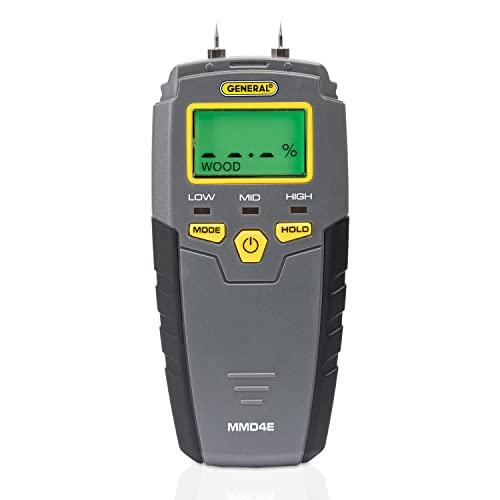
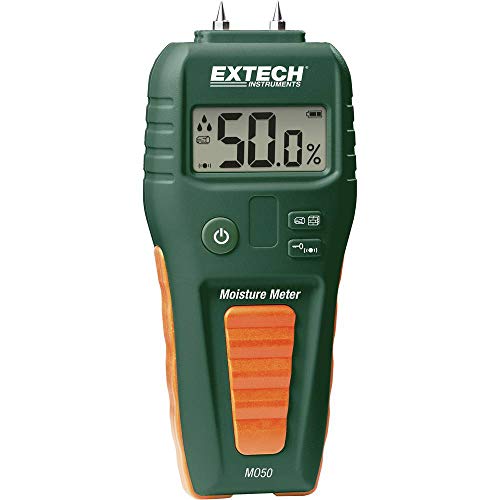

Products shown because their documented specifications fit this guide. Price and availability are on Amazon and can change.
Frequently Asked Questions
What moisture content should firewood be?
Under 20 percent, ideally 15 percent or less. Split a log and read the freshly exposed face; the outside of an unsplit log reads much drier than the core.
What moisture content should flooring be at installation?
Typically 6 to 9 percent in a heated home, and within about 2 percent of the subfloor. Acclimatize the flooring on site until readings stabilize.
Why do I get different readings on the same board?
Wood moisture varies with position, and readings across the grain differ from along it. Take several readings along the grain and average them.
Affiliate disclosure: Akermin earns a commission from qualifying Amazon purchases made through links on this page. Our editorial picks are based on documented specifications and owner feedback, not commissions.
Related Guides

PHOEBUS LINK RCX100 Review: 40 mK Is the Figure This Job Needs
A handheld thermal camera with a 160 by 120 infrared detector, a 320 by 240 enhanced image, 40 mK sensitivity, a focus free 40 by 30 degree field of view, a 25 Hz refresh rate and still JPG image capture.
Read More→
Fluke 62 MAX+ Review: The Cold End Is Printed Three Different Ways
A non contact infrared thermometer for electrical, mechanical, HVAC and automotive surfaces, with dual rotating lasers that mark the edges of the measurement area, minimum, maximum, difference and average readings, and an IP54 rating.
Read More→
General Tools MMD7NP Review: Percent on Wood, Relative on Drywall
A pinless non invasive moisture meter that reads up to three quarters of an inch into a surface, with scales of 0 to 53 percent for softwood, 0 to 35 percent for hardwood and relative readings on wallboard, drywall and masonry.
Read More→