As an Amazon Associate, Akermin earns from qualifying purchases. Product links on this page are affiliate links.

Extech · Extech SL510 Sound Level Meter, 35-130 dB, Class 2 | Sound 35-130 dB, +/-1dB Class 2 (IEC 61672), A/C weighting, fast/slow response, data hold, MIN/MAX, backlit
View on AmazonPrice and availability are shown on Amazon and can change at any time.
Verdict
The SL510 is a simple, competent sound level meter. The listing documents a 35 to 130 dB range, ±1 dB accuracy meeting Class 2, A and C weighting, fast and slow response, a backlit LCD, data hold and min/max. That is the full feature set of a general-purpose meter in a compact body, and it is enough for checking a plant room, a classroom, a machine shop or a neighbour’s complaint against a threshold. It does not include a calibrator, so readings are indications unless you buy one separately, and it does not log to a PC. For spot checks and screening, it is the meter to carry; for reported surveys, the 407732-KIT with its calibrator is the better purchase.
Who It Is For
- Facilities and maintenance staff checking plant and ventilation noise.
- Teachers, estates officers and office managers screening rooms.
- HVAC technicians verifying that a new unit meets a noise specification.
Documented Specifications
| Item | Documentation |
|---|---|
| Range | 35 to 130 dB |
| Accuracy | ±1 dB, meets Class 2 |
| Weighting | A and C |
| Response | Fast and slow |
| Display | Backlit LCD |
| Functions | Data hold, min/max |
What Class 2 and ±1 dB Mean
Sound level meter classes are defined by international standards. Class 1 is the precision class, with tighter tolerances across frequency and temperature, used for legal and laboratory work. Class 2 allows wider tolerances and is accepted for general workplace and environmental screening. The listing’s ±1 dB figure is the stated accuracy at the reference condition; over the full frequency range the Class 2 tolerance is wider, which is normal. In practical terms, a Class 2 meter distinguishes a room at 78 dB from one at 82 dB with confidence, and that is what most decisions require. Our guide to choosing a sound level meter explains when Class 1 is required.
Using the Weightings and Responses
A-weighting is the default for occupational and general noise because it mimics the ear’s reduced sensitivity to low and very high frequencies. C-weighting is closer to flat and is used for peak levels and for judging low-frequency plant noise that A-weighting under-reports. Fast response follows changing sound and is used for impulsive sources; slow response averages for a steadier reading of continuous noise. The SL510’s min/max recall captures the extremes over a period, which is useful for a machine cycle or a lesson. Data hold freezes the display when the meter has to be held away from the eye.
Display and Handling
The backlit LCD is the practical differentiator from older meters: plant rooms and ceiling voids are dark, and a reading that cannot be seen is no reading. The compact body fits a shirt pocket and can be held at arm’s length to keep the operator’s body out of the sound field, which is the correct technique. Owners describe the meter as fast to switch on and read, which encourages using it often. A windscreen over the microphone is worth using outdoors and near ventilation outlets, because air movement across a bare microphone registers as low-frequency noise and inflates the reading. Readings should be taken with the meter pointed at the source, at ear height for occupational checks, and away from reflecting walls where practical; those three habits remove most of the variation between two people measuring the same room.
Calibration
Without a calibrator the SL510’s readings cannot be verified on site. For screening that is acceptable; for a report it is not. A separate calibrator can be bought, or the 407732-KIT chosen instead. Any meter used for records should also be sent for periodic calibration; see how to read a calibration certificate.
Strengths
- Class 2 accuracy in a compact body.
- Full set of weightings and responses.
- Backlit display for dark spaces.
Limitations
- No calibrator included.
- No datalogging or PC interface.
- Class 2, not Class 1.
How It Compares
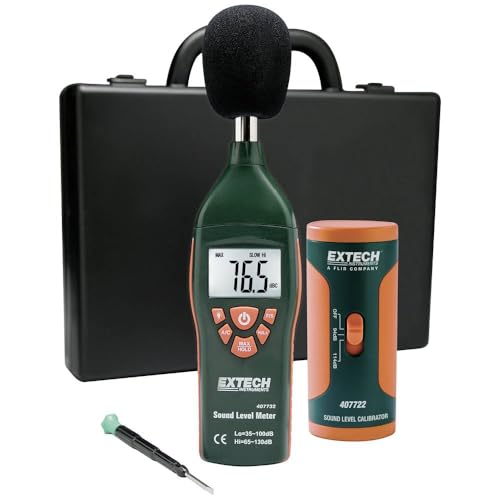
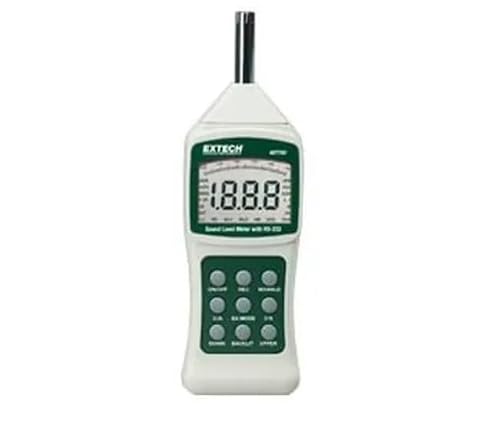
The Extech 407732-KIT covers the same range and adds a calibrator. The Extech 407750 adds an RS-232 PC interface for logging. The Extech EN300 includes a basic sound reading among five measurements. The SL510 is the choice for a dedicated, pocketable meter for spot checks.
How We Research
This review is based on Extech’s published specifications, the Amazon listing and owner reports. We did not run laboratory tests.
Recommended Tools

Products shown because their documented specifications fit this guide. Price and availability are on Amazon and can change.
Frequently Asked Questions
Is the SL510 a Class 2 meter?
The listing states that its ±1 dB accuracy meets Class 2 standards. Class 2 is the general-purpose class used for most screening and occupational checks.
Does it come with a calibrator?
No. For a kit with a calibrator, see the Extech 407732-KIT.
When should I use C weighting?
For peak measurements and for low-frequency noise from plant, fans and bass. A weighting is used for nearly all general and occupational limits.
Can it log readings?
It has data hold and min/max recall, not datalogging. The Extech 407750 offers a PC interface.
Affiliate disclosure: Akermin earns a commission from qualifying Amazon purchases made through links on this page. Our editorial picks are based on documented specifications and owner feedback, not commissions.