As an Amazon Associate, Akermin earns from qualifying purchases. Product links on this page are affiliate links.
Choose a sound level meter by the use. For anything compared with a limit, a specification or another person’s measurement, buy a meter that states IEC 61672 Class 2 (or Class 1 for environmental and legal work) and an acoustic calibrator to go with it. Require A and C weighting, fast and slow response, and Leq integration for exposure and planning measurements. Add data logging and PC output for reports, a windscreen for outdoor use and a tripod mount. For a rough idea of loudness, an unclassified consumer meter is fine and a phone app is nearly as good.
Step 1: Class
| Class | Tolerance at 1 kHz | Use | Typical examples |
|---|---|---|---|
| Class 1 | ±1.1 dB, 16 Hz to 16 kHz | Environmental noise, legal evidence, research, acoustic consultancy | Brüel & Kjær, NTi, Svantek, Cirrus Class 1 |
| Class 2 | ±1.4 dB, 20 Hz to 8 kHz | Workplace noise surveys, equipment checks, general complaints | Extech SL510, 407732-KIT, Reed, Cirrus Class 2 |
| Unclassified | Not tested to the standard | Rough loudness checks, home theater setup, hobby | TopTes TS-501B, many consumer meters |
See what a sound level meter is.
Step 2: Functions
- Weighting: A for almost everything; C for peaks and low-frequency noise; Z for analysis. See what dBA means.
- Time response: fast (125 ms) and slow (1 s), selectable.
- Integration: Leq over a set period; Lmax and Lmin; percentiles (L10, L90) for environmental work; peak (LCpeak) for impulsive noise.
- Range: 30 to 130 dB covers most uses; a single wide range avoids range switching errors.
- Resolution: 0.1 dB.
- Frequency analysis: octave or third-octave bands on higher-end meters, for diagnosing sources.
Step 3: Calibration
An acoustic calibrator produces a reference tone (94 dB or 114 dB at 1 kHz) that fits over the microphone. Check before and after each session; a change of more than 0.5 dB invalidates the session. Meters that accept a calibrator have a standard 1/2-inch or 1/4-inch microphone. Some Class 2 meters are sold as a kit with the calibrator (Extech 407732-KIT). Periodic laboratory calibration of both meter and calibrator is required by measurement standards for professional use.
Step 4: Logging and output
Internal logging of Leq and levels over time, and USB or Bluetooth output to a computer or app, turn a measurement into a report. For workplace surveys and long environmental measurements this is essential; for a one-off check, the display suffices.
Step 5: Accessories
- Windscreen (foam ball) for any outdoor or fan-adjacent measurement.
- Tripod with the meter’s 1/4-inch thread, to keep the operator’s body away from the microphone.
- Extension cable for the microphone on higher-end units.
- A case; microphones are fragile.
Recommendations by use
| Use | Choose |
|---|---|
| Checking a noisy appliance or neighbor for your own information | Unclassified meter or app |
| Home theater and studio level setting | Unclassified meter with C weighting and slow response |
| Workplace noise survey, equipment specification check | Class 2 with Leq and a calibrator |
| Noise complaint to a council or landlord | Class 2 minimum with logging; Class 1 if it may go further |
| Environmental assessment, planning, legal | Class 1 with logging, percentiles and octave bands; professional calibration |
Sound meters are covered in the environmental monitoring category alongside multifunction meters; see how to choose an environmental meter.
Recommended Tools


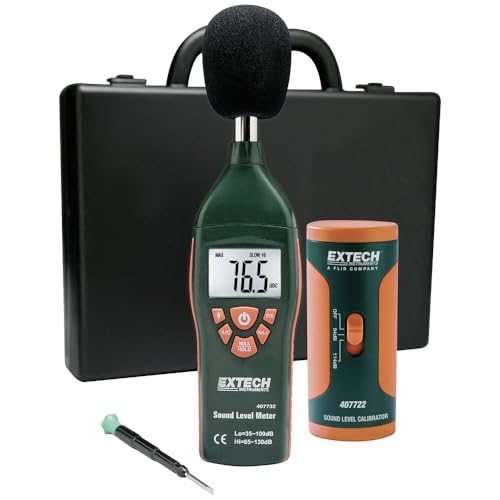
Products shown because their documented specifications fit this guide. Price and availability are on Amazon and can change.
Frequently Asked Questions
Do I need a Class 2 sound level meter?
For workplace noise assessments, equipment checks against a specification, and most complaints, yes. For a rough idea of how loud something is, an unclassified meter or even an app is enough.
What is Leq and do I need it?
Equivalent continuous level: the constant level with the same energy as the fluctuating sound over a period. Any measurement against an exposure limit or a planning condition needs it.
Do I need a calibrator?
For any measurement you will report or rely on, yes. A 94 dB or 114 dB acoustic calibrator confirms the meter before and after each session and is required by measurement standards.
Affiliate disclosure: Akermin earns a commission from qualifying Amazon purchases made through links on this page. Our editorial picks are based on documented specifications and owner feedback, not commissions.
Related Guides

CPS LS790B Leak-Seeker Review: Non Combustible Is the Deciding Word
An ion pump refrigerant leak detector individually calibrated to find a leak rate better than a quarter of an ounce per year, with ten selectable sensitivity ranges, a water vapour filter and a bar graph plus tone display.
Read More→
BW Clip BWC2-H Review: Alarm Points Set Before the Clock Starts
A single gas hydrogen sulfide detector with one button operation, hibernation mode, automatic logging of the 35 most recent gas events and bump test results, and compatibility with IntelliDoX and MicroDock II docking.
Read More→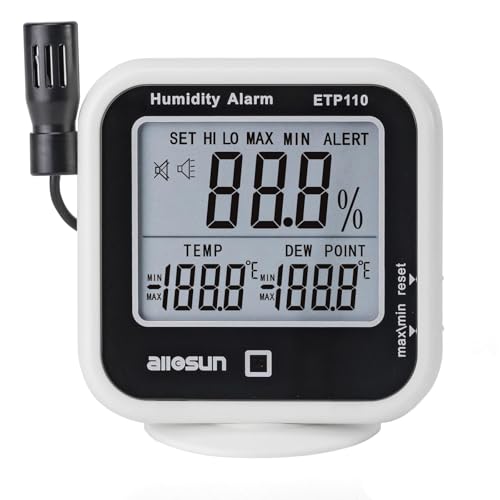
ALLOSUN Thermometer Hygrometer Review: Half a Metre of Lead and No Tolerance
A battery powered thermometer and hygrometer showing temperature, relative humidity and dew point, with a settable humidity alarm, a sensor on a lead of about 50 cm, maximum and minimum memory and a large LCD.
Read More→