As an Amazon Associate, Akermin earns from qualifying purchases. Product links on this page are affiliate links.
Short answer: the C8 captures 320 by 240 and the TG268 upscales to it from 160 by 120, according to the listings themselves. For measuring small targets the C8 is the stronger tool. The TG268 earns its place as a spot thermometer with an image attached, helped by a laser that shows the measurement area.
What Each Listing States
| Item | TG268 | C8 |
|---|---|---|
| Image resolution | 320 x 240, upscaled from 160 x 120 by Vivid IR | 320 x 240 true thermal (76,800 pixels) |
| Visual camera | 640 x 480, stated as enabling MSX | Stated, resolution not given in the bullets |
| Laser | Bullseye laser indicating the measurement area | Not stated in the bullets |
| Field of view | Not stated in the bullets | 35 degrees horizontal |
| MSX | Yes | Yes |
What Upscaling Does and Does Not Do
Upscaling takes the samples a detector actually captured and interpolates between them to produce a larger image. It genuinely helps with presentation: edges look less blocky, gradients look smoother and a screenshot survives being enlarged in a report without looking like a mosaic. What it cannot do is invent a measurement. If a warm terminal and the cool bar beside it landed on the same detector pixel, that pixel holds one averaged value, and no amount of interpolation separates them afterwards. The FLIR listings are refreshingly clear about this, which makes the comparison easy to make honestly.
They Are Not Really the Same Kind of Tool
The TG268 belongs to the spot thermometer family with imaging added. You point it, the bullseye laser shows how large the measured area is, and you read a number with a picture for context. That is a fast, practical workflow for checking a run of registers, a row of bearings or a set of breakers where you mostly want numbers and a record of where they came from. The C8 belongs to the inspection camera family: you frame a scene, look for anomalies and then measure what you found. One starts with a number, the other starts with an image.
The laser deserves particular credit. A spot thermometer without one leaves you guessing how wide the measurement spot is at your working distance, which is the single biggest source of wrong readings with these instruments. A visible indication of the measured area removes that guesswork. The general principle is covered in thermal camera versus infrared thermometer.
How to Choose Between Them
If your work is a list of points to be checked and logged, the TG268 approach is faster. If your work is finding something you did not already know was there, the C8 approach finds it, and the extra captured resolution means that what you find is measured rather than smeared. Neither listing publishes thermal sensitivity or accuracy in the bullets, so read the current datasheets if those numbers carry weight in your decision.
Who Buys Which
- HVAC technician checking supply and return temperatures: TG268, for the laser-defined spot and the speed.
- Electrician surveying a panel: C8, for captured resolution on small targets.
- Home inspector: C8, because the job is finding anomalies rather than confirming known points.
- Buyer who wants both behaviours: a camera plus a separate infrared thermometer is often cheaper than one device that does both adequately.
How We Research
All figures are quoted from the manufacturer listings, including the upscaling language, which is stated by FLIR rather than inferred by us. We did not run laboratory tests. The full ranking is in the thermal imaging camera roundup.
Recommended Tools
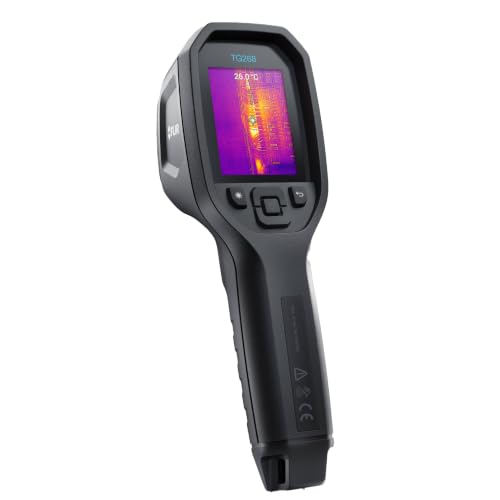


Products shown because their documented specifications fit this guide. Price and availability are on Amazon and can change.
Frequently Asked Questions
Is the TG268 really 320 by 240?
The image is. The listing states that Vivid IR upscales the image to 320 by 240 from 160 by 120, so the detector behind it captures 19,200 samples and the software presents 76,800 pixels. The C8 listing states 320 by 240 as true thermal imaging, described as 76,800 pixels.
Does upscaling make the image useless?
No. Upscaling smooths the image and can make a gradient easier to read on screen. What it cannot do is recover a small target that fell inside one detector pixel, because that information was never captured.
What is the bullseye laser for?
The TG268 listing states a laser pointer that indicates the size of the measurement area. That is genuinely useful with a spot thermometer function, because it shows you what the measurement is averaging rather than leaving you to guess.
Which is better for electrical work?
The C8, on the published detector figures, because small connections at a distance are exactly the case where captured resolution matters and upscaling does not help.
Affiliate disclosure: Akermin earns a commission from qualifying Amazon purchases made through links on this page. Our editorial picks are based on documented specifications and owner feedback, not commissions.