As an Amazon Associate, Akermin earns from qualifying purchases. Product links on this page are affiliate links.
Short answer: the 902 FC is the specialist for combustion heating, with a stated 200 microamp DC range for flame rods and a 60 kilohm resistance range for thermistors. The EX623A is the broader instrument, adding DC current through the jaw, two thermocouple inputs, an infrared spot and LoZ.
What Each Listing States
| Item | Fluke 902 FC | Extech EX623A |
|---|---|---|
| Current | True RMS clamp, AC stated | 600 A AC and DC |
| Microamp DC | 200 microamps for flame rod | DC microamp function for flame rod |
| Resistance | Extended to 60 kilohms for thermistors | Not stated in the bullets |
| Temperature | Flue gas temperature capture stated | Dual type K inputs plus built-in infrared thermometer |
| Ghost voltage | Not stated in the bullets | LoZ to prevent false readings |
| Non-contact voltage | Not stated in the bullets | NCV stated |
The Flame Rod Measurement Is Why These Meters Exist
A gas furnace proves its flame with a flame rod, and the current it produces is measured in microamps. A standard multimeter cannot resolve it, so technicians without the right meter end up replacing parts on suspicion. Both of these meters state a microamp DC function for exactly this, and that single capability separates an HVAC clamp from a general electrical one.
The Fluke adds a second furnace-specific range: resistance to 60 kilohms for thermistors. Most meters stop at 4 or 6 kilohms, which is not enough to read a thermistor at room temperature. Without it, you are guessing whether a sensor has drifted.
Two Temperature Inputs Change the Workflow
The EX623A states two type K inputs. That is the difference between measuring supply air, writing it down, moving the probe, measuring return air and subtracting, and simply reading the split off the screen. On a service call where you are adjusting and re-measuring, the two-probe approach is faster and less error prone, and it captures both temperatures at the same instant, which matters on a system that is cycling.
The built-in infrared thermometer complements that with a fast non-contact check of a compressor body, a duct or a breaker. It is a spot check rather than an image, and it reads low on shiny metal, so treat it as a screening tool.
LoZ Is Not an HVAC Feature but It Solves a Real Problem
Long cable runs sitting alongside energised conductors pick up induced voltage, and a high impedance meter dutifully reports it. That ghost voltage sends technicians looking for faults that do not exist. A low impedance mode loads the circuit slightly and collapses the induced voltage, so a real supply reads and a phantom one does not. The EX623A states LoZ; if you have ever chased a reading that vanished when you connected a load, you know why it matters.
DC Current Through the Jaw
The EX623A is described as an AC and DC clamp to 600 A. The 902 FC bullets do not state DC current through the jaw. For heat pumps with variable speed DC motors, inverter-driven equipment and any system with DC control circuits, that capability is increasingly relevant, and it is worth confirming on the current datasheet before choosing.
Who Buys Which
- Gas furnace and combustion heating service: 902 FC, for the thermistor range alongside flame rod current.
- General HVAC including heat pumps and inverter equipment: EX623A, for DC current and the two temperature inputs.
- Anyone who measures temperature differentials constantly: EX623A.
- Electrical work with occasional HVAC: a general clamp such as the Fluke 325.
How We Research
All figures are quoted from the manufacturer listings. We did not run laboratory tests and publish no measurements of our own. Ranking in the clamp meter roundup.
Recommended Tools

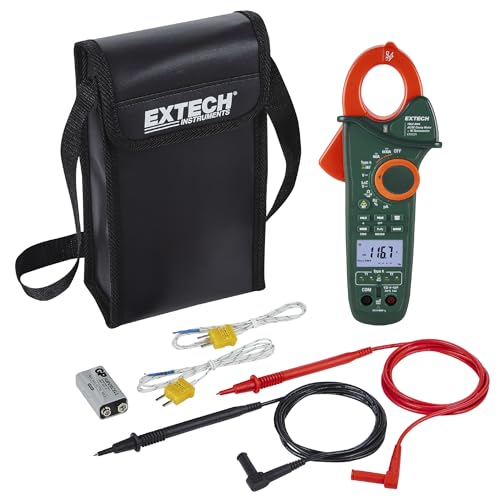

Products shown because their documented specifications fit this guide. Price and availability are on Amazon and can change.
Frequently Asked Questions
Which measures flame rod current?
Both address it. The Fluke 902 FC listing states 200 microamp DC current measurement to measure flame rod. The Extech EX623A listing states a DC microamp function intended for HVAC flame rod current.
What is the 60 kilohm resistance range for?
Thermistors. The 902 FC listing states an extended resistance range to measure thermistors up to 60 kilohms, which ordinary meters topping out at 4 or 6 kilohms cannot read.
Why two type K inputs?
To read two temperatures at once and show the difference directly. Supply and return air, or the two sides of a coil, is the measurement most HVAC diagnostics are built on.
Does the Fluke measure DC current through the jaw?
The 902 FC bullets do not state DC current through the jaw. The EX623A is described as a 600 A AC and DC clamp, so it does.
Affiliate disclosure: Akermin earns a commission from qualifying Amazon purchases made through links on this page. Our editorial picks are based on documented specifications and owner feedback, not commissions.
Related Guides

Klein Tools CL900 Clamp Meter Review: What the Listing Leaves Out
A specification-by-specification review of the Klein Tools CL900 that flags every gap in the published listing.
Read More→
Southwire GFCI Receptacle Tester Review: One Button, Seven Checks, and the Cost of Getting It Wrong
The Southwire GFCI receptacle tester is a compact seven-mode wiring checker whose real cost is in the button, the leads and the reference it does not ship with.
Read More→
ALLOSUN EM3082 Pocket Multimeter Review: What the Listing Leaves Out
A specification-led review of the ALLOSUN EM3082 that separates what the listing states from what it omits, and explains the practical consequences of each gap.
Read More→