As an Amazon Associate, Akermin earns from qualifying purchases. Product links on this page are affiliate links.

FORENSICS DETECTORS FD · 4 Gas Meter for Confined Space | USA NIST Calibration | O2, CO, H2S, LEL
View on AmazonPrice and availability are shown on Amazon and can change at any time.
Verdict
The Forensics Detectors four gas meter is aimed at people whose gas monitoring has to stand up to scrutiny. The listing states sensors for oxygen, carbon monoxide, hydrogen sulfide and combustibles measured as LEL, USA NIST calibration with the unit supplied factory calibrated, zero and span calibration options, and adjustable audio, visual and vibration alarms at preset levels. Traceable calibration and user span adjustment are the features that separate a professional instrument from a device that simply beeps.
Documented Specifications
| Item | Manufacturer listing |
|---|---|
| Gases | Oxygen, carbon monoxide, hydrogen sulfide, combustibles as LEL |
| Calibration | USA NIST calibration, supplied factory calibrated |
| User calibration | Zero and span options |
| Alarms | Adjustable audio, visual and vibration at preset levels |
| Sensors | Described as nano sensors for fidelity and resolution |
The listing does not publish measurement ranges, accuracy, battery life or sensor life in its bullets. Battery life in particular is worth confirming if the monitor must cover a full shift.
Why Traceability Is the Headline
A gas monitor exists because your senses cannot detect the hazard. That means you are trusting the instrument absolutely, and the only basis for that trust is calibration against a known standard. Traceability to a national metrology institute means the chain from your instrument back to a defined reference is documented rather than assumed.
For a hobbyist this is abstract. For anyone whose work is inspected, whose entry permits are audited, or whose insurer asks questions after an incident, it is the difference between a defensible position and an awkward conversation.
Zero and Span, and Why Both
Zeroing establishes the baseline: what the instrument reads in clean air. Span calibration establishes the slope: what it reads in a known concentration. A monitor that has only been zeroed will read zero correctly and may under-report everything above it, which is exactly the failure that gets people hurt.
Being able to perform both yourself means the instrument can be maintained on your schedule rather than sent away. It also means you need calibration gas, a regulator and a flow arrangement, which is a real cost to budget alongside the monitor. Any organisation buying gas detection should plan for this from the start.
Adjustable Alarms Reflect Real Sites
Default alarm levels are based on widely used occupational exposure guidance, and many sites have their own action levels that are stricter or that reflect a specific hazard. A monitor with adjustable thresholds can be set to match the site procedure rather than forcing the procedure to match the tool. Document any change, and make sure everyone using the monitor knows what it is set to.
The Routine That Keeps It Honest
- Fresh air zero at the start of every shift, in air you are sure about.
- Bump test with known gas before entry, confirming every sensor responds and every alarm channel works.
- Full span calibration at the stated interval, with a record kept.
- Replace sensors at end of life rather than waiting for them to fail a bump test.
- Never zero the instrument inside the space you are about to enter.
Strengths
- NIST traceable calibration stated.
- User zero and span calibration.
- Adjustable alarm levels across audio, visual and vibration.
- Standard confined space gas set.
Limitations
- No ranges, accuracy, battery life or sensor life published.
- Calibration gas and regulator are additional costs.
- No data logging stated, unlike some competitors.
- More expensive than consumer four gas units.
How It Compares
The TopTes Guard-101 states a 14 hour battery and alarm record storage at lower cost, without a traceable calibration claim. The head to head is at Guard-101 versus the Forensics meter. Our ranking is in the four gas detector roundup.
How We Research
All figures come from the manufacturer listing. We did not run laboratory tests and publish no measurements of our own. Nothing here replaces your employer’s confined space procedures.
Recommended Tools
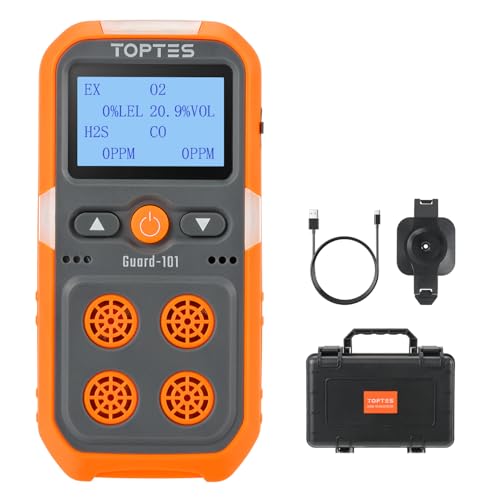

Products shown because their documented specifications fit this guide. Price and availability are on Amazon and can change.
Frequently Asked Questions
What does NIST calibration mean?
It means the calibration is traceable to standards maintained by the National Institute of Standards and Technology. For regulated or audited work, traceability is often part of the requirement rather than a bonus.
Can I calibrate it myself?
The listing states zero and span calibration options. Zero sets the baseline in clean air, span adjusts the reading against a known gas concentration. Both are needed to keep a monitor trustworthy between services.
Are the alarm levels adjustable?
Yes. The listing states adjustable audio, visual and vibration alarms at preset levels, which matters when a site has its own action levels rather than the defaults.
Does it arrive ready to use?
The listing states it comes factory calibrated. Still perform a fresh air zero and a bump test before relying on it, as with any gas instrument.
Affiliate disclosure: Akermin earns a commission from qualifying Amazon purchases made through links on this page. Our editorial picks are based on documented specifications and owner feedback, not commissions.