As an Amazon Associate, Akermin earns from qualifying purchases. Product links on this page are affiliate links.

Generic · Air Particle Meter for Air Quality Testing, 6-Channel Particle Counter
View on AmazonPrice and availability are shown on Amazon and can change at any time.
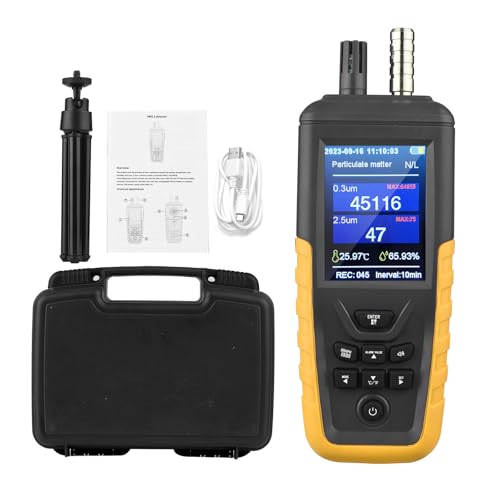
A handheld laser particle counter with an active pump drawing 2.83 litres per minute, six size channels at 0.3, 0.5, 1.0, 3.0, 5.0 and 10 micrometres, independent alarm thresholds on every channel, saved measurement records, ambient temperature and humidity, single and continuous sampling, a 2.8 inch colour display and a rechargeable battery. The published flow rate is what makes its numbers comparable rather than indicative. The absence of any calibration standard is what keeps it out of certification work.
A tenth of a cubic foot a minute is why the counts compare
The second bullet states that a built in pump draws air at 2.83 litres per minute, or 0.1 cubic feet per minute. Two separate things are being claimed there, and both are worth more than they look.
The first is that there is a pump at all. Many air quality monitors rely on a small fan or on air drifting through a chamber, which means the volume of air examined in a given time is unknown and varies with room draughts. A pump pulls a defined sample past the laser, so repeat readings taken at the same spot describe the same amount of air.
The second is the specific figure. 0.1 cubic feet per minute is the conventional sampling rate in cleanroom practice, chosen because the arithmetic falls out cleanly: one minute of sampling gives exactly a tenth of a cubic foot, ten minutes gives exactly one cubic foot. Counts taken at this rate can be set beside counts from other instruments and beside published limits without conversion.
That the figure appears in the bullets at all is the most useful editorial decision on this page. A count without a volume is not a measurement, and a surprising number of listings in the wider category never state one. Our comparison of handheld particle counters treats a published flow rate as the first filter.
Six channels, and the smallest one sets the floor
The channels are 0.3, 0.5, 1.0, 3.0, 5.0 and 10 micrometres. Six bands is generous for a handheld instrument and it is what makes the device diagnostic rather than merely alarming, because the size distribution tells you something about the source.
Coarse counts dominating the upper channels point at mechanical processes: cutting, sanding, sweeping, fabric and skin. A spike concentrated in the smallest channels points at combustion or at something that condensed out of a vapour. Watching which channel moves is how you work out what changed in a room.
The limitation sits at the bottom of the list. 0.3 micrometres is the smallest particle this instrument can see, and indoor air is full of smaller ones. Cooking, candles, flames and engine exhaust all generate particles below that threshold in very large numbers. Those are not reported, so a reading that falls after ventilation has told you about the counted fraction only.
This is inherent to optical counting rather than a flaw in this unit. Scattering from a particle falls away steeply as it gets smaller than the wavelength of the light being used, so every laser instrument has a size below which a particle produces too little signal to register. State it plainly to yourself before relying on a clean reading. The detail behind the physics is in our note on comparing laser particle sensors.
Without a calibration standard it is a comparison instrument
Here is what the five bullets do not contain: a counting efficiency figure, a coincidence loss limit, a flow rate tolerance, an accuracy specification of any kind, the name of a calibration standard, or any mention of a calibration certificate.
Those omissions all point at the same boundary. Classification and certification work, the kind that produces a document saying a room meets a defined cleanliness class, requires an instrument calibrated against the recognised standard for light scattering airborne particle counters and accompanied by a certificate with a date on it. Nothing here supports that, and the instrument should not be bought to do it.
What survives that restriction is most of the useful work. Comparison does not need absolute accuracy, because a consistent instrument subtracts its own bias when you use it twice:
- Counts at a supply diffuser against counts in the return, which is how a leaking or bypassed filter shows itself.
- Counts before and after a cleaning routine, which turns cleaning from a ritual into something measurable.
- Counts at a bench while a process runs, against the same bench idle, which localises a source.
- Counts at the same point weekly, which catches a filter approaching the end of its service life.
That is a genuinely capable brief, and it is where this instrument belongs. Our page on counters for filter testing covers that workflow in more detail.
Per channel thresholds are the feature to set up first
The third bullet states that independent alarm thresholds can be configured for all six channels. On an instrument that already displays six numbers, this is the feature that changes how you work.
The reason is attention. Walking a room while reading six columns off a 2.8 inch screen is awkward and you will miss the moment something changes. Setting a threshold on the one channel that matters for the job turns the instrument into something that notices on your behalf, which is what frees you to move the probe methodically instead of staring at it.
Which channel you choose depends on the question. A filter investigation lives in the smallest channels, since that is where a bypass shows first. A dust or swarf problem lives in the upper ones. Setting all six at once mostly produces an instrument that beeps constantly.
Alongside the alarms, the same bullet promises saved measurement records for later review. Note carefully what is and is not claimed: storage is stated, and a Type C interface is mentioned in the last bullet, but nothing says measurements can be transferred to a computer. Records you can read on the device are a different proposition from records you can send to someone, and the page does not promise the second.
Pump, display, battery and the unnamed manufacturer
| Specification | Published in the listing |
|---|---|
| Size channels | Six: 0.3, 0.5, 1.0, 3.0, 5.0, 10 micrometres |
| Sampling | Built in pump, 2.83 litres per minute, stated as 0.1 CFM |
| Detection principle | Laser scattering |
| Alarms | Independent thresholds on all six channels |
| Storage | Measurement records saved for later review |
| Other sensors | Ambient temperature and relative humidity |
| Sampling modes | Single and continuous, adjustable automatic shutdown |
| Display | 2.8 inch colour, with rear stand |
| Power and interface | Rechargeable 2000 mAh battery, Type C interface |
| Languages | Chinese, English, Russian, Japanese |
| Counting efficiency and accuracy | Not stated in the listing bullets |
| Calibration standard or certificate | Not stated in the listing bullets |
| Flow rate tolerance | Not stated in the listing bullets |
| Whether channels are cumulative or differential | Not stated in the listing bullets |
| Record capacity and data export route | Not stated in the listing bullets |
| Temperature and humidity accuracy | Not stated in the listing bullets |
| Battery runtime and pump service life | Not stated in the listing bullets |
| Manufacturer | Not stated in the listing bullets |
The last row deserves more attention than it usually gets. A pump driven counter is a maintained instrument: pumps wear, flow rates drift, and the only way to keep counts trustworthy over years is periodic recalibration. A product with no named manufacturer has no documented route to any of that, which turns a repairable instrument into a disposable one.
The hardware choices around the measurement are sensible otherwise. A rear stand matters more than it sounds, because continuous sampling means leaving the instrument standing somewhere pointing at the air rather than holding it. Adjustable automatic shutdown is the right companion to that, since the default timeouts on handhelds are the usual reason a long sample ends early.
Right for filter checks and cleaning verification
Buy this if you want to measure whether something you did worked. Filter changes, duct cleaning, extraction improvements, a sanding enclosure, a workshop ventilation change: all of those are before and after questions, all are answered by counts at a defined flow rate, and none requires a calibration certificate. Six channels and per channel alarms make it a better diagnostic tool than a single number monitor, and the published flow rate makes the numbers mean something.
Do not buy it to classify a cleanroom, to satisfy an auditor, or to produce a figure anyone else will sign. No calibration standard is named, no accuracy is published and no manufacturer is identified, which together rule out any use where the number has to be defensible. Nor should anyone buy it expecting a complete picture of indoor particulate: the smallest channel stops at 0.3 micrometres, and a great deal of what you breathe is smaller than that.
Recommended Tools


Products shown because their documented specifications fit this guide. Price and availability are on Amazon and can change.
Frequently Asked Questions
Why does the sampling flow rate matter so much?
Because a particle count is meaningless without a volume attached to it. Saying there were four hundred particles is like saying there were four hundred raindrops; the question is always how much air they were in. The pump here draws 2.83 litres per minute, which is 0.1 cubic feet per minute, the conventional cleanroom rate. A one minute sample is then exactly a tenth of a cubic foot, and ten minutes is exactly one cubic foot, which is why results from instruments at this flow rate can be compared with each other and with published limits.
Can I use it to certify a cleanroom?
No. Classification work requires an instrument calibrated to the recognised standard for light scattering airborne particle counters, with a current certificate, and the listing names no standard and mentions no certificate. What this instrument can legitimately do is compare, which covers a great deal of real work: before and after a filter change, one end of a room against the other, a bench during a process against the same bench idle.
What does the 0.3 micrometre channel not see?
Everything smaller, which indoors is a large population. Combustion, candles, cooking oil smoke and vehicle exhaust produce enormous numbers of particles below 0.3 micrometres, and the smallest of those penetrate deepest into the lungs. A falling count on this instrument after you ventilate a kitchen tells you the counted sizes have fallen. It says nothing about the uncounted fraction, which is the single most important thing to understand about any optical counter.
Are the six channels cumulative or differential?
The listing does not say, and it changes how you read the screen. A cumulative channel reports every particle at or above that size, so the 0.3 channel includes everything the other five see. A differential channel reports only particles between that size and the next, so the six numbers add up to the total. Mistaking one convention for the other makes the figures look wrong by a large factor, and the manual should be the first thing you check.
Is this the same thing as a PM2.5 reading in micrograms?
No, and the difference is easy to miss. This instrument reports how many particles it counted in each size band. A monitor quoting PM2.5 in micrograms per cubic metre reports an estimated mass. Converting counts to mass requires assumptions about particle density and shape that no handheld instrument can verify, so the two figures are related but not interchangeable, and a count is the more direct measurement of the two.
Affiliate disclosure: Akermin earns a commission from qualifying Amazon purchases made through links on this page. Our editorial picks are based on documented specifications and owner feedback, not commissions.