As an Amazon Associate, Akermin earns from qualifying purchases. Product links on this page are affiliate links.
Compare laser particle sensors on five specifications from the module datasheet: whether sampling is fan-driven (essential) or passive; the smallest particle counted (typically 0.3 µm) and the number of size bins; the stated accuracy and the reference it was tested against; humidity handling (a built-in or paired RH sensor and a correction); and rated lifetime with a cleaning or fan-purge function. Monitors rarely publish these, but they usually name or can be traced to a module (Plantower PMS5003/7003, Sensirion SPS30, Cubic PM2005/PM2012, Honeywell HPMA115), whose datasheet does.
How the sensor works
A fan draws air through a channel where a laser beam crosses it. Each particle scatters a flash of light onto a photodiode; the pulse height indicates size. Counts per size bin are converted to mass concentration using an assumed particle density and shape. See why particle sensors disagree for the assumptions involved.
Specification 1: Sampling
Fan-driven sensors sample a known flow and respond within seconds. Passive sensors (no fan; some use a heater to induce convection) respond slowly and inconsistently. Any monitor without an audible or specified fan is suspect for PM2.5 work.
Specification 2: Size range and bins
| Module | Lower limit | Bins reported | Outputs |
|---|---|---|---|
| Plantower PMS5003 | 0.3 µm | 6 (0.3, 0.5, 1, 2.5, 5, 10 µm) | PM1, PM2.5, PM10; particle counts |
| Sensirion SPS30 | 0.3 µm | 4 size classes | PM1, PM2.5, PM4, PM10; number concentrations; typical size |
| Cubic PM2012 / PM2005 | 0.3 µm | Several | PM1, PM2.5, PM10 |
| Honeywell HPMA115 | 0.3 µm | Fewer | PM2.5, PM10 |
| Sharp GP2Y (infrared, passive) | About 0.5 µm, poorly resolved | None | A dust density estimate; not suitable for PM2.5 monitoring |
More bins allow better source diagnosis; see how to compare PM1, PM2.5 and PM10 readings.
Specification 3: Accuracy claims
Datasheets state something like ±10 µg/m³ at 0 to 100 µg/m³ and ±10 percent above, usually against a specified reference aerosol under laboratory conditions. Independent evaluations (South Coast AQMD’s AQ-SPEC program and academic studies) test modules against regulatory instruments and are more informative than the datasheet; SPS30 and PMS5003 consistently rank well.
Specification 4: Humidity
Particles absorb water above about 70 percent RH and scatter more light. Modules with an integrated or paired humidity sensor allow the monitor firmware to correct; some do it internally. A monitor that reports RH alongside PM is more likely to correct than one that does not. See can a humidifier affect particle readings.
Specification 5: Lifetime and cleaning
Rated life is typically 8 years of continuous operation or 8,000 to 10,000 hours of laser time; sensors that sleep between samples last longer. Dust accumulates on the optics and fan; the SPS30 has a fan-cleaning mode that spins up periodically. Monitors that expose a cleaning function or duty-cycle the sensor keep accuracy longer. A sensor that reads persistently low compared with a new one is aging.
Tracing a monitor to its module
- The listing or manual may name the module.
- Teardown reports and review sites often identify it.
- The outputs give a clue: PM4 means SPS30; six size bins means Plantower.
- Price sets a floor; a genuine laser module with a fan is not free.
Which monitors use good modules
IQAir AirVisual, Qingping and many Temtop units use Plantower or Sensirion modules; GoveeLife’s PM monitors use laser sensors with stated ±15 µg/m³ accuracy. Monitor comparisons are in best air quality monitors; the wider selection process is in how to choose a PM2.5 monitor.
Recommended Tools


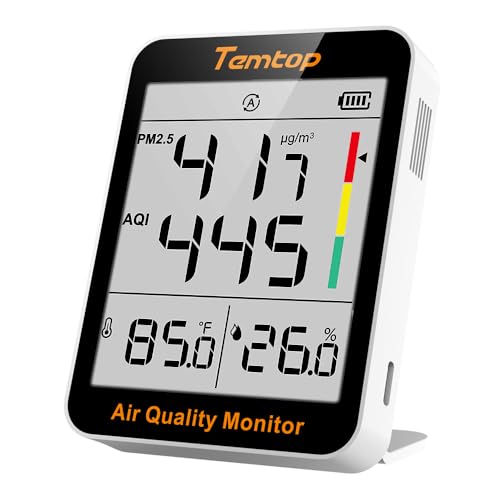
Products shown because their documented specifications fit this guide. Price and availability are on Amazon and can change.
Frequently Asked Questions
Which laser particle sensor is best?
Sensirion SPS30 and the Plantower PMS5003 family are the most studied and perform well against reference instruments. Differences between good modules are smaller than differences caused by humidity and placement.
How long does a laser particle sensor last?
Manufacturers rate them for 8 to 10 years of continuous operation or roughly 8,000 hours of laser life; dust on the optics and fan wear reduce sensitivity earlier in dirty environments.
What is the smallest particle a consumer sensor can detect?
About 0.3 µm. Particles below that are not counted directly; PM1 and PM2.5 mass below the limit is inferred from the size distribution, which is why smoke readings are less reliable.
Affiliate disclosure: Akermin earns a commission from qualifying Amazon purchases made through links on this page. Our editorial picks are based on documented specifications and owner feedback, not commissions.
Related Guides

Temtop Handheld Particle Counter Review: Three Channels and No Published Flow Rate
A pump suction handheld particle counter reading 0.3, 0.5 and 1.0 micron channels alongside PM2.5, PM10 and TSP, with temperature and humidity sensors, 32 GB of internal storage and a 3500 mAh battery.
Read More→
VETOUCH Plug In CO2 Monitor Review: An Alarm the Bullets Never Define
A mains powered three in one monitor showing carbon dioxide, temperature and humidity on a 1.83 inch colour screen, with three brightness settings and a display that flips 180 degrees.
Read More→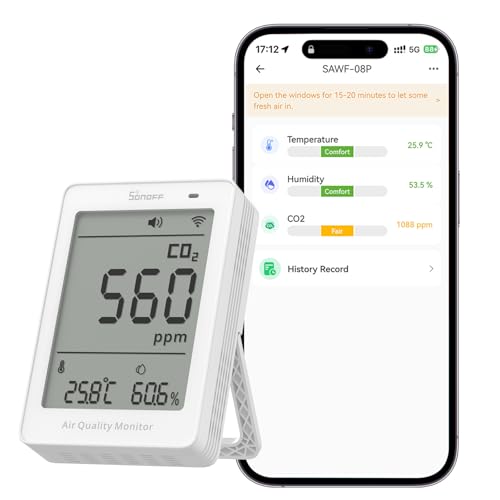
SONOFF AirGuard SAWF-08P Review: NDIR Accuracy Written as a Formula
A mains powered Matter compatible monitor showing CO2, temperature and humidity on one screen, with an NDIR sensor, 5 second updates and 12 months of history in the eWeLink app.
Read More→