Choose a PM2.5 monitor with a laser scattering sensor and a fan (not a passive infrared dust sensor), ideally a named module (Plantower PMS5003, Sensirion SPS30, Cubic PM2005 or similar), a humidity sensor so the firmware can correct for water-swollen particles, a history chart with export, and a display showing µg/m³ rather than only an index. PM1 and PM10 channels are useful extras. For most homes the sensor matters more than the brand, and the monitor’s job is to show change: cooking, candles, smoke, and whether the purifier or hood is working.
Step 1: The sensor
A laser particle sensor draws air past a laser with a small fan, counts scattered-light pulses and converts them to mass per size bin. Passive infrared dust sensors, found in the cheapest devices, are far less sensitive and not suitable. Look for a module name; Plantower, Sensirion, Cubic, Honeywell and Sharp are common. See how to compare laser particle sensors and PM2.5 vs PM10.
Step 2: Channels and units
- PM2.5 in µg/m³: essential. An AQI-only display hides the number.
- PM10: for distinguishing dust from smoke.
- PM1: for identifying combustion; see what PM1 is.
- AQI: a convenience; know which country’s scale the monitor uses. See how to interpret AQI.
Step 3: Humidity handling
Above about 70 percent RH particles absorb water and scatter more light; uncorrected sensors read 20 to 50 percent high. Monitors with a humidity sensor and a correction algorithm hold up better in bathrooms, kitchens and humid climates. See can a humidifier affect particle monitor readings.
Step 4: Response and averaging
Sensors report every second; monitors display a rolling average of 10 seconds to a few minutes. For catching cooking spikes and testing a hood, a short average; for logging, a minute or more. Check whether the interval is adjustable.
Step 5: Logging and export
A chart on the device or app that covers at least a day, and CSV export if you want to compare rooms or prove a point. GoveeLife’s H5106 exports two years; IQAir’s AirVisual keeps cloud history; Temtop’s S1 shows an on-device chart. See how to choose an air quality data logger.
Step 6: Form factor
| Use | Form | Notes |
|---|---|---|
| Kitchen and living room, permanent | Plug-in with display | Continuous fan sampling; Wi-Fi alerts to run a purifier |
| Bedroom, nursery | Plug-in with night dimming, or quiet battery unit | Fan noise matters; check the spec |
| Carrying between rooms, car, travel | Battery portable | Intermittent sampling; check battery life |
| Outdoor reference (balcony) | Weatherproof outdoor sensor | Lets you decide whether to open windows |
Step 7: Test it
Light a candle in a closed room and blow it out; a working monitor spikes within a minute. Cook something in oil; the kitchen reading should climb to hundreds of µg/m³ and fall over an hour. If the display barely moves, the sensor is passive infrared or the intake is blocked. See why PM2.5 spikes while cooking.
Using it
The monitor’s value is in showing what raises particles and what removes them. Run the purifier and watch the decay; run the hood and compare peaks; close windows on smoky days and see whether the house holds. Pairing a PM2.5 monitor with a CO₂ monitor covers the two commonest problems; see CO₂ vs PM2.5 and how to use a monitor with an air purifier. Monitors with particle sensors are compared in best air quality monitors.
Recommended Tools

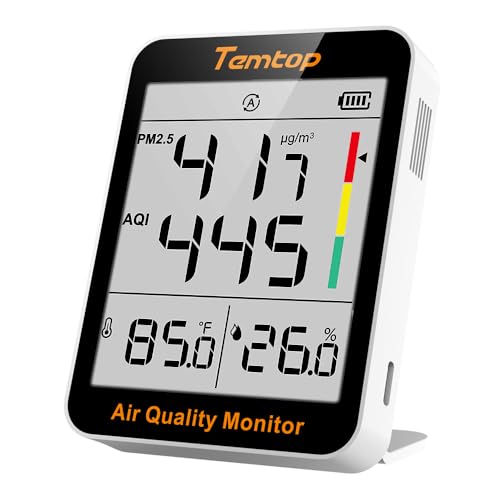
Products shown because their documented specifications fit this guide. Price and availability are on Amazon and can change.
Frequently Asked Questions
How accurate are consumer PM2.5 monitors?
Typically within 10 to 30 percent of a reference instrument at moderate levels in dry air, and excellent at showing change. They read high in humid air and can differ from each other by similar margins.
Do I need PM10 as well as PM2.5?
PM2.5 is the health-relevant number. PM10 adds source diagnosis (coarse dust versus smoke) and is estimated by the same sensor, so it costs nothing extra to have.
Battery or plug-in?
The sensor fan draws power, so most PM2.5 monitors are plug-in or last days on a charge. Battery models sample intermittently to extend life.
Affiliate disclosure: Akermin earns a commission from qualifying Amazon purchases made through links on this page. Our editorial picks are based on documented specifications and owner feedback, not commissions.
Related Guides

How to Compare Laser Particle Sensors
Named module, fan-driven flow, size bins, humidity handling, lifetime. The five things a spec sheet should tell you.
Read More→
How to Check Whether an Air Quality Monitor Measures Real VOCs
Every consumer VOC reading is a metal-oxide index. The check is whether the monitor admits it, and whether the sensor is alive.
Read More→How to Interpret AQI on an Indoor Air Monitor
AQI is a translation of one pollutant into a 0 to 500 scale. Know which pollutant, which country's scale and which averaging time.
Read More→