As an Amazon Associate, Akermin earns from qualifying purchases. Product links on this page are affiliate links.
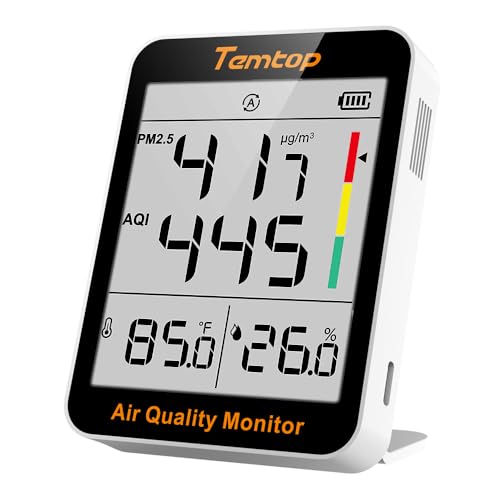
Short answer: take the H5106 if you want published accuracy figures for all three parameters and a fast refresh. Take the Temtop S1 if you prefer an AQI style readout that puts the number in context without needing you to know what a microgram per cubic metre means.
What Each Listing States
| Item | GoveeLife H5106 | Temtop S1 |
|---|---|---|
| Parameters | PM2.5, temperature, humidity | PM2.5, AQI, temperature, humidity |
| PM2.5 accuracy | Plus or minus 15 micrograms per cubic metre | Not stated in the bullets |
| Temperature and humidity accuracy | Plus or minus 0.54 F and plus or minus 3 percent RH | Stated as higher accuracy than traditional hygrometers |
| Refresh | Two second correction interval | Continuous, interval not stated |
| Sensor | Not named in the bullets | Miniature laser particle sensor |
| Display | LED with four ambient quality levels, night mode | Combined comfort and air quality screen |
| Connectivity | 2.4 GHz WiFi needed for the clock | Not stated in the bullets |
What a PM2.5 Monitor Is Actually For
Particulate monitors are at their most useful as change detectors. The absolute number from a consumer laser sensor carries real uncertainty, but the pattern is trustworthy: a spike when you sear something in a pan, a rise that follows lighting a candle, a plateau that appears on a smoky day and does not clear when the windows are shut. Those patterns tell you where particulates come from in your own home, which is the knowledge that leads to a change in behaviour.
Both devices will show you that. The H5106’s two second refresh makes the cause and effect more obvious, because you see the number climb while you are still standing at the cooker.
Reading the Accuracy Statement Honestly
Plus or minus 15 micrograms per cubic metre is a large uncertainty in absolute terms. Outdoor air in a clean location might sit below 10, so the monitor cannot reliably distinguish clean from very clean. During cooking or a smoke event readings run to several hundred and the same uncertainty is irrelevant. Understand which end of the scale you care about before treating any consumer particulate reading as precise.
The Temtop does not publish a PM2.5 accuracy figure at all, which is common in this category and means the two cannot be compared on that axis. Naming a laser particle sensor is still worth something, since it confirms the measurement is optical rather than inferred.
Keep the Sensor Clean
The GoveeLife listing includes a line worth heeding: keep the sensor clear for accurate detection. Laser particulate sensors draw air across an optical path, and dust accumulating inside gradually raises the baseline. A monitor that used to read near zero in fresh air and now reads 20 is usually telling you about itself rather than the room. Keep the inlet clear, avoid putting the device where it will be blasted with dust, and treat a slow upward creep over months with suspicion.
AQI Is a Translation, Not a Measurement
The Temtop reports AQI as well as PM2.5. AQI maps a concentration onto a coloured scale designed to convey risk to the public, and different countries use different mappings for the same concentration. It is genuinely helpful for anyone who does not want to learn what a microgram per cubic metre means. Just remember that the underlying particulate figure is the measurement, and AQI is an interpretation of it.
Who Buys Which
- Tracing indoor particulate sources: H5106, for the fast refresh.
- A household that wants a simple colour verdict: Temtop S1.
- Wildfire smoke seasons: either indoors, ideally with an outdoor reference; see the IQAir comparison.
- Ventilation rather than particulates: neither; you want a CO2 monitor.
How We Research
Figures come from the manufacturer listings. We did not run laboratory tests and publish no measurements of our own. Ranking in the air quality monitor roundup.
Recommended Tools

Products shown because their documented specifications fit this guide. Price and availability are on Amazon and can change.
Frequently Asked Questions
What accuracy does the H5106 state?
The listing states PM2.5 accuracy of plus or minus 15 micrograms per cubic metre, temperature accuracy of plus or minus 0.54 F and humidity accuracy of plus or minus 3 percent relative humidity, with a two second data correction interval.
Does the Temtop S1 show AQI?
Yes. The listing states it tracks PM2.5 and AQI continuously alongside temperature and humidity. AQI is a derived index rather than a measurement, so the underlying PM2.5 figure is the one to compare between devices.
Do either need WiFi?
The H5106 listing states 2.4 GHz WiFi is required for the time display. Both show their readings on their own screens without a connection.
Are these accurate enough to act on?
For noticing that something changed, yes. A 15 microgram uncertainty is significant at low levels and irrelevant during a genuine smoke event, where readings run into the hundreds. Treat them as indicators of change rather than reference instruments.
Affiliate disclosure: Akermin earns a commission from qualifying Amazon purchases made through links on this page. Our editorial picks are based on documented specifications and owner feedback, not commissions.
Related Guides

Sacnahe Air Quality Monitor Review: Seven Readings, No Sensor Named, No Accuracy Given
A WiFi monitor claiming AQI, CO2, PM2.5, PM1.0, PM10, TVOC and HCHO with Tuya app logging, reviewed from a listing that never says how any of it is measured.
Read More→
POWERTEC AD1001 Review: An NDIR Monitor Aimed at the Workshop, With Ranges but No Accuracy
A seven inch multi sensor monitor with an NDIR CO2 sensor, electrochemical formaldehyde, semiconductor TVOC and laser particle sensing, reviewed from the listing.
Read More→
GoveeLife H5106 vs IQAir AirVisual: Indoor Number or Indoor and Outdoor Together?
The H5106 reports indoor PM2.5 with a stated accuracy of 15 micrograms per cubic metre. The IQAir bundle adds a weatherproof outdoor monitor with two laser sensors and up to eight parameters.
Read More→