As an Amazon Associate, Akermin earns from qualifying purchases. Product links on this page are affiliate links.

HSCLPM · 16-in-1 Indoor Air Quality Monitor with CO2 Detector and AQI Tester Meter
View on AmazonPrice and availability are shown on Amazon and can change at any time.
A rechargeable desktop monitor that displays carbon dioxide, PM1.0, PM2.5, PM10, formaldehyde, TVOC, temperature and humidity on one large screen, with a seven level colour coded air quality indicator. Eight measurements are named in the bullets and the product is sold as sixteen in one. The decisive omission is not the arithmetic, though: a listing whose first two bullets lead on carbon dioxide never once says what kind of sensor is reading it.
Counting to sixteen with eight measurements
Work through the bullets with a pen and the list of distinct measured quantities comes to eight: carbon dioxide, three particulate size fractions, formaldehyde, TVOC, temperature and humidity.
Sixteen in one appears in the product name and in the first line of the first bullet. The other eight are never identified. There is no supplementary list, no footnote, no table.
Counts like this are generally assembled by adding things the screen shows to things the sensors measure. An air quality index derived from the particulate reading. A battery level. A charging state. Maximum and minimum values. A time display. Fahrenheit as well as Celsius. Each one is a line on the screen, and none is another sensor.
This is not a reason to dismiss the product, because eight genuine channels at this size is a reasonable sensor set. It is a reason to ignore the headline number entirely and buy on the eight you can verify. If any one of them matters to you, check it against the accuracy specifications these monitors do and do not publish before deciding.
The word missing from every carbon dioxide bullet
Carbon dioxide leads bullet one and owns bullet two, which promises accurate carbon dioxide and PM2.5 monitoring and calls them the two most important indicators of indoor air quality. The sensor behind that claim is never named.
In this class of instrument there are two ways to put a carbon dioxide number on a screen, and they are not comparable.
- An infrared sensor, which shines light through a small chamber and measures how much is absorbed near 4.26 micrometres, a wavelength carbon dioxide absorbs strongly. That is a measurement of the gas itself.
- A metal oxide sensor, which reacts to a mix of oxidisable gases and then has its output converted by a formula into an estimated carbon dioxide equivalent. That is an inference from an unrelated signal, and it tracks cooking, cleaning products and aerosols as readily as it tracks breathing.
Two details here point in opposite directions. In the product favour, the listing consistently writes CO2 rather than eCO2, and manufacturers using the estimating approach usually label it. Against it, the same device reports TVOC, which means a broadband gas sensor is present and the hardware needed to derive an estimate is already inside the case.
So the page does not settle it, and the specification that would settle it is one word long. There is also no accuracy figure, no measurement range, no warm up time, and no statement about how the carbon dioxide channel is calibrated or whether it uses automatic baseline correction, which is the behaviour that decides whether readings stay honest after a month on a shelf. Our walkthrough on telling a true infrared sensor from an estimate covers the checks you can run yourself once it arrives.
A colour scale with no breakpoints behind it
The third bullet is built on a seven level colour coded air quality indicator, which it says shows the current air quality clearly so you know when to improve ventilation.
An index is a translation, not a reading. Somewhere behind every colour band there is a table that says this concentration becomes amber and that one becomes red, and those tables are set by national authorities, differ between countries, and differ for every pollutant. Seven bands is a vendor choice, not a standard, and the breakpoints are not printed anywhere on this page.
The result is a scale you cannot audit. Green means the manufacturer considers this acceptable. It does not mean the room is below any particular guideline, and two monitors from different brands can show different colours for the same air without either being wrong.
The concentration figures are the honest output, and the listing does credit itself by showing them: the fourth bullet describes the carbon dioxide number, the particulate levels, temperature, humidity and the index together on one screen. Read the numbers, treat the colour as decoration, and compare against published guideline levels yourself. Our note on reading an index on an indoor monitor goes through why the indoor case is particularly loose.
Portable is a claim about a battery that is never specified
The last bullet is the mobility pitch: a built in rechargeable battery, suitable for homes, offices, baby rooms, recreational vehicle travel and camping.
No capacity. No runtime. No charge time. No statement about whether it keeps measuring while plugged in.
That matters more on this instrument than on a simple thermometer, because particulate measurement is not passive. A laser scattering channel runs a small fan to pull air past the beam, and the fan plus the laser is the dominant load in the device. A monitor with three particulate channels is therefore a heavier consumer than its size suggests, and runtime figures for this type are usually quoted in hours rather than days.
There is a second gap in the same area. Nothing in the bullets mentions logging, memory, an app or any way to export a reading. Combined, those two omissions define what the product is: something you watch, in the room, while you are there. It cannot show you the overnight carbon dioxide curve in a bedroom, which is one of the most useful things this class of device does, and it cannot hand you a record of a week in a damp flat.
The rows that decide whether you can trust a reading
| Specification | Published in the listing |
|---|---|
| Measurements named | CO2, PM1.0, PM2.5, PM10, HCHO, TVOC, temperature, humidity |
| Headline channel count | 16 in 1, with eight named |
| Air quality index | Seven colour levels |
| Display | Large screen showing all readings at once |
| Power | Built in rechargeable battery |
| Carbon dioxide sensor type | Not stated in the listing bullets |
| Accuracy, any channel | Not stated in the listing bullets |
| Measurement range, any channel | Not stated in the listing bullets |
| Resolution, any channel | Not stated in the listing bullets |
| Index breakpoints behind the seven levels | Not stated in the listing bullets |
| Formaldehyde and TVOC sensor types | Not stated in the listing bullets |
| Calibration method or baseline correction | Not stated in the listing bullets |
| Battery capacity and runtime | Not stated in the listing bullets |
| Logging, memory or data export | Not stated in the listing bullets |
| Warm up or response time | Not stated in the listing bullets |
Nine blank rows against five filled ones is an unusual ratio even in this category, and the blanks are not obscure. Accuracy, range and sensor type are the three things that separate a monitor from a mood light, and none of the three is here for any of the eight channels.
What the filled rows do establish is a sensible shape: everything on one screen at once, which beats a device that cycles through readings, and a battery so the thing can be carried to the room you are worried about.
Buy it to notice change, not to prove a number
This is a reasonable first instrument for someone who wants to know whether a bedroom gets stuffy, whether frying produces a particulate spike, or whether a newly furnished room settles down over weeks. Those are all questions about change over time in one place, and change is the thing a monitor with unpublished accuracy can still show you honestly, because the error largely cancels when you compare a reading with the same instrument an hour earlier.
Do not buy it if you need a number that someone else will act on. Without a stated sensor type for carbon dioxide, without an accuracy figure for anything, and with no way to export a reading, it cannot support a conversation with a landlord, an employer or a building manager. Anyone in that position should pay for a monitor that publishes its sensor technology and its tolerance, and should prefer one that logs.
Recommended Tools


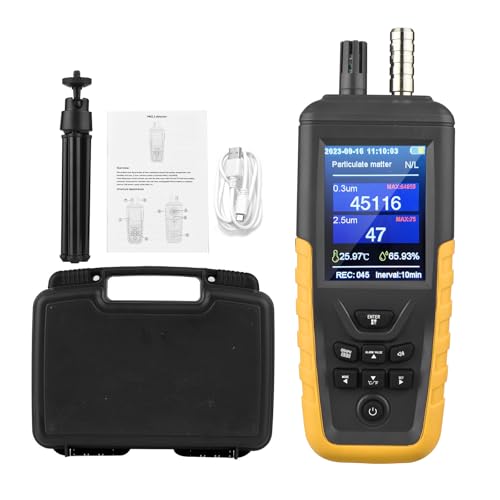
Products shown because their documented specifications fit this guide. Price and availability are on Amazon and can change.
Frequently Asked Questions
What are the sixteen things it measures?
The bullets name eight: carbon dioxide, PM1.0, PM2.5, PM10, formaldehyde, TVOC, temperature and humidity. The remaining eight are never enumerated anywhere on the page. Counts like this are usually reached by adding derived or displayed items to the measured ones, for example an air quality index, a battery indicator, a clock or high and low values, none of which is an additional sensor. Treat eight as the number you can verify.
Does it have a real CO2 sensor?
Unknown from the listing, which is the problem. Two approaches are sold at this size. A true infrared sensor measures carbon dioxide directly by its absorption of light near 4.26 micrometres. A metal oxide gas sensor measures something else entirely and converts the result into an estimated carbon dioxide equivalent. The listing writes CO2 rather than eCO2, which points the right way, but it also carries a TVOC channel, which is exactly the hardware used to derive an estimate, and nothing on the page rules that out.
Can I rely on the seven colour levels?
Use them to notice a change, not to judge compliance. An air quality index is not a measurement; it is a mapping from a concentration to a category, defined by a published set of breakpoints that differ between countries and between pollutants. The listing never publishes the breakpoints behind its seven levels, so a green reading cannot be checked against any guideline. The concentration figures on the same screen are the useful part.
Does it record data I can keep?
The bullets describe real time readings, a large display and a rechargeable battery. There is no mention of logging, of a companion app, of a memory, or of any way to get a reading off the device. That makes it a live instrument rather than a recorder, so it can tell you that a room is bad now but cannot show you what happened overnight or produce evidence for a landlord.
How long does the battery last?
Not stated. The listing claims it is portable and suggests using it in cars, nurseries and while camping, which are all situations where runtime decides whether the claim holds. Neither the capacity nor the hours are published. Worth noting too that particulate measurement uses a small fan and a laser, which draws considerably more power than a temperature and humidity display, so runtime on a monitor of this type is rarely long.
Affiliate disclosure: Akermin earns a commission from qualifying Amazon purchases made through links on this page. Our editorial picks are based on documented specifications and owner feedback, not commissions.