As an Amazon Associate, Akermin earns from qualifying purchases. Product links on this page are affiliate links.

MugEasy · Endoscope Camera with Light, 1920P HD Borescope Tools(16.5FT) | Snake Camera with 8 LED Lights, IP67 Waterproof Inspection Camera, 4.3" IPS Screen, No App,for auto repair,Walls,Pipes&Sewers
View on AmazonPrice and availability are shown on Amazon and can change at any time.
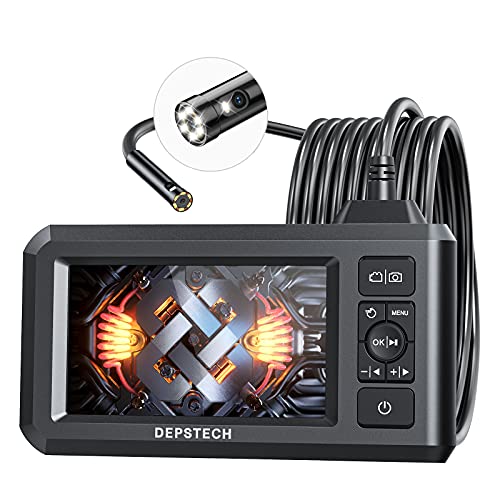
A single lens 7.9 mm borescope on a 16.5 ft semi rigid cable, with a 4.3 inch IPS screen at about 170 degrees of viewing angle, 1920 by 1080 capture, eight adjustable LEDs, IP67 protection, colour flip and brightness adjustment, no app or WiFi, and hook, magnet and side mirror in the box. The number worth noticing is one almost no competitor publishes: a 1.29 inch camera head, stated as half the usual length, which is what lets a probe of this diameter turn a tight corner.
The rigid section is the real constraint on access
Buyers compare probe diameters, and diameter does decide whether a probe enters a hole. What decides whether it gets anywhere after that is the length of the part that cannot bend.
Every borescope has a rigid camera head: the lens, the sensor, the LEDs and their wiring, in a metal or plastic barrel. Behind it the cable flexes. Ahead of it, nothing does. So when a probe meets a bend, the head has to fit through the straight space available at the corner, and a long head jams where a short one passes.
The listing states a 1.29 inch short lens for narrow pipe inspection, described as half the length of conventional lenses, making it easier to manoeuvre at difficult angles. That is roughly 33 mm of rigid section rather than the 60 mm or so that a longer head would occupy.
The practical consequence appears at a right angled fitting, at the entry to a wall cavity through a drilled hole where the cavity runs across your line of approach, and inside any bore with a change of direction. A 7.9 mm probe with a short head reaches places a 7.9 mm probe with a long head cannot, and no other number on either specification sheet would have told you that.
It is a genuinely useful disclosure and it is the main reason this listing stands out, which is slightly odd given it is mentioned in passing.
Single lens, and the mirror in the box
This is a single camera facing forward. The accessory list includes a side mirror, which tells you how the sideways look is intended to happen.
It is worth being clear about what that costs, because a mirror is not a neutral substitute for a second camera. The image is reversed, so left and right are swapped and your hand movements feel inverted. Light is lost, because the LEDs now illuminate a surface the camera sees indirectly. The effective focus distance changes, because the light path is longer than the apparent gap. And a clip on mirror can be knocked off inside a pipe, which converts an inspection into a retrieval.
Against that, a mirror weighs nothing, cannot fail electrically, costs nothing to include and can be removed when not wanted. For occasional sideways looks it is adequate. For work where most of what you examine is beside the probe rather than ahead of it, a dual lens unit is the better buy and our dual lens comparison covers them.
The screen and the lighting choices
The display is a 4.3 inch IPS panel with about 170 degrees of horizontal viewing angle. That figure describes the panel, not the camera: it is how far off axis you can be and still read it, which matters when the handset is propped on a surface while you work the cable.
The listing pairs 1920 by 1080 capture with that panel, and as with every unit in this bracket a 4.3 inch screen cannot show 1080 lines. What you judge on site is coarser than what was recorded, so capture generously and review properly later.
Eight adjustable LEDs is the right specification and the adjustment is the important half. A probe inside a wet or polished pipe a centimetre from the wall, with the lights at full, returns a white disc and nothing else. Being able to wind them down is what makes close work possible at all.
The colour flip and brightness shift are small software conveniences that reduce interpretation errors rather than improving the image, which is a fair trade for features that cost nothing to implement.
The specification, and the contradiction
| Specification | Published in the listing |
|---|---|
| Probe diameter | 7.9 mm |
| Camera head length | 1.29 inches, stated as half conventional |
| Capture | 1920 by 1080 |
| Screen | 4.3 inch IPS, about 170 degree viewing angle |
| Lighting | Eight LEDs, button adjustable |
| Cable | 16.5 ft in the title, 16.6 ft in the bullets, semi rigid |
| Protection | IP67 |
| Operation | No WiFi, no app, no driver |
| Accessories | Hook, magnet, side mirror, Type-C cable |
| Focus range | Not stated in the listing bullets |
| Battery capacity or runtime | Not stated in the listing bullets |
| Lens count | Single |
The cable length appears as 16.5 ft in the product name and 16.6 ft in the bullet text. Both are about five metres and the difference is immaterial, but a listing that cannot keep an easy figure consistent is a listing to read carefully on the harder ones.
The missing focus range is the gap that will affect your images most. With a short head and a small diameter, expect a close window, and expect anything further than a hand span to be soft.
No battery figure at all is unusual in this group, where competitors state capacity and hours. Plan for less than you hope.
Who should buy it
Buy this if your inspections involve bends. Drain traps, pipework with elbows, cavities entered at an angle, anywhere a probe has to turn shortly after it goes in. The short camera head is a real advantage for exactly that, and at 7.9 mm with IP67 and sixteen feet of semi rigid cable the rest of the specification supports it.
Buy something else if most of what you need to see is beside the probe, where two lenses beat a mirror, or if your access hole is tighter than 7.9 mm. And if the battery matters for your working day, note that this listing does not state one at all.
Recommended Tools

Products shown because their documented specifications fit this guide. Price and availability are on Amazon and can change.
Frequently Asked Questions
Why does the length of the camera head matter?
Because the head is the one part of the probe that cannot bend. A semi rigid cable will take a curve, but the rigid section containing the lens and LEDs will not, so the longest straight space the probe needs is the length of that head. The listing states 1.29 inches and describes it as half the length of conventional lenses, which means it turns a tighter corner than a longer headed probe of the same diameter. For a bend inside a pipe or a sharp turn into a cavity, that is the specification that decides success.
Is 7.9 mm small enough for engine work?
Not for cylinder inspection through a spark plug port, which usually needs about 5.5 mm or less. Seven point nine millimetres is a general purpose size that handles drains, ducts, wall cavities, behind appliances and open engine bay access. The listing frames it as a sewer and confined space tool, which is a fair description.
What is the cable length, 16.5 or 16.6 feet?
The product name says 16.5 ft and the third bullet says 16.6 ft. It is a trivial inconsistency and either figure is about five metres, but it is worth noting because a listing that contradicts itself on an easy number invites questions about the harder ones.
What do colour flip and brightness shift do?
They are display adjustments rather than camera ones. Flipping the image corrects the orientation when the probe has ended up rotated, which is constant on a semi rigid cable. Shifting brightness on the screen helps when the scene is uniformly dark or uniformly glaring. Neither changes what the sensor captured, and both reduce the mental effort of interpreting what you see.
What is missing?
The focus range, which on a fixed focus probe decides how close the subject must be for a sharp image. The battery capacity and runtime. And the number of lenses is single, so a side mirror is supplied in the box to do the sideways looking, with the usual penalties of a reversed image and lost light.
Affiliate disclosure: Akermin earns a commission from qualifying Amazon purchases made through links on this page. Our editorial picks are based on documented specifications and owner feedback, not commissions.
Related Guides

FLIR One USB-C Thermal Imaging Camera Review: The Phone-Attachment Baseline
A detailed review of the FLIR One USB-C thermal camera for Android, explaining its Vivid IR upscaling, MSX image blending, stated accuracy and the practical limits of a phone-attachment design.
Read More→
Wagner Meters Orion 950 Pinless Wood Moisture Meter: A Review for Thermal Inspection Work
A review of the Wagner Meters Orion 950 pinless wood moisture meter, explaining its dual depth measurement, Bluetooth reporting, and where it stops being the right instrument next to a thermal camera.
Read More→
Tramex Moisture Encounter ME5 Review: The Dual-Depth Pinless Meter
A detailed look at the Tramex ME5 pinless moisture meter, centered on its dual-depth measurement and its practical limits.
Read More→