Best Dual-Lens Borescopes: Forward and Side-View Cameras Compared
A dual-lens borescope carries a forward camera and a side camera at the tip and switches between them with a button, so the wall of a cylinder, a pipe or a stud bay can be viewed square-on without a mirror or a twist of the cable. This guide compares the listings on tip diameter, how the side view is presented, whether the tip also articulates, and reach, using only the manufacturers' figures.
As an Amazon Associate, Akermin earns from qualifying purchases. Product links on this page are affiliate links.
Our Top Picks
These borescopes were compared on manufacturer listing figures: probe diameter, how the side camera is switched or displayed, articulation, cable length, screen, resolution, lighting for each lens, waterproof rating, recording and battery. We did not run laboratory tests or inspect anything with the tools; every figure is the manufacturer's own and gaps are marked Not stated.
Best Overall
Teslong NTS500 Dual Lens Borescope With 5-Inch Monitor
Two complete cameras on a 0.21 in tip, each with its own LED, 9.8 ft, IP67.
Two complete cameras built into a 0.21 in (5.5 mm) tip that passes a spark plug hole
One button toggles between forward and side view; no mirror needed
Side camera has its own LED; six adjustable front LEDs
9.8 ft IP67 probe; 5-inch 1280 x 720 IPS screen; 3500 mAh battery
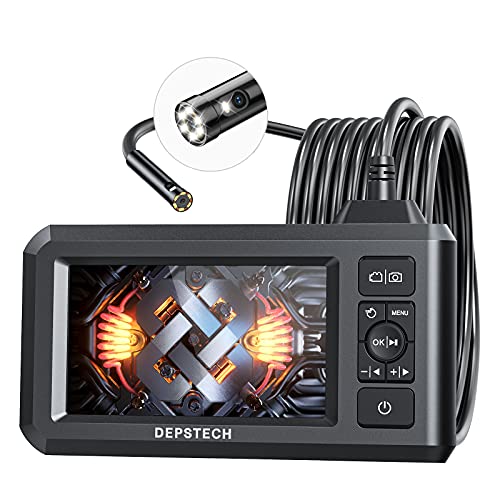
DEPSTECH DS650 Dual Lens Articulating Borescope, 5 ft
Dual 78-degree lenses on a 210-degree two-way articulating tip with split-screen view.
Dual lenses, each with a 78-degree field of view, on a tip with 210-degree bidirectional articulation
Split-screen display and a side-mounted control wheel for one-handed steering
0.33 in probe on a 5 ft semi-rigid cable; IP67; high-temperature warning system
2 MP camera with manual focus 3 to 8 cm and 1.5x zoom; 1080P photos and video to a built-in 8 GB card; 4.5-inch IPS screen; 2200 mAh stated at 4+ hours
All figures come from the manufacturers' Amazon listings at the time of research. Not stated means the listing gives no value. Articulation angles and lens fields of view are quoted as the manufacturer states them.
How to Choose a Dual-Lens Borescope
Four questions settle it:
Tip Size for the Hole
Two cameras take space. The NTS500 fits both on 0.21 in; the articulating units are 0.33 in; several listings do not state it.
Switch, Split or Steer
A button switch is simplest. Split screen shows both at once. Articulation aims the side lens instead of rotating the cable.
Light on the Side Lens
A side camera without its own LED sees a dark wall. Teslong states a side LED; the DEPSTECH DS620 states an 8+1+1 layout in our main guide.
Reach and Water
5 ft for engines, 16.5 ft for ducts and drains. Most state IP67; two articulating listings give no rating or an unnamed one.
What does a side lens show that the front lens cannot?
The wall you are next to, square-on. A forward camera in a cylinder, a pipe or a stud bay looks down the length of the space and sees the wall at a grazing angle where detail flattens out. The side camera faces the wall directly, so a scored cylinder, a cracked pipe joint or the back of drywall is seen the way you would see it standing in front of it. Teslong describes it as replacing a clip-on mirror, which is exactly the older workaround.
Should I choose a dual lens or an articulating tip?
Dual lens for reach and slim access; articulation for aiming. A fixed side lens has to be rotated by twisting the cable, which works in a pipe and is awkward in a cylinder where the target is behind a valve. An articulating tip steers the camera but adds diameter and usually shortens the cable. The DEPSTECH DS650 and DXZtoz combine both; the joystick articulating guide covers the single-lens steerable units.
Why do the front and side lenses have different focal ranges?
Because they work at different distances. DEPSTECH states 1.2 to 3.1 in for the DS300 front camera and 0.8 to 2.4 in for its side camera: the side lens is beside the wall it is looking at, an inch or two away, while the front lens looks a little farther ahead. Fixed-focus borescope cameras are sharp only inside their stated band, so a 4 in pipe wall may be soft for the front lens and sharp for the side lens.
Does the side lens have its own light?
On some. Teslong states that the NTS500 side camera has its own LED illumination and that the 5-inch dual lens unit gives each camera independent LEDs. The DEPSTECH DS300 states seven LEDs without assigning them, and the DS650 states three brightness levels. A side camera without a dedicated LED relies on spill from the forward lights and can show a dark wall; check the lighting description if the side view is the reason you are buying.
Is a triple-lens borescope better than a dual lens?
It adds a second side view so you can see both walls of a pipe or bay without rotating the cable, which the DEPSTECH DS620 in our main borescope guide states with an 8+1+1 LED layout. For a drain or a duct where both walls matter that saves time; for an engine cylinder where the tip is slim and the target is one surface, a good dual lens on a small probe does the job. The DS620 listing does not state its probe diameter.
Reviews
Teslong NTS500 Dual Lens Borescope With 5-Inch Monitor Best Overall
The NTS500 is the reference dual lens unit because it puts two cameras on the slimmest tip in the group. Teslong states a 0.21 in (5.5 mm) probe that passes a spark plug hole with two complete cameras built into it, one forward and one to the side, switched by a single button; the listing makes the point that no clip-on mirror is needed. Each camera has its own light, six adjustable LEDs for the forward view and a separate LED for the side, which matters because a side camera without its own light sees a dark wall.
The 9.8 ft cable and 5-inch 1280 x 720 IPS screen with a 3500 mAh battery serve engines, walls and traps alike, and the probe is IP67 with a sealed aerospace-style connector.
The listing does not state recording, battery hours or a split-screen mode, and the tip does not articulate, so a side camera pointing at the wrong wall means rotating the cable. For a steerable dual lens the DEPSTECH DS650 is the answer; for a longer cable, the DS300.
Strengths
Two cameras on a 0.21 in tip
Side camera lit by its own LED
IP67 with a sealed connector
5-inch 720P screen
Limitations
No articulation; rotate the cable to aim the side lens
DEPSTECH DS650 Dual Lens Articulating Borescope, 5 ft Best Articulating Dual Lens
The DS650 is the pick when a fixed side lens is not enough and the tip has to be steered. DEPSTECH states two lenses with 78-degree fields of view on a tip that articulates 210 degrees in two directions, driven by a control wheel on the side of the handset for one-handed use, with a split-screen mode that shows both cameras at once. Inside a cylinder the side lens can be swung to the valve seat rather than hoping the cable rotation lands on it.
The probe is 0.33 in on a 5 ft semi-rigid cable, IP67 rated, with three LED brightness levels and a high-temperature warning. The camera is 2 MP with manual focus from 3 to 8 cm, best at 3 to 5 cm, and 1.5x zoom; photos and 1080P video record to a built-in 8 GB card, and the 4.5-inch IPS screen runs on a 2200 mAh battery stated at more than 4 hours.
The cost of articulation is size and reach: 0.33 in is too large for a spark plug hole that the NTS500 enters, and 5 ft is an engine bay, not a duct run.
DEPSTECH DS300 Dual Lens Inspection Borescope, 16.5 ft Best Value
The DS300 is the dual lens unit to buy for reach and documentation at the lowest tier. DEPSTECH states front and side cameras with a split-screen mode that shows both at once and three observation modes on one button, on a 16.5 ft semi-rigid cable that runs along a duct or down a drain. The listing is specific about each camera's working distance, 1.2 to 3.1 in for the front and 0.8 to 2.4 in for the side, so the side lens is tuned for a wall an inch or two away.
It records 2 MP photos and 1080P video to a microSD card that is not in the box, on a 4.3-inch IPS screen. The probe is IP67 with seven adjustable LEDs at three levels, a 180-degree rotation setting rights an inverted view, and the battery is stated at about 4 hours.
The probe diameter is not stated, which matters for spark plug holes; the NTS500 states 0.21 in. And the tip does not articulate. For walls, ducts and drains it is the most capability per tier here.
Short answer: the Teslong NTS500 is the dual-lens borescope to buy for slim access, with two complete cameras and their own LEDs on a 0.21 in IP67 tip and a 9.8 ft cable; the DEPSTECH DS650 is the pick when the side lens has to be aimed rather than rotated, adding 210-degree two-way articulation, a split-screen view and built-in recording on a 0.33 in tip; and the DEPSTECH DS300 is the value unit with split-screen dual cameras on a 16.5 ft cable that records 1080P video.
Why a second camera changed the borescope
A single forward camera in a cylinder, a pipe or a wall bay looks down the length of the space, and the surface you care about, the cylinder wall, the pipe joint, the back of the drywall, is beside it at a grazing angle where scratches, cracks and staining flatten into nothing. The old fix was a clip-on mirror that reflected a sideways view into the forward lens. A dual-lens tip puts a second camera facing sideways and switches to it with a button; Teslong’s listing describes the NTS500 that way, two complete cameras, one button, no extra mirror. It is now the default layout for wall, pipe and engine work, and the borescope selection guide treats it as the baseline. The differences between units are in how small the two cameras can be made, how the side view is presented and whether the tip also steers.
Tip diameter: two cameras in a small space
Fitting two sensors and their lights into a probe costs diameter, and the listings show the spread. The Teslong NTS500 states 0.21 in (5.5 mm) with both cameras aboard, and states that it passes a spark plug hole; the Teslong TD500 dual lens states 6.5 mm; the DEPSTECH NTC55 states 7.9 mm; the Teslong 5-inch dual lens states an 8 mm cable and the T TAKMLY an 8.0 mm camera; the two DEPSTECH articulating units state 0.33 in, which is 8.4 mm. The DS300 and the DXZtoz do not state a diameter. For a drilled hole in a wall, a cleanout or a duct opening any of these fit. For a spark plug hole or an injector port the NTS500 is the only dual lens unit here whose listing confirms it.
Switch, split screen or steer
There are three ways to use the side lens. The simplest is a button that swaps the screen from one camera to the other: the NTS500, Teslong 5-inch dual lens, T TAKMLY and DXZtoz work that way, and the NTC55 switches in its phone app. The second is split screen, which shows both cameras at once so the pipe wall and the view ahead are on the same display; the DEPSTECH DS300, DS650 and the 5-inch DEPSTECH articulating unit state it. The third is to steer the tip as well: the DS650 states 210-degree bidirectional articulation driven by a side-mounted control wheel, the DEPSTECH 5-inch unit states 210-degree two-way articulation on an upgraded joystick, the DXZtoz states a control knob with a 90-degree side camera, and the Teslong TD500 6.5 mm states articulation without an angle. Steering aims the side lens at a valve seat or a piston crown instead of twisting the cable and hoping; it costs diameter and reach, and the joystick articulating guide compares the single-lens steerable units on those terms.
Light and focus on the side lens
A side camera without its own light looks at a wall lit only by spill from the forward LEDs, and the result is a dim image. Teslong states that the NTS500 side camera has its own LED and that the 5-inch dual lens gives each camera independent LEDs, with six front and one side. The DEPSTECH DS300 states seven adjustable LEDs at three levels without assigning them, the DS650 states three brightness levels, the NTC55 states 8+1, and the T TAKMLY states eight front LEDs. Focus is the other variable: these are fixed-focus cameras sharp only within a stated band, and DEPSTECH gives the DS300 front lens 1.2 to 3.1 in and the side lens 0.8 to 2.4 in, which tells you the side camera is tuned for a wall an inch or two away. The DS650 is the exception with manual focus from 3 to 8 cm and 1.5x zoom, which suits an engine where the target distance changes as the tip articulates.
Reach, water and recording
Cable length sorts the group into engine tools and cavity tools. The articulating units, the DS650 and the DEPSTECH 5-inch, state 5 ft; the NTS500 states 9.8 ft; the DS300, NTC55 and Teslong 5-inch state 16.5 ft and the T TAKMLY 16.4 ft, which run along a duct or down a drain; the TD500 6.5 mm and DXZtoz do not state a length. Most state IP67 probes; the DEPSTECH 5-inch articulating unit says fully waterproof without a rating and the TD500 6.5 mm listing gives none, so keep those two out of water until the manual confirms. Recording follows the DEPSTECH and phone units: the DS300 records 2 MP photos and 1080P video to a microSD card that is not included, the DS650 to a built-in 8 GB card, the DEPSTECH 5-inch unit states one-touch photo and video, and the NTC55 saves to the phone; the NTS500, Teslong 5-inch and TD500 listings do not state recording, and the T TAKMLY states that it cannot.
Which dual lens unit for which job
For engines the tip decides: the NTS500 is the dual lens that passes a spark plug hole, and the DS650 is the one that steers once inside if the opening allows 0.33 in. For walls and ducts the DS300 and Teslong 5-inch dual lens give 16.5 ft of reach with a lit side camera, and the DS300 adds split screen and recording. For drains the same 16 ft units apply with IP67 probes. For a phone-based dual lens the NTC55 pairs a 2560 x 1440 sensor with a 7.9 mm tip and a 16.5 ft cable over a wired connection. The main borescope guide sets these beside the single-lens and triple-lens units.
How We Research
Borescopes were compared on manufacturer listing text: probe diameter, how the side camera is switched or displayed, articulation range and control, cable length, screen size, resolution, lighting per lens, focal range, waterproof rating, recording and battery. Owner feedback was reviewed for recurring comments on side-camera brightness and articulation durability. We did not run laboratory tests, did not inspect anything with the tools and publish no measurements of our own. Amazon data supplies images, availability and links only.
Yes, a pyrometer needs power, but the source depends on the type: batteries for handheld guns, mains or loop power for fixed sensors, and sometimes no local power for passive optical types.