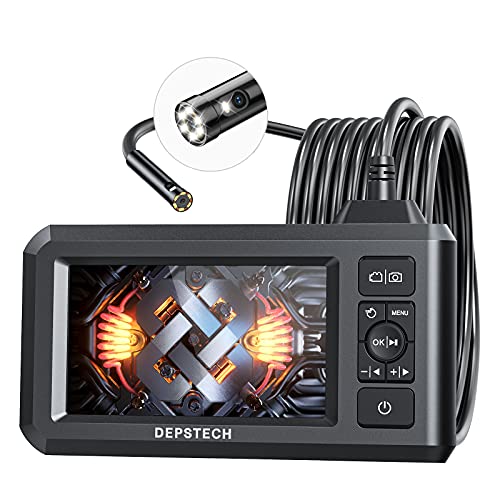
Best Borescopes: Inspection Cameras for Walls, Engines, Drains and Ducts
A borescope puts a small camera on the end of a cable so you can look inside a wall, a cylinder, a drain or a duct without opening it up. The probe diameter decides what it can enter, the cable length decides how far it reaches, and the display decides whether a phone is involved. This guide sorts the listings on those three things, using only figures the manufacturers state.
As an Amazon Associate, Akermin earns from qualifying purchases. Product links on this page are affiliate links.
Our Top Picks
These borescopes were compared on manufacturer listing figures: probe diameter, cable length and stiffness, display type, number of lenses, resolution, waterproof rating, lighting, recording and battery. We did not run laboratory tests or inspect anything with the tools; every figure is the manufacturer's own and gaps are marked Not stated.
Best Overall
Teslong NTS500 Dual Lens Borescope With 5-Inch Monitor
0.21 in dual lens probe, 9.8 ft cable, 5-inch 720P screen and IP67.
0.21 in (5.5 mm) probe that the listing states passes through a spark plug hole
Front and side cameras at the tip; one button toggles between them, no mirror needed
9.8 ft probe; 5-inch 1280 x 720 IPS screen; 3500 mAh battery
IP67 waterproof probe; six adjustable front LEDs plus a side-camera LED
All figures come from the manufacturers' Amazon listings at the time of research. Not stated means the listing gives no value, not that the feature is absent. Probe diameter is the figure to confirm before buying for a specific hole.
How to Choose a Borescope
Four decisions cover it:
Probe Diameter
3.9 mm enters a spark plug hole with room to spare, 5.5 mm just fits, 8 mm needs a drilled hole or an open cavity. Several listings do not state it; ask before buying for a specific opening.
Cable Length and Stiffness
Semi-rigid cables hold a bend so you can steer. 5 ft suits engines and wall cavities; 16.5 ft reaches along a duct or a drain.
Screen or Phone
A built-in screen works without pairing and keeps the phone clean. A phone borescope gives a bigger, sharper display and records into the gallery.
Waterproof and Recording
IP67 on the probe covers drains and damp cavities. Check whether the unit records; two listings here state that they cannot.
What probe diameter do I need for walls, engines and drains?
For a spark plug hole or an injector port, 3.9 mm to 5.5 mm; the Teslong NTS500 states that its 0.21 in (5.5 mm) tip passes a spark plug hole and the NIDAGE states 3.9 mm. For a wall cavity you drill the hole to suit, so 8 mm is fine. For a drain, anything that fits the trap opening works, and the larger tips usually carry more LEDs. Several listings here do not state the diameter, so confirm before buying for a specific opening.
What is the difference between a semi-rigid cable and a flexible one?
A semi-rigid cable holds whatever bend you put in it, so you can shape a curve to get around a stud or into a duct branch and it stays there while you push. A fully flexible cable flops and is hard to steer past the first obstacle. Most of the units here state semi-rigid construction; the Klein ET21 describes a high-flex snake that maintains rigidity, which is the same idea.
Do I need a built-in screen, or is a phone borescope enough?
A built-in screen works the moment you switch it on, does not depend on an app or a pairing step and keeps a dirty probe away from an expensive phone. A phone borescope gives a larger, sharper display, saves straight to the gallery and costs less to make because the screen is yours. The Klein ET21 and ET30 use Wi-Fi; the DEPSTECH NTC55 plugs in by cable. For daily trade use most owners report preferring a screen unit.
How far away can a borescope camera focus?
Close. Borescope cameras are fixed-focus lenses set for a short working distance: the DEPSTECH DS300 states 1.2 to 3.1 in for the front camera and 0.8 to 2.4 in for the side camera, and the NIDAGE states 3 to 10 cm. Objects farther away are visible but soft. The Klein ET30 states auto focus, which is unusual in this group.
Can a borescope see through insulation or drywall?
No. It is a camera and needs a clear line of sight inside an open cavity. In an insulated wall the probe pushes into fiberglass and shows fiberglass. It is the tool for confirming what a thermal camera or a moisture meter has already flagged, through a small hole, not a substitute for them.
Reviews
Teslong NTS500 Dual Lens Borescope With 5-Inch Monitor Best Overall
The NTS500 is the borescope that covers the widest range of jobs on one stated spec sheet. Teslong states a 0.21 in probe, which is 5.5 mm and thin enough to pass a spark plug hole into a combustion chamber, and two complete cameras at the tip, one facing forward and one to the side, switched with a button so a wall cavity or a cylinder wall can be viewed square-on without a clip-on mirror. The cable is 9.8 ft.
The handset is a 5-inch 1280 x 720 IPS screen with a 3500 mAh battery in a body the manufacturer describes as industrial-grade plastic and toughened glass, drop-resistant. The probe is IP67 with an aerospace-style connector, six adjustable front LEDs and a separate LED for the side camera, with flashlight and backlight buttons.
The listing does not state photo or video recording, battery runtime in hours or the camera resolution at the sensor, and 9.8 ft is shorter than the 16.5 ft DEPSTECH and Teslong 5-inch units. For engines and walls the slim dual lens tip is the reason to buy it.
The ET21 is the pick for a technician who would rather carry a phone than a second screen. Klein states a Wi-Fi link that sends video and images to a smartphone up to 30 ft away, and a free ET21 app for iOS and Android that connects, views, saves and shares the results, which is the recording step for a report. The camera is 5.5 mm, the same class as the Teslong NTS500 tip, so it enters the same holes.
The 5 ft snake is IP67 rated and described as high-flex while maintaining rigidity, meaning it bends around a stud or elbow and holds the curve. Adjustable LEDs light the cavity.
The listing does not state the camera resolution, the battery type or runtime, or whether a second lens or an articulating tip is fitted; from the text it is a single forward camera. Five feet is enough for a wall cavity, a duct branch or an engine bay, and not enough for a drain run.
DEPSTECH DS300 Dual Lens Inspection Borescope, 16.5 ft Best Value
The DS300 is the borescope that gives the most stated capability at the lowest tier here. DEPSTECH lists front and side cameras with a split-screen mode that shows both at once, three observation modes on one button, a 70-degree field of view, a 4.3-inch IPS screen and recording of 2 MP photos and 1080P video to a microSD card, which is not included. The cable is 16.5 ft of semi-rigid material that bends and holds its shape, and the probe is IP67 with seven adjustable LEDs at three brightness levels.
The listing is specific about focus: the front camera is sharp from 1.2 to 3.1 in and the side camera from 0.8 to 2.4 in, which is the working distance inside a wall or a pipe. Battery life is stated at about 4 hours, and a 180-degree rotating camera orientation helps when the image arrives upside down.
The probe diameter is not stated, so do not assume it passes a spark plug hole; the NTS500 states 0.21 in. For walls, ducts and drains within 16 ft it does the job and records it.
Strengths
Dual lens with split screen
16.5 ft cable
Records 2 MP photos and 1080P video
Focal ranges stated for both cameras
Limitations
Probe diameter not stated
microSD card not included
4.3-inch screen is the smallest of the screen units
Short answer: the Teslong NTS500 is the borescope for the widest spread of jobs, with a 0.21 in dual lens probe that passes a spark plug hole, a 9.8 ft cable, a 5-inch 720P screen and an IP67 tip; the Klein ET21 WiFi is the wireless pick for a technician who wants the phone as the screen, with a 5.5 mm IP67 camera and a stated 30 ft Wi-Fi range; and the DEPSTECH DS300 is the value unit that reaches 16.5 ft, shows front and side views on a split screen and records 1080P video.
What a borescope is for, and what it is not
A borescope is a small camera and light on the end of a cable, with a screen or a phone at the other end. It answers the question that a thermal camera and a moisture meter raise but cannot settle: what is actually in there. A cold patch on a wall becomes a view of a missing batt through a small hole; a misfire becomes a view of a scored cylinder wall through the spark plug hole; a slow drain becomes a view of the trap. It is a line-of-sight tool, so it needs an opening and a cavity with some space in it, and it shows surfaces rather than measuring anything. What a borescope is and when it is useful covers the basics.
Probe diameter decides where it goes
The first figure to check is the tip diameter, because it decides which openings the camera can enter. A 3.9 mm probe, as the NIDAGE states, passes a spark plug hole with room to move and enters injector ports and small drilled holes. A 5.5 mm tip, which is the Teslong NTS500’s 0.21 in and the Klein ET21’s stated camera size, still passes a spark plug hole; Teslong says so directly. The DEPSTECH NTC55 states 7.9 mm, and the Teslong 5-inch dual lens states an 8 mm cable; those want a drilled hole or an existing opening such as a register, a trap or a cleanout. The Klein ET30 gives its size as fitting a 1-1/8 in hole without its collar. Four listings in the table, including the two DEPSTECH screen units and the Teslong TD500, do not state the diameter at all.
Cable length and why semi-rigid matters
Length decides reach, and the listings cluster at two figures. The 5 ft cables on the Klein ET21, NIDAGE and Teslong TD500 cover an engine bay, a wall cavity between studs and a duct branch. The 16.5 ft cables on the DEPSTECH DS300, DS620 and NTC55 and the Teslong 5-inch dual lens run along a duct trunk, down a drain stack or across a ceiling cavity. The NTS500 sits between them at 9.8 ft. Construction matters as much as length: a semi-rigid cable holds the bend you put in it, so you can pre-shape a curve to clear a stud or drop into a trap and it stays that way while you push, whereas a limp cable stops at the first obstacle. Every unit here that describes its cable calls it semi-rigid or, in Klein’s words, high-flex while maintaining rigidity.
Screen, phone or Wi-Fi
Three display types appear in the table. Built-in screens, on the NTS500, the two DEPSTECH screen units, the Teslong 5-inch and TD500 and the NIDAGE, work the moment the unit is on, need no pairing and keep a dirty probe away from a phone; stated sizes run from the DS300’s 4.3 in to the 5 in IPS panels on the Teslongs and DS620. Wired phone borescopes such as the DEPSTECH NTC55 plug into a phone by USB-C or a Lightning adapter and use the phone as screen and storage, with the phone’s resolution behind a 2560 x 1440 camera. Wi-Fi units, the Klein ET21 and ET30, send the picture to a phone app without a cable, which Klein states works up to 30 ft on the ET21. Wireless suits a probe in an attic while you are on a ladder; the wireless borescope guide compares those units in detail.
Single, dual and triple lenses
A forward camera looks down the cavity or the pipe; a side camera looks at the wall of it. The NTS500, Teslong 5-inch dual lens, DEPSTECH DS300 and NTC55 all state a front and a side camera switched by a button or, on the NTC55, in the app; the DS300 adds a split-screen mode that shows both at once, and the Teslong units give the side camera its own LED. The DEPSTECH DS620 goes to three lenses on one button. The alternative is an articulating tip that steers a single camera: the Teslong TD500 states two-way articulation on a 5 ft cable, which suits engine work where a fixed side lens may face the wrong way. The articulating borescope guide covers that approach; the dual lens guide compares the fixed side-view units.
Waterproof rating, recording and the limits
Most probes here state IP67, which covers a wet wall cavity, a trap and a shallow drain; the Klein ET30 and Teslong TD500 listings do not state a rating, so keep them out of water until the manual confirms one. The rating applies to the probe, not the handset, and a cable that has been in a drain wants a rinse before it goes back in the case. Recording is the other thing to read for: the DEPSTECH DS300 and DS620 record 2 MP photos and 1080P video to a microSD card that is not in the box, the Teslong TD500 ships with a 32 GB card and records audio too, the Klein and NTC55 apps save to the phone, the NTS500 and Teslong 5-inch listings do not say, and the NIDAGE states plainly that it cannot record.
Related guides
For the selection method in full, see how to choose a borescope for inspection work. The home inspection, plumbing and dual lens guides on this site apply the same figures to specific jobs.
How We Research
Borescopes were compared on manufacturer listing text: probe diameter, cable length and construction, display type and size, lens count and switching, resolution, waterproof rating, lighting, focal range, recording, battery and warranty. Owner feedback was reviewed for recurring comments on image clarity and cable durability. We did not run laboratory tests, did not inspect anything with the tools and publish no measurements of our own. Amazon data supplies images, availability and links only.
A handheld thermal camera with a 160 by 120 infrared detector, a 320 by 240 enhanced image, 40 mK sensitivity, a focus free 40 by 30 degree field of view, a 25 Hz refresh rate and still JPG image capture.
A non contact infrared thermometer for electrical, mechanical, HVAC and automotive surfaces, with dual rotating lasers that mark the edges of the measurement area, minimum, maximum, difference and average readings, and an IP54 rating.
A pinless non invasive moisture meter that reads up to three quarters of an inch into a surface, with scales of 0 to 53 percent for softwood, 0 to 35 percent for hardwood and relative readings on wallboard, drywall and masonry.