As an Amazon Associate, Akermin earns from qualifying purchases. Product links on this page are affiliate links.
For an inspection you are being paid to perform, the Airthings Corentium Pro is the pick that matters, because its listing states it is fully AARST/NRPP certified, which is the credential a radon measurement professional is expected to hold and the one a relocation company or attorney will ask about. The X-Sense XR0B-SR is the sensible second device for a homeowner or a low-stakes screening: its listing states results in 24 hours and 95 percent accuracy after 7 days or more, with a 2-year battery and no lab fee. The Airthings View Plus is a whole-home air quality monitor that happens to include a radon sensor; its listing describes continuous app-connected monitoring, not a closed test, so it is a homeowner’s long-term watch rather than an inspection instrument. The AEGTEST HOUND-1011S Portable Radon Detector, High-Accuracy and the AEGTEST HOUND-1011S Portable Radon Detector, High-Accuracy are the same product listed twice with identical bullets, so choose on availability rather than on any difference between them.
What a real estate radon test actually has to produce
A radon test in a property transaction is not a measurement in the scientific sense alone. It is a record. Somebody, usually a licensed inspector or a state-certified measurement professional, places a device, leaves it for a defined period, retrieves it, and produces a number that can be defended if the buyer and seller disagree. The device is only one part of that chain, but it is the part that determines whether the rest of the chain is even possible.
Two things follow from that. First, the device has to be capable of running an uninterrupted, time-stamped measurement over the required period. Second, the person running it has to be able to show that the instrument and the method meet the standard the transaction relies on. In the United States the relevant framework is the AARST National Radon Proficiency Program, usually shortened to NRPP. A device whose listing states it is AARST/NRPP certified is telling you the manufacturer has put it through that programme. A device whose listing is silent on certification is not necessarily bad, but it is not the instrument you hand to a relocation company as the basis of a test.
Consumer monitors have improved enormously, and several of them now measure radon competently for a homeowner. That is a different job. A homeowner wants a trend and a warning. An inspector wants a closed test with a defensible endpoint. Keep those two jobs separate when you read the listings below.
Certification, and why the listing wording matters
Only one listing in this group uses the words. The Airthings Corentium Pro is described as fully AARST/NRPP certified, portable, tamper resistant and EMI-proof, with temperature, pressure and humidity sensors alongside the radon channel, and a free mobile app for iOS and Android. Those extra environmental sensors are not decoration. Radon emanation from soil and building materials varies with temperature and barometric pressure, and a measurement taken while the pressure is falling can read differently from one taken in steady conditions. Recording pressure and temperature alongside the radon count lets a professional explain an unusual result rather than simply report it.
Tamper resistance matters in a transaction because the test is adversarial by nature. If the seller opens windows during the measurement, the number is invalid, and a device that records its own continuity and placement is worth more than one that does not. The listing states tamper resistance as a feature; it does not publish the exact mechanism, so treat the claim as stated and ask the manufacturer for the detail if you need it for a report.
The X-Sense XR0B-SR takes the opposite approach. Its listing does not mention NRPP or any certification programme. What it does publish is a testing timeline: results in 24 hours, accuracy reaching 95 percent after 7 days or more, up to 999 days of tracking with no lab fee, a 2-year battery, sound and light alerts when radon exceeds a threshold, and a one-touch reset that clears the data so one device can be moved between rooms. That reset button is the clearest signal of intent. A device designed to be wiped and redeployed is a screening tool, not an evidence tool. For a homeowner checking a basement before deciding whether to pay for a professional test, that is exactly right. For an inspector producing a report, it is not.
The timing problem: 12 hours, 24 hours, 7 days
Radon measurement is a counting problem. The detector counts alpha particles from radon decay, and the statistical uncertainty of that count falls as the measurement runs longer. A short test is not wrong, it is simply less precise, and the shorter the window the more a closed-house protocol and stable weather matter. This is why the listings quote different timelines, and why those timelines tell you what each device is for.
The AEGTEST HOUND-1011S Portable Radon Detector, High-Accuracy, and its duplicate the AEGTEST HOUND-1011S Portable Radon Detector, High-Accuracy, state that first results appear within 12 hours with hourly updates, and that concentration can be viewed over windows from the past 12 hours to 504 days. The sensor is described as a high-precision semiconductor, the range as 0.09 to 1000 pCi/L, and the unit can be switched between pCi/L and Bq/m3. The device runs from a Type-C cable for continuous monitoring, and the built-in battery is stated to last up to 45 days in sleep mode. A 12-hour first reading is a screening number. It will tell you whether a house is obviously elevated, which is useful for triage, but it is not a 48-hour closed-house test and the listing does not claim it is.
The X-Sense XR0B-SR states 24 hours for first results and 95 percent accuracy after 7 days or more. That is a more honest description of the underlying statistics than a single accuracy figure would be, and it is one of the few listings here that ties its accuracy claim to a duration. The Airthings View Plus does not publish a radon accuracy figure or a minimum measurement period at all. Its listing describes continuous monitoring with live data and notifications, which is a different promise: it tells you what is happening now, not what the average was over a controlled window.
The radon monitors that fit an inspection, and the ones that do not
Airthings Corentium Pro
The only pick whose listing states AARST/NRPP certification, the credential an inspection-grade measurement is built around.
X-Sense XR0B-SR
A no-lab-fee screening monitor with stated 24-hour first results and 95 percent accuracy after 7 days or more.
Airthings View Plus
A whole-home air quality monitor with a radon channel, built for continuous owner monitoring rather than a closed inspection test.
AEGTEST HOUND-1011S
A portable semiconductor radon detector with audible and visual alarms, listed with a 0.09 to 1000 pCi/L range.
The comparison table: what each listing publishes
| Pick | Certification stated | First result | Radon range | Power | Other sensors |
|---|---|---|---|---|---|
| Airthings Corentium Pro | Fully AARST/NRPP certified | Not stated in the listing bullets | Not stated in the listing bullets | Not stated in the listing bullets | Temperature, pressure, humidity |
| Airthings View Plus | Not stated in the listing bullets | Not stated in the listing bullets | Not stated in the listing bullets | Battery powered | PM2.5, CO2, VOC, humidity, temperature, pressure |
| AEGTEST HOUND-1011S | Not stated in the listing bullets | Within 12 hours, hourly updates | 0.09 to 1000 pCi/L | Type-C cable; up to 45 days in sleep mode on battery | Not stated in the listing bullets |
| X-Sense XR0B-SR | Not stated in the listing bullets | Within 24 hours | Not stated in the listing bullets | 2-year battery | Not stated in the listing bullets |
The pattern is worth reading carefully. The device built for professional measurement publishes its certification and its environmental sensors but not its range or its first-result time. The devices built for homeowners publish their timing and range but not their certification. That is not an accident of marketing; it reflects what each manufacturer expects the buyer to care about. An inspector cares whether the instrument is recognised. A homeowner cares whether it will tell them something tonight.
The AEGTEST HOUND-1011S Portable Radon Detector, High-Accuracy and the AEGTEST HOUND-1011S Portable Radon Detector, High-Accuracy are the same product with the same title and the same four bullets. There is no functional difference to describe. If you want that device, choose between the two listings on availability and on which one you can actually receive, not on any specification, because none differs.
The mistake buyers make: treating a monitor as a test
The most common error in this category is buying a continuous radon monitor and assuming the purchase itself makes the measurement valid. It does not. A valid test has a protocol: closed-house conditions for a defined period before and during the measurement, a device placed in the lowest lived-in level, a documented start and end, and no disturbance. A monitor that runs for months can tell you a great deal about a house, but if the windows were open for two of those weeks the average is not a test result.
The second error is trusting a published accuracy percentage without asking what it refers to. A consumer radon sensor quoting a very tight accuracy figure is often quoting the resolution of its display or the repeatability of its electronics rather than its agreement with a reference chamber. The X-Sense XR0B-SR avoids this trap by tying its 95 percent figure to a duration of 7 days or more, which is a statement about counting statistics and is at least internally consistent. Where a listing gives a bare accuracy number with no duration and no reference method, treat it as a claim about the device, not about the air.
The third error is forgetting that these are not alarms in the life-safety sense. The AEGTEST HOUND-1011S Portable Radon Detector, High-Accuracy and the X-Sense XR0B-SR both have audible and visual alerts, and the Airthings View Plus sends notifications. None of them is a substitute for a carbon monoxide alarm, a smoke alarm, or a professional mitigation decision. A radon alert tells you to test further or to call a mitigator. It does not make the house safe by itself.
Placement, records and where this category stops
Radon is heaviest close to the ground and to the source. In a real estate test the device goes in the lowest level that is regularly occupied, which in most houses means the basement or the ground-floor living space, not the attic and not the kitchen counter. The X-Sense XR0B-SR’s one-touch reset exists precisely so one device can be moved from room to room, but note that clearing the data also clears the record. If you are comparing rooms, keep your own note of which room each reading came from.
For a homeowner who wants to understand a house over time rather than pass a test, the broader air quality picture is often the more useful purchase. A monitor that also tracks PM2.5, CO2 and VOCs will tell you about the basement as a living space, not just about one gas. If that is your goal, the basement-specific comparisons on this site are a better starting point than a single-gas radon device, and the same logic applies to monitors chosen for basement conditions. If you are tracking several floors and want to know whether a reading upstairs is dilution or a second source, the multi-floor discussion in radon monitoring across floors is the relevant one.
The category stops being the right answer when a transaction, a lender or a regulation requires a specific protocol. At that point you need a certified measurement professional and a device that meets the programme’s requirements, and a consumer monitor, however good, is supporting evidence rather than the test itself. It also stops when the reading is high. A monitor tells you there is a problem; a mitigator tells you what to do about it, and no amount of additional monitoring substitutes for that call.
Recommended Tools

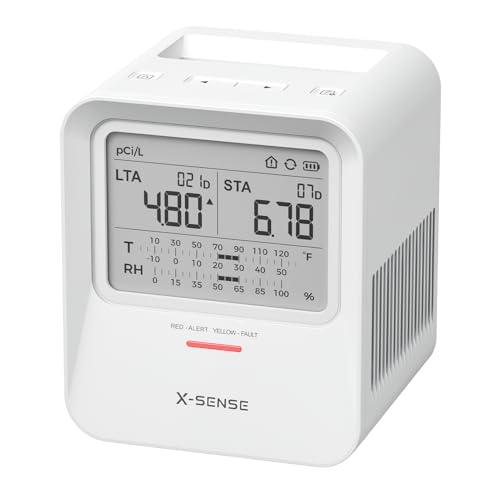


AEGTEST HOUND-1011S Portable Radon Detector, High-Accuracy Sensor for Home, Lightweight,
View on AmazonProducts shown because their documented specifications fit this guide. Price and availability are on Amazon and can change.
Frequently Asked Questions
Can I use a consumer radon monitor for an official real estate test?
Only if the device and the person using it meet the standard the transaction relies on. The Airthings Corentium Pro's listing states AARST/NRPP certification, which is the credential a measurement professional is expected to hold. The other listings here do not state any certification, so they are best treated as screening tools that tell you whether to commission a proper test.
How long does a radon test need to run?
The listings here quote different first-result times: 12 hours for the AEGTEST HOUND-1011S Portable Radon Detector, High-Accuracy and the AEGTEST HOUND-1011S Portable Radon Detector, High-Accuracy, 24 hours for the X-Sense XR0B-SR, and no stated figure for the Airthings Corentium Pro or the Airthings View Plus. A first result is not a final result. The X-Sense XR0B-SR states 95 percent accuracy after 7 days or more, which reflects the way counting statistics improve with time. Short tests are screening numbers; longer closed-house measurements are what a transaction needs.
Are the AEGTEST HOUND-1011S Portable Radon Detector, High-Accuracy and the AEGTEST HOUND-1011S Portable Radon Detector, High-Accuracy different products?
No. They carry the same title and the same four bullets, word for word. There is no functional difference to describe. If you want that device, choose between the two listings on availability rather than on specification.
Does a radon monitor also protect me from carbon monoxide?
No. A radon detector measures radon and nothing else unless its listing says otherwise. The Airthings View Plus is the only pick here that also tracks CO2, PM2.5 and VOCs, and even that does not measure carbon monoxide. You still need separate CO and smoke alarms.
What does the listing not tell me about the Airthings Corentium Pro?
Its radon measurement range, its first-result time, its power source and its battery life are all absent from the listing bullets. The certification, the environmental sensors, the portability, the tamper resistance and the app are stated. If you need the missing figures for a report, ask the manufacturer directly rather than assuming them.
Do I need a radon monitor at all if I am not selling?
A monitor is worth having if you want to know whether a level is stable or drifting over seasons, because radon varies with weather and with how the house is used. If you simply want a yes or no answer before deciding on mitigation, a single professional test may be the cheaper and more decisive route.
Affiliate disclosure: Akermin earns a commission from qualifying Amazon purchases made through links on this page. Our editorial picks are based on documented specifications and owner feedback, not commissions.