As an Amazon Associate, Akermin earns from qualifying purchases. Product links on this page are affiliate links.

TOPDON · TOPDON TC001 Plus Thermal Camera for Android, 512 x 384 Super Resolution with Visual Camera, 256 x 192 IR Resolution, Dual-Lens Thermal Imaging Camera for Smartphones and Tablets, PC (not for iOS)
View on AmazonPrice and availability are shown on Amazon and can change at any time.
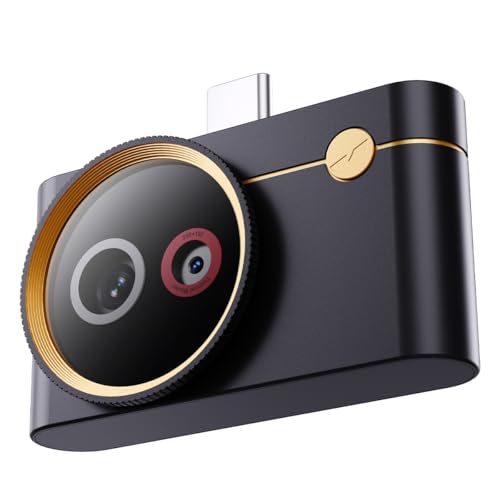
A one ounce, 2.8 by 1.65 by 0.55 inch Android attachment with a 256 by 192 detector presented as 512 by 384, a minus 4 to 1022 F range at plus or minus 3.6 F or 2 percent, a 1 m drop rating and OTG support. The reason to choose it is the software: nine simultaneous measurement areas across point, line and surface, continuous measurement with waveform graphs, annotated reports and per pixel chart export. The reason some people cannot choose it is in the product name: not for iOS.
The platform warning belongs in the title, and it is there
The product name reads, in part, thermal imaging camera for smartphones and tablets, PC, not for iOS. That parenthesis is the most user friendly thing in the listing.
Phone attachment thermal cameras generate a predictable category of disappointment: the connector is wrong, the app is not on your platform, or the adapter is sold separately and nobody said so. Putting the exclusion where it cannot be missed prevents a wasted purchase.
It also tells you something about the product focus. Android and PC support with OTG, and no iOS layer to maintain, is a narrower target and usually a better supported one. The listing goes on to describe USB connection to a PC for real time analysis, which is unusual in this category and consistent with that focus.
The resolution figures are both published
The listing states 512 by 384 Super IR resolution in one breath and 256 by 192 IR resolution in the next, in the same product name. As with others in this category, the detector is the smaller number and the larger one is produced by interpolation.
At 256 by 192 this is a mid level detector: 49,152 measured elements. Upscaling to 196,608 pixels smooths the image and makes small features look less blocky, which genuinely helps interpretation, but it adds no information and cannot resolve something that fell between two detector elements.
The listing also claims image fusion technology with a visible light lens. Fusion is the same idea as other vendors use under different names: borrow edge detail from a visible camera so the thermal image has landmarks you recognise. It changes no temperature and it substantially reduces the chance of misidentifying what you are looking at.
One phrase in that bullet cannot be assessed. The listing describes a robust 100 W visible light lens. Watts measure power, not optics or resolution, and the phrase has no meaning as written. It is most likely a mistranslation of a pixel count. We flag it rather than interpret it, because guessing at a specification is how wrong figures spread.
Nine areas and the waveform are the real features
Two capabilities in this listing are rare at this level and both change what the tool can be used for.
The first is nine simultaneous measurement areas in three forms. A point gives one temperature. A line gives a profile along a path, which is how you see where a cold bridge starts and stops across a wall junction. A surface gives the statistics of a region, so you can compare the average of one component against another rather than two arbitrary spots. Having nine of these at once means a frame can answer a comparison question outright.
The second is continuous measurement generating waveform graphs. That is temperature against time, and it catches the faults a still image cannot. A connection that only warms under load. A motor that climbs through a duty cycle. A thermostat that overshoots. You cannot photograph any of those; you have to watch them, and a graph is the record of having watched.
Taken together these push the tool past looking and into measuring. Our Android thermal camera comparison sets out which units in this category offer anything comparable.
Per pixel export is the feature to understand
| Specification | Published in the listing |
|---|---|
| Native detector | 256 by 192 |
| Processed output | 512 by 384 Super IR |
| Range | Minus 4 to 1022 F, minus 20 to 550 C |
| Accuracy | Plus or minus 3.6 F or 2 percent of reading |
| Measurement | Nine areas, point, line and surface |
| Recording | Continuous measurement with waveform graphs |
| Export | Per pixel charts, annotated reports, server upload |
| Physical | 2.8 by 1.65 by 0.55 inch, 1 oz, 1 m drop rated |
| Platform | Android, tablets and PC via OTG and USB, not iOS |
| Thermal sensitivity or NETD | Not stated in the listing bullets |
| Field of view | Not stated in the listing bullets |
| Emissivity adjustment | Not stated in the listing bullets |
Most phone attachments trap your data. Images live in a vendor app, in a vendor format, and what you can do with them is what the app offers this year. The listing here states export of charts for every pixel point, which means the temperature field leaves as numbers.
That has a practical consequence. A finding you exported as data can be re examined, re plotted, compared against a later survey or handed to someone else’s software. A finding that exists only as a JPEG in an app cannot. For anyone who may need to defend a diagnosis after the fact, this is the most valuable thing in the listing.
Three gaps work against it. No NETD figure, which is the specification that would tell you whether the detector can see the faint differences in building work. No field of view, so you cannot calculate what a pixel covers at a distance. And no mention of emissivity adjustment, which limits confident work on bare metal regardless of how good the reporting is.
Who should buy it
This suits an Android user whose findings have to become records: a contractor evidencing a repair, an engineer tracking a fault over time, anyone who needs a graph rather than a snapshot. The nine area measurement, the waveform recording and the per pixel export are a reporting toolkit, not a feature list, and at one ounce with a 1 m drop rating it will be in a pocket when needed.
It is not for iPhone users, and the listing says so where you cannot miss it. It is not the choice if you need fine spatial detail, because the detector is 256 by 192. And without a published NETD or emissivity setting, it is a weaker fit for faint building survey work and for bare metal electrical inspection than its reporting features might suggest.
Recommended Tools

Products shown because their documented specifications fit this guide. Price and availability are on Amazon and can change.
Frequently Asked Questions
Does it work with an iPhone?
No. The product name itself states not for iOS, and the listing describes Android smartphones, tablets and PC. Putting an incompatibility in the product name rather than in the small print is unusual and it is the right thing to do, because the single most common complaint about phone attachments is buying one for the wrong platform.
What is the detector resolution?
The listing gives both figures: 512 by 384 Super IR resolution and 256 by 192 IR resolution. The detector is 256 by 192 and the larger number is the processed output. Judge spatial capability on 256 by 192, which is mid level for this category.
What does per pixel chart export actually give me?
The listing states the TopInfrared software allows data reporting and recording for each image with the ability to export charts for every pixel point. That means the temperature data leaves the app as data rather than as a picture, so you can analyse or archive it outside the vendor tool. For anyone who has to justify a finding later, that is a materially different proposition from an app that only produces images.
What are the nine measurement areas?
The listing describes three dimensions, point, line and surface, enabling simultaneous measurement across nine areas. A point reads one spot, a line reads a profile along a path, and a surface reads the statistics of a region. Being able to place nine of those at once is how you compare several components in one frame instead of moving a crosshair and relying on memory.
What is the 100 W visible light lens?
This phrase does not describe anything meaningful in English, and watts are a unit of power rather than of optics or resolution. It most likely originates as a mistranslated pixel count. We cannot say what the visible camera specification actually is, and the listing does not state it in a form that can be checked.
Affiliate disclosure: Akermin earns a commission from qualifying Amazon purchases made through links on this page. Our editorial picks are based on documented specifications and owner feedback, not commissions.