As an Amazon Associate, Akermin earns from qualifying purchases. Product links on this page are affiliate links.
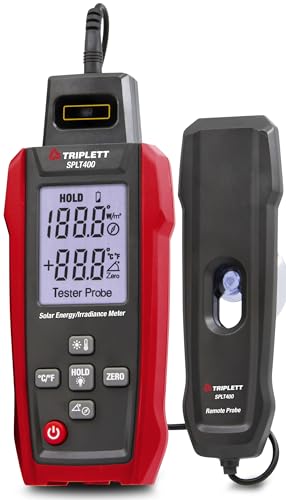
Triplett · Triplett SPLT400 Solar Irradiance and Temperature Meter | Sunlight Intensity Measurement with Tilt Angle and Compass
View on AmazonPrice and availability are shown on Amazon and can change at any time.
A handheld meter for siting solar panels, reading irradiance in watts per square metre from a cosine corrected silicon photodiode sensor on a 6.6 ft cable, with temperature, tilt from -90 to 90 degrees and a compass azimuth, able to show irradiance with temperature or tilt with compass at the same time. Data hold, switchable Fahrenheit and Celsius, a low battery indicator, four AA cells and a carrying case are included. The phrase that decides whether it is worth owning is cosine corrected. The figure that would tell you how far to trust a reading, an accuracy tolerance, is not published anywhere on the page.
Cosine corrected is the most useful phrase on the page
Most irradiance meters in this bracket say accurate. This one says cosine corrected silicon photodiode, which is a statement about how the sensor responds to light arriving at an angle, and on an instrument built for deciding where to put a panel that is the whole measurement.
Here is why. A flat sensor facing the sun collects the full beam. Tip it away and the same beam spreads across a larger area of the sensor face, so the power per unit area falls, and it falls as the cosine of the angle between the beam and the surface normal. That is not an error, it is what irradiance on a tilted plane actually is, and a panel behaves the same way.
The trouble is that a bare photodiode does not follow that cosine law. At steep angles it under reads, because light reflects off the surface instead of entering it and because the effective aperture stops scaling the way the geometry says it should. Correcting that means fitting a shaped diffuser over the element so the response does track the cosine, and a sensor built that way is described as cosine corrected.
For this instrument it matters twice over. You are deliberately measuring at angles, since the point of the tilt function is to find the tilt that collects most, and you are comparing readings taken in different orientations against one another. Without cosine correction those comparisons are not valid, and the instrument would be measuring its own geometry rather than the site.
It is also why the sensor sits on a 6.6 ft cable instead of in the body of the meter. The sensor head has to be placed in the plane of the proposed array, coplanar with where the glass will be, while you stand and read the display. Holding the whole instrument flat in one hand and calling that the plane of array is the commonest route to a meaningless number, and the cable is what prevents it. What solar irradiance is covers the quantity and its units.
The bullet headed accurate contains no accuracy figure
The third bullet is titled Accurate and Fast Measurements. What follows is a watts per square metre readout, a 300 ms sampling time and the sensor description. Two of those are real and the first word of the heading is supported by none of them.
A 300 ms sample is a speed specification. It tells you the reading settles quickly, which genuinely helps when walking a roof and watching a figure move as cloud passes, and it says nothing about whether the figure is right.
An accuracy specification for an irradiance meter looks quite different. It is a tolerance, normally a percentage of reading plus a fixed count, sometimes with a separate figure for angular response error and a separate figure for temperature drift of the sensor itself. None of those appears. Neither does a measurement range, so the highest irradiance the display will show is unstated, nor a resolution, so the smallest step is unstated too.
The same holds for the other three measurements. Temperature gets no range and no tolerance. Tilt gets a published range of -90 to 90 degrees and no tolerance. The compass gets neither. Anybody wanting to know how closely two readings can be compared has nothing to work from. Choosing a solar irradiance meter sets out which of those figures to insist on.
A silicon photodiode is not a reference pyranometer
Naming the sensor type is a disclosure, and it tells you what class of instrument you are buying.
Silicon responds across a band of wavelengths rather than the whole solar spectrum, and that band is narrower than the spectrum arriving at ground level. A silicon sensor is therefore calibrated against a reference spectrum, and it reports correctly while the real spectrum resembles that reference. When the spectrum shifts, under heavy overcast, at low sun angles, through haze or at altitude, the reading drifts away from the true broadband figure.
The alternative is a thermopile, which absorbs across the spectrum and measures the resulting heat, and which is what reference grade pyranometers use. Thermopiles are slower, which is part of why a 300 ms sample is worth publishing here, and they belong to a different class of instrument altogether.
So read the readings for what they are. Good for comparing one location, orientation or time of day against another. Good for quantifying what a chimney or a tree takes away. Good for sanity checking an array that is under performing. Not a calibrated absolute figure anybody would put into a performance guarantee. Nothing in the listing claims otherwise, which is to its credit, and no classification standard is named, so a buyer who needs one should assume this is not it.
The compass is magnetic, and the roof is steel
The fourth bullet gives a compass azimuth function for orientation tracking. The function is genuinely useful, because array output depends on azimuth as much as on tilt, and having bearing and tilt on the same screen as irradiance is the reason to carry one instrument rather than three.
Two cautions come with any magnetic compass and neither is in the bullets.
The first is declination. A magnetic compass points at the magnetic pole, not the geographic one, and the difference between them varies by location and drifts slowly over time. Solar design is done against true south or true north, so a magnetic bearing has to be corrected before it means anything. The listing does not say whether the instrument can hold a declination offset or whether it simply reports raw magnetic, which is the question to ask.
The second is local iron. Standing seam steel roofing, purlins, racking rails, conduit and a DC cable carrying current all deflect a magnetic needle, and on a commercial roof you are surrounded by all five. The reading shifts as you move, which makes it look precise and local when what it is actually doing is being pulled. Take the bearing away from metal, or take it at ground level clear of the building and transfer it.
The simultaneous display in the second bullet is the practical answer to the rest of the work. Irradiance with temperature, or tilt with compass, means a site reading is one glance rather than four button presses, and irradiance meters with temperature probes explains why the temperature channel belongs next to the irradiance one in the first place.
Four bullets of figures, and the tolerances that are absent
| Specification | Published in the listing |
|---|---|
| Irradiance readout | Watts per square metre |
| Irradiance sensor | Cosine corrected silicon photodiode |
| Sampling time | 300 ms |
| Tilt range | -90 to 90 degrees |
| Orientation | Compass azimuth function |
| Simultaneous display | Irradiance with temperature, or tilt with compass |
| Temperature units | Switchable Fahrenheit and Celsius |
| Other functions | Data hold, low battery indicator |
| Supplied | 6.6 ft sensor cable, four AA batteries, carrying case |
| Irradiance accuracy | Not stated in the listing bullets |
| Irradiance range and resolution | Not stated in the listing bullets |
| Temperature range and accuracy | Not stated in the listing bullets |
| Tilt accuracy | Not stated in the listing bullets |
| Compass accuracy or declination setting | Not stated in the listing bullets |
| Sensor spectral range or classification | Not stated in the listing bullets |
| Logging or data output | Not stated in the listing bullets |
| Battery life | Not stated in the listing bullets |
Data hold deserves a positive mention among all that. On a roof, with a sensor on a cable held at an angle in one hand and a display in the other, freezing the reading is what lets you look at it without changing it. It is a small function that reflects somebody having actually used the tool.
The absence of any data output reads as a design decision rather than an oversight. This is a meter you read and write down, and for site surveys that is normal.
A siting instrument, bought for the right reason
Buy it to answer siting questions. Which of two roof planes collects more. How much a chimney or a tree takes away at four in the afternoon. What tilt and bearing a mounting frame should be set to. Whether an existing array points where the installer said it does. For all of those the instrument is well shaped: the quantities are the right ones, they appear two at a time, the sensor can be placed in the plane of the array on its cable, and the angular response is corrected so that readings taken at different angles can be compared with each other.
Do not buy it to produce a figure somebody else will rely on. With no accuracy tolerance, no range, no resolution and no classification named, an irradiance number from it cannot be defended, and a commissioning or warranty measurement needs an instrument whose uncertainty is written down.
And set the compass expectation correctly. It is a magnetic bearing taken near a great deal of metal, so treat it as a good working indication and establish true orientation another way whenever the orientation is what matters.
Recommended Tools
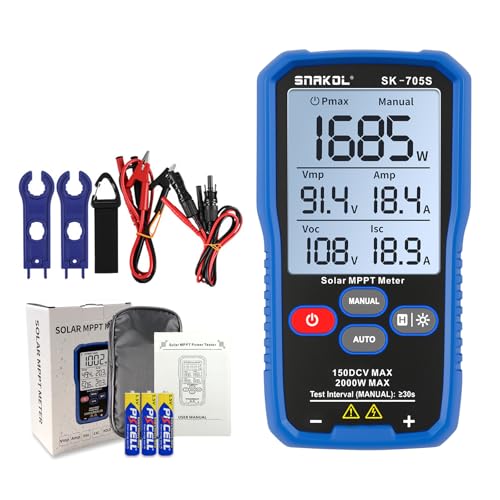


Products shown because their documented specifications fit this guide. Price and availability are on Amazon and can change.
Frequently Asked Questions
What does cosine corrected actually mean?
A flat sensor facing a light beam collects the full beam. Tip it away and the same beam spreads over a larger area of the sensor face, so the power per unit area falls as the cosine of the angle between the beam and the surface normal. That is what irradiance on a tilted plane genuinely is, and a panel behaves the same way. A bare photodiode does not follow that law at steep angles, because light reflects off the surface instead of entering it. Cosine correction means a shaped diffuser has been fitted so the response tracks the cosine, and on an instrument whose purpose is measuring at various tilts, that is the difference between comparable readings and meaningless ones.
Is a 300 ms sampling time an accuracy specification?
No. It is a speed specification, and a useful one when walking a roof and watching a figure change as cloud passes. Accuracy is a tolerance, normally a percentage of reading plus a fixed count, and sometimes with separate figures for angular response error and for temperature drift of the sensor. None of those appears here, nor does a measurement range or a resolution, so the bullet headed Accurate and Fast Measurements supports only the second half of its own heading.
Why is the sensor on a 6.6 ft cable instead of in the meter?
Because the sensor has to sit in the plane of the proposed array, coplanar with where the glass will be, while you stand and read the display. Holding the whole instrument flat in your hand and treating that as the plane of array is the commonest way to produce a meaningless figure, and the cable is what prevents it. It also means the sensor can be laid on an existing module, or set on a mounting frame, without the display being somewhere you cannot see.
Can I use its compass reading directly for panel azimuth?
Only with two corrections the bullets do not mention. A magnetic compass points at the magnetic pole rather than the geographic one, and solar design is done against true north or south, so the local declination has to be applied; the listing does not say whether the instrument can store an offset or whether it reports raw magnetic. And local iron deflects the needle, which on a commercial roof means standing seam steel, purlins, racking rails, conduit and current carrying DC cable all pulling at once. Take the bearing clear of metal.
Is a silicon photodiode good enough for solar work?
For siting work, yes. Silicon responds over a band of wavelengths narrower than the spectrum arriving at the ground, so it is calibrated against a reference spectrum and reads correctly while the real spectrum resembles it, drifting under heavy overcast, at low sun angles and through haze. The reference alternative is a thermopile, which absorbs across the spectrum and measures the heat, and which is slower. Read this instrument for comparing locations, orientations, times of day and shading, not for an absolute figure somebody else will rely on.
Affiliate disclosure: Akermin earns a commission from qualifying Amazon purchases made through links on this page. Our editorial picks are based on documented specifications and owner feedback, not commissions.