As an Amazon Associate, Akermin earns from qualifying purchases. Product links on this page are affiliate links.
For site survey and panel reporting work, P1 is the pick: the listing states a mono-crystalline sensor reading up to 1400 W/m2, and it offers temperature two ways, a built-in sensor or an external suction mount probe, plus integrated compass and inclination. P2 is the alternative when you want irradiance and temperature or tilt and compass shown together on screen, with a cosine-corrected silicon photodiode sampling at 300 ms. P3 is the budget entry, a handheld meter with a 0.1 to 1999.9 W/m2 range and a stated drift figure, but its listing publishes no temperature function at all, so it only belongs on this page as the light-only option. P4 is a weather station, not an irradiance meter, and is excluded from the picks.
Why the temperature channel changes what the light reading means
A silicon photodiode or a mono-crystalline reference cell responds to the light falling on it. That is the irradiance number, in watts per square metre. It is the input side of the performance equation. The output side depends on cell temperature, because a photovoltaic cell loses open-circuit voltage as it heats. A panel sitting in full sun at 25 C ambient can be far hotter at the surface, and the difference between a cool morning reading and a hot afternoon reading is not the light, it is the heat.
That is why a meter with a temperature probe is more useful than a meter with a light sensor alone. If you are surveying a roof to decide where to mount an array, you want to know how much light each candidate position receives and how warm the mounting surface gets. If you are troubleshooting an underperforming string, you want the irradiance at the plane of the array and the back-of-panel temperature at the same moment, so the two numbers describe the same conditions. A separate handheld thermometer can do the second job, but it introduces a time offset and a second instrument to carry.
The mechanism matters here. A suction mount probe sticks to the back of a panel and reads its surface temperature, which is closer to cell temperature than the air temperature is. A built-in sensor reads whatever the meter body is sitting in, usually ambient air. Both are useful, but they answer different questions. If the listing offers only one, know which one you are getting. For the broader relationship between the light reading and array output, see irradiance versus panel output.
Sensor type, range and sampling: what the three listings publish
The three picks use different light-sensing technologies, and the listings describe them differently. P1 states a mono-crystalline solar sensor with a range up to 1400 W/m2. P2 states a cosine-corrected silicon photodiode with a 300 ms sampling time. P3 states a wavelength range of 340 to 1100 nm and a sampling time of 2.5 times per second.
A mono-crystalline sensor is effectively a small reference cell of the same family as the panels being tested. A silicon photodiode is a solid-state light sensor. Both respond to the solar spectrum, but they are not identical, and the listing is the only authority on which one you are buying. Cosine correction matters because light arriving at a steep angle to the sensor face is under-read unless the sensor geometry compensates. P2’s listing states cosine correction; the others do not state it either way.
Sampling time tells you how quickly the displayed number settles. P2’s 300 ms and P3’s 2.5 readings per second are in the same order of magnitude; both are fast enough for a hand-held survey where you hold the meter steady and wait for a stable reading. None of the three listings publishes an accuracy figure in W/m2. P3 publishes a drift figure of under 1.5 percent per year, which is a stability statement, not an accuracy statement. If you need a stated accuracy, the listings do not provide one and you should ask the manufacturer.
| Specification | P1 | P2 | P3 |
|---|---|---|---|
| Light sensor type | Mono-crystalline solar sensor | Cosine-corrected silicon photodiode | Not stated beyond wavelength range |
| Irradiance range | Up to 1400 W/m2 | Not stated | 0.1 to 1999.9 W/m2 |
| Wavelength range | Not stated | Not stated | 340 to 1100 nm |
| Sampling time | Not stated | 300 ms | 2.5 readings per second |
| Temperature measurement | Built-in sensor or external suction mount probe | Temperature displayed alongside irradiance | Not stated |
| Tilt / inclination | Integrated inclination sensor | -90 to 90 degrees | Not stated |
| Compass | Integrated compass | Compass azimuth function | Not stated |
| Stated drift | Not stated | Not stated | Under 1.5 percent per year |
The table is deliberately sparse in places. Where a listing is silent, the honest answer is that the figure is not published, and no amount of comparing will produce it.
The three instruments that actually measure irradiance and temperature
Fluke IRR2-BT Solar Irradiance Meter
The only pick whose listing states two routes to temperature, a built-in sensor and an external suction mount probe, so you can read ambient air and panel surface temperature without carrying a second instrument. The listing also states a mono-crystalline sensor reading up to 1400 W/m2, an integrated compass, and an inclination sensor for documenting panel orientation and tilt.
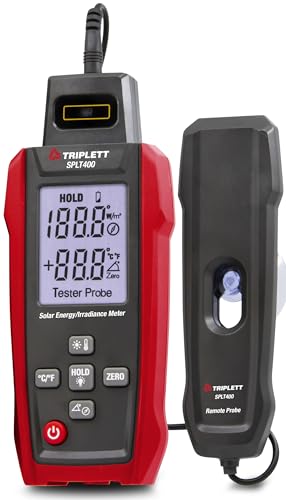
Triplett SPLT400 Solar Irradiance and Temperature Meter
The listing states simultaneous display of irradiance and temperature, or tilt and compass, which saves toggling between screens during a survey. The light sensor is a cosine-corrected silicon photodiode sampling at 300 ms, and tilt covers -90 to 90 degrees with a compass azimuth function.
DANOPLUS Solar Power Meter
A handheld light meter with a stated 0.1 to 1999.9 W/m2 range, switchable to Btu/(ft2-h), a 340 to 1100 nm wavelength range, a HOLD button and a stated drift under 1.5 percent per year. Its listing publishes no temperature measurement, so treat it as the light-only budget option.
Tilt, compass and the paperwork that travels with the reading
An irradiance number without a record of where the sensor was pointing is hard to reproduce. Two readings from the same roof can differ by a large margin if one was taken at the wrong tilt or azimuth. P1 and P2 both address this. P1’s listing states an integrated compass and inclination sensor to measure and document site and panel orientation and inclination. P2’s listing states tilt measurement from -90 to 90 degrees and a compass azimuth function for orientation tracking.
The practical value is in the report. If you are writing up a site survey, the panel plane tilt and the compass bearing are part of the record, alongside the irradiance and the temperature. A meter that captures all four in one visit reduces the chance of an inconsistent dataset. P3’s listing does not publish tilt or compass functions at all, so if orientation tracking is part of your procedure, P3 is not the instrument for that step.
There is a maintenance point that none of the listings dwell on. A light sensor is an optical surface. Dust, pollen, a fingerprint or a bird dropping on the diffuser will reduce the reading, and the error is silent because the meter still displays a plausible number. Wipe the sensor window before a survey and check it again at the end. The compass and tilt functions are less affected by surface contamination but can be disturbed by nearby steel or a magnetic mount, so keep the meter away from the racking when you take an orientation reading.
The fourth listing is a weather station, not an irradiance meter
P4 is a seven-in-one outdoor weather sensor with a Wi-Fi hub. Its listing states temperature, humidity, wind direction and speed, light and UV levels, and rainfall, transmitted to a hub and viewed in an app. It measures light and UV as part of a weather dataset. It does not publish an irradiance figure in watts per square metre, it does not publish a temperature probe for panel surface contact, and it does not publish tilt or compass functions for array orientation.
A weather station is a useful instrument for long-term site monitoring, but it answers a different question from a hand-held survey meter. If your task is to compare candidate mounting positions, or to record the plane-of-array irradiance and panel temperature during a commissioning check, the weather station is not the tool. It is excluded from the picks for that reason. If you want the wider category context, the guide to choosing a solar irradiance meter covers the decision in more depth.
Where a hand-held meter stops being the right answer
These instruments are survey and spot-check tools. They give you a reading at a moment in time, at a place you choose. They are not data loggers, and none of the three listings publishes a logging interval, internal memory or an export format. If you need a continuous record of irradiance and temperature across a day or a season, a hand-held meter is the wrong class of instrument, and you should be looking at a fixed sensor with a logger.
They are also not electrical test instruments. An irradiance meter tells you how much light is arriving; it does not tell you whether a string is connected correctly, whether an inverter is tracking, or whether a fuse has blown. Those checks need a multimeter or a clamp meter rated for the DC side of a photovoltaic system. The solar clamp meters page covers that side of the job. A survey visit usually needs both: the irradiance and temperature record from this meter, and the electrical measurements from a separate instrument.
Finally, none of these meters is a safety device. They do not alarm, they do not warn you of live conductors, and they do not replace a risk assessment. They are measuring instruments for people who already know what they are doing on a roof or at a combiner box.
Recommended Tools


Products shown because their documented specifications fit this guide. Price and availability are on Amazon and can change.
Frequently Asked Questions
Do I need a temperature probe, or is the irradiance reading enough?
If you are only comparing how much light two positions receive, a light-only meter is sufficient. If you are explaining why an array is underperforming, or writing a commissioning report, you need the panel temperature as well, because cell output falls as temperature rises. P1 and P2 both publish temperature measurement; P3 does not.
What is the difference between a built-in temperature sensor and a suction mount probe?
A built-in sensor measures the temperature of the meter body, which is usually close to ambient air temperature. A suction mount probe attaches to the back of a panel and reads its surface temperature, which is closer to cell temperature. P1's listing states both options, so you can record ambient and panel temperature in the same visit.
Why do the listings not publish an accuracy figure in W/m2?
That is what the supplied listings state, and the absence is real. P3 publishes a drift figure of under 1.5 percent per year, which describes how much the reading may change over time, not how close it is to the true value. If accuracy is critical to your procedure, ask the manufacturer for the calibration specification before buying.
Can I use one of these meters to log irradiance over a full day?
None of the three listings publishes a logging function, memory or export format. They are hand-held spot-check instruments. For continuous recording you need a fixed sensor connected to a data logger, which is a different product class.
Is the ECOWITT weather station a substitute for an irradiance meter?
No. Its listing states light and UV levels as part of a weather dataset, but it does not publish an irradiance figure in watts per square metre, a panel contact temperature probe, or tilt and compass functions. It is a different instrument for a different job.
Which pick is best for documenting panel orientation and tilt?
Both P1 and P2 publish orientation and tilt functions. P1 states an integrated compass and inclination sensor; P2 states tilt from -90 to 90 degrees and a compass azimuth function. P3 publishes neither. Choose between P1 and P2 on whether you want the external suction probe for panel temperature, which only P1's listing states.
Affiliate disclosure: Akermin earns a commission from qualifying Amazon purchases made through links on this page. Our editorial picks are based on documented specifications and owner feedback, not commissions.
Related Guides

UNI-T UT503PV Review: A DC 1000 V Headline on a CAT III 600 V Body
A solar insulation resistance tester that works on energised PV strings up to DC 1000 V, with test voltages of 125, 250, 500 and 1000 V, a range to 4000 megohms, automatic discharge, 1000 stored result sets and USB or Bluetooth transfer.
Read More→
ANCEL BA101 Review: The Exclusion List Is the Most Useful Bullet
A 12 volt battery, cranking and charging system tester covering 100 to 2000 CCA that reports state of health, state of charge, voltage, current and CCA, drawing its own power from the battery under test.
Read More→
Tenmars Solar Power Meter Review: One Accuracy Figure, Two Very Different Jobs
A handheld solar irradiance meter reading 0 to 1999 watts per square metre or 0 to 634 BTU per square foot per hour, with a selectable 199.9 or 1999 scale, maximum and minimum tracking, data hold and manual zeroing.
Read More→