As an Amazon Associate, Akermin earns from qualifying purchases. Product links on this page are affiliate links.

VETOUCH · VETOUCH Plug in CO2 Detector Wall, 3-in-1 Air Quality Monitor CO2 Alarm, Digital Display CO2 Monitor, Household Temp Humidity Meter, Real-Time CO2 Level Sensor Alert for Home Office School Garage
View on AmazonPrice and availability are shown on Amazon and can change at any time.
A mains powered monitor that plugs straight into an outlet and shows carbon dioxide, temperature and humidity together on a 1.83 inch colour screen, with three brightness settings including off and a display that can be rotated 180 degrees by a five second button press. Its first bullet states clearly that it measures carbon dioxide and is not a carbon monoxide or smoke alarm, which is a disclosure worth praising. Its bullets never name the sensor technology, never give a measuring range, never give an accuracy figure and never describe the alarm that appears in the product name.
Credit the warning most sellers would have cut
Inside the first bullet, in capitals, is an important note saying the device detects carbon dioxide and not carbon monoxide, that it is an air quality monitor, and that it is not a substitute for a smoke or carbon monoxide alarm.
That sentence costs the seller sales and it is exactly right. The two gases share two letters and nothing else. Carbon dioxide is the ordinary product of breathing, present in outdoor air at roughly 420 parts per million, and a rising indoor figure is a statement about ventilation rather than about poison. Carbon monoxide comes from incomplete combustion, is odourless, and is dangerous at a few tens of parts per million.
The warning is necessary because of the shape of this product. A small white box that plugs into a wall socket and displays a number with a coloured status is precisely the form factor people associate with a plug in carbon monoxide alarm, and a shopper scanning a page can easily read CO2 as CO. Publishing the distinction in the first bullet rather than burying it is the responsible choice, and quite a few listings in this category do not make it. If the distinction is new to you, carbon dioxide against carbon monoxide sets out why one is a ventilation signal and the other a life safety one.
No sensor type, which is the fact the rest depends on
Having been careful about what gas it measures, the listing declines to say how.
Two technologies dominate at this size. An infrared absorption sensor passes a beam through a small chamber and measures how much energy disappears at a wavelength carbon dioxide absorbs. That is a measurement of the gas itself, and its characteristic weakness is slow baseline drift which manufacturers handle with periodic recalibration.
The alternative is a metal oxide semiconductor sensor that does not respond to carbon dioxide at all. It responds to volatile organic compounds, and firmware converts that response into an estimated carbon dioxide figure on the reasoning that people emit both. That number is usually labelled eCO2, where the e stands for estimated. It follows occupancy in a bedroom quite convincingly and then reports a spike when somebody opens a bottle of cleaning fluid, fries an onion or paints a wall. The failure is not noise, it is a confident wrong answer.
Nothing in these five bullets distinguishes the two, and the product name uses the word sensor without qualification. For comparison, another monitor in the same set names its infrared carbon dioxide sensor explicitly and lists the sensing method for each of its other channels, which is how it should be done. Our walkthrough on checking whether a monitor uses a true infrared sensor lists what to ask and what the readings look like in each case.
An alarm in the title and nowhere in the bullets
The product name contains the words CO2 Alarm and Real-Time CO2 Level Sensor Alert. Read all five bullets looking for either and you find nothing.
There is no threshold. No sound pressure level. No statement that a buzzer exists. No description of a colour change on the display. No mention of a user settable limit. The only outputs described anywhere on the page are three numbers on a screen, a choice of three brightness levels, and the ability to turn the screen round.
That matters more than it sounds, because one of the three brightness levels is off. A device whose only documented output is a display, used with the display switched off at night, has no documented output at all. If there is a buzzer, the listing has not said so.
The honest conclusion is narrow. Treat the alarm wording as language in the title rather than as a feature, and if you want to be told when the air goes bad rather than finding out when you look, confirm with the seller that an audible alert exists and at what level it triggers. The figure you would want it set near is covered in what counts as a good indoor carbon dioxide level.
An outlet is the wrong height for two of the three readings
Plug and play is the first bullet and it is a real advantage. Nothing to charge, nothing to replace, and the monitor stays where it was put rather than migrating to a shelf and running flat. A permanently powered sensor is also the only kind that gives you a continuous picture.
The placement follows from the power, though, and it is not the placement you would choose. Outlets sit low on a wall. Air near the floor is cooler than air in the room, and draughts from doors, skirting gaps and floorboards collect there, so a temperature reading at outlet height describes the coldest layer in the room. The humidity reading inherits the same bias, since relative humidity depends on temperature: measure cooler air and the same amount of moisture reads as a higher percentage.
There is a second mechanism pushing the other way. The electronics that step mains voltage down to the few volts the sensors need dissipate that difference as heat, inside the same small plastic body that holds the temperature sensor. Self heating biases the reading upward. The two effects do not cancel in any predictable amount.
Carbon dioxide is the reading least affected, because carbon dioxide mixes thoroughly through a room rather than pooling by the floor in any way that matters at indoor concentrations. So the ventilation signal, which is the reason to own this, survives the placement better than the comfort readings do. The two comfort channels are the ones to treat as indicative.
The display choices, and the four figures that are missing
| Reading or feature | What the listing states |
|---|---|
| Carbon dioxide | Measured, technology not named |
| Temperature | Measured |
| Humidity | Measured |
| Carbon monoxide | Explicitly not detected |
| Power | Plugs into any outlet, no batteries needed |
| Screen | 1.83 inch colour |
| Brightness | Three settings: off, low and high |
| Orientation | Rotates 180 degrees on a five second long press |
| Carbon dioxide measuring range | Not stated in the listing bullets |
| Carbon dioxide accuracy and resolution | Not stated in the listing bullets |
| Whether the figure is measured or estimated | Not stated in the listing bullets |
| Alarm threshold, and whether any sound exists | Not stated in the listing bullets |
| Calibration or baseline correction behaviour | Not stated in the listing bullets |
| Logging, history or data export | Not stated in the listing bullets |
The two display features are the strongest part of the page and they are strong for the same reason: somebody thought about where this device physically lives. Outlet orientation is not standardised, and a plug in monitor with a fixed screen is upside down in about half the sockets in a house. A five second press to rotate the image removes that problem for nothing. An off setting for the backlight matters in a bedroom, where a glowing number by the skirting board is the reason people unplug these.
The 1.83 inch screen carries a bolder claim, that you can read carbon dioxide, temperature and humidity from fifteen feet away. Three values sharing a screen that size leaves each of them a small fraction of a short diagonal, and fifteen feet is a long way to read a small digit. Colour helps, since a status band can be judged at a distance even when the number cannot. Expect to read the colour across the room and the figures from nearer.
The blank rows are the review, though. A carbon dioxide monitor with no stated range, no accuracy, no resolution and no sensor technology has published nothing that can be checked against any other device.
Buy it to watch a trend, not to quote a number
This makes sense as an ambient awareness device in a bedroom, a home office, a small classroom or a garage workshop: something that sits in the wall, never needs charging, and goes from green to red when a room has filled up and nobody has opened a window. For that purpose the display engineering is better than average and the honest carbon monoxide warning means nobody is being misled about what it protects against.
It is the wrong device if the number itself has to mean something. Without a stated sensor technology you cannot know whether you are reading carbon dioxide or an estimate derived from volatile organic compounds, and those two behave differently in exactly the situations where you would consult the monitor, such as a kitchen or a freshly cleaned room. Without a range, an accuracy figure or a calibration description there is nothing to compare against a second instrument.
And it is not a safety device of any kind, which the seller says before you do. If you want to be told about a hazard rather than about stuffiness, buy a carbon monoxide alarm as well, and keep this for the ventilation question it is actually built for.
Recommended Tools


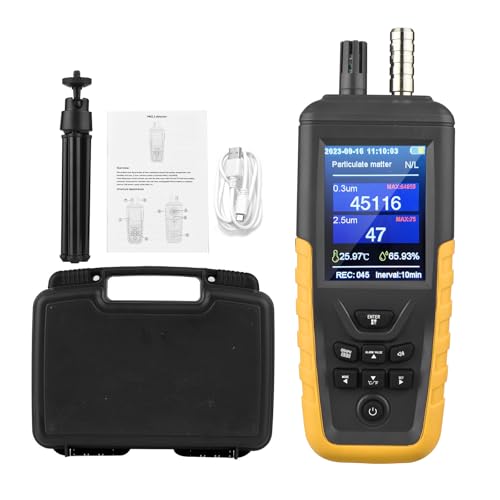
Products shown because their documented specifications fit this guide. Price and availability are on Amazon and can change.
Frequently Asked Questions
Does this detect carbon monoxide?
No, and the listing says so in capital letters inside its own first bullet. It detects carbon dioxide, and it is explicit that it is not a substitute for a smoke or carbon monoxide alarm. The two gases are unrelated in every way that matters. Carbon dioxide is what you exhale and what tells you a room is under ventilated. Carbon monoxide is a product of incomplete combustion and is acutely poisonous at concentrations thousands of times smaller. A device for one is no protection against the other.
Does the listing say what kind of carbon dioxide sensor it uses?
It does not, anywhere, and that is the gap that decides the purchase. There are two families in this price bracket. A true infrared sensor shines a beam through a sample chamber and measures how much is absorbed at a wavelength carbon dioxide absorbs, which is a direct measurement of the gas. The alternative is a metal oxide sensor that responds to volatile organic compounds and reports an estimated figure derived from them, usually labelled eCO2. The second kind tracks a room full of people reasonably and can be fooled completely by cooking, cleaning products or fresh paint.
Will the temperature reading be reliable in a wall outlet?
Two things work against it and the listing addresses neither. The unit is mains powered, and the circuitry that converts mains to low voltage dissipates heat inside the same small enclosure that holds the sensor, which biases the reading upward. And an outlet is usually near the floor, where air is cooler and draughts from doors and skirting collect, so the reading describes the ankle zone rather than the room. Another monitor in this group states plainly that continuous mains operation can warm its own sensor. This listing stays quiet about it.
What alarm does it actually have?
The listing never says. The product name contains the words CO2 Alarm and Real-Time CO2 Level Sensor Alert, and then no bullet describes a threshold, a buzzer, a sound level or a colour change. The only outputs described anywhere are numbers on a screen and three brightness settings, one of which is off. Until a seller confirms otherwise, treat the alert language as marketing and the device as a display.
Why does the 180 degree screen flip matter?
Because outlet orientation is not standardised and a plug in device with a fixed screen reads upside down in roughly half of them. Some outlets are installed with the ground pin up, some down, some in a strip at an angle, and a monitor you cannot read is a monitor you ignore. A long press of five seconds to rotate the display is a very small piece of engineering that removes a reason to unplug the thing and put it in a drawer. It is the most thoughtful line in the listing.
What should a carbon dioxide monitor listing publish?
Four figures and one technology. The sensor type, so you know whether the number is measured or estimated. The measuring range in parts per million, since outdoor air sits around 420 and occupied rooms routinely pass 1000. An accuracy specification, normally expressed as a fixed part plus a percentage of reading. A resolution. And the calibration behaviour, because many low cost infrared sensors apply an automatic baseline correction that assumes the room reaches outdoor levels periodically, which is wrong in a space that is occupied continuously.
Affiliate disclosure: Akermin earns a commission from qualifying Amazon purchases made through links on this page. Our editorial picks are based on documented specifications and owner feedback, not commissions.
Related Guides

Temtop Handheld Particle Counter Review: Three Channels and No Published Flow Rate
A pump suction handheld particle counter reading 0.3, 0.5 and 1.0 micron channels alongside PM2.5, PM10 and TSP, with temperature and humidity sensors, 32 GB of internal storage and a 3500 mAh battery.
Read More→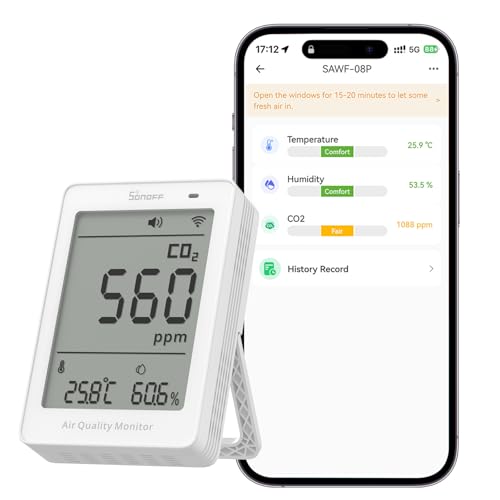
SONOFF AirGuard SAWF-08P Review: NDIR Accuracy Written as a Formula
A mains powered Matter compatible monitor showing CO2, temperature and humidity on one screen, with an NDIR sensor, 5 second updates and 12 months of history in the eWeLink app.
Read More→
Sainlogic Air Quality Monitor Review: A Tolerance for Temperature, None for CO2
A portable indoor air quality monitor with a 7.2 inch display, tri colour status LED, seven thresholds you set yourself and nine readings covering CO2, three particulate sizes, formaldehyde, TVOC, temperature and humidity.
Read More→