As an Amazon Associate, Akermin earns from qualifying purchases. Product links on this page are affiliate links.
1,000 ppm means one thousand CO₂ molecules for every million molecules of air, or 0.1 percent. Outdoor air is about 420 ppm, so a room at 1,000 ppm carries roughly 580 ppm of CO₂ added by the people in it. Because exhaled breath is about 40,000 ppm, that works out to about 1.5 percent of the room’s air being air someone has already breathed. Ventilation standards land on 1,000 ppm as the level at which fresh-air supply is just adequate, which is why it appears on so many guidelines as the point to act.
Parts per million, plainly
A ppm is a proportion, like a percentage but a million times finer. 10,000 ppm equals 1 percent. So:
| Concentration | ppm | Percent |
|---|---|---|
| Outdoor air (2026) | 420 | 0.042% |
| Ventilation action point | 1,000 | 0.1% |
| Stuffy meeting room | 2,000 | 0.2% |
| 8-hour occupational limit | 5,000 | 0.5% |
| Exhaled breath | 40,000 | 4% |
Where the 1,000 ppm figure comes from
Building ventilation standards specify fresh air per person, commonly in the range of 7 to 10 liters per second. Run the steady-state arithmetic with a seated adult’s CO₂ output and outdoor air at 420 ppm, and the room settles at roughly 1,000 to 1,100 ppm. In other words, a room sitting at 1,000 ppm is receiving about the minimum fresh air the standard calls for. Below that number the room is doing better than the standard; above it, worse. The figure has been in guidance since the nineteenth century, when Max von Pettenkofer proposed 1,000 ppm as the threshold for “good” indoor air on the basis of odor.
The re-breathed fraction
A more intuitive way to read the number: the share of the air in the room that has already been through someone’s lungs. Subtract outdoor CO₂ and divide by the CO₂ in breath: (1,000 − 420) ÷ 40,000 ≈ 1.5 percent. At 2,000 ppm it is about 4 percent; at 3,000 ppm about 6.5 percent. That fraction is what matters for anything airborne that people exhale, which is why public-health guidance during the pandemic pushed targets down toward 800 ppm.
What people notice at 1,000 ppm
Most people notice nothing. The air may smell slightly “used” to someone walking in from outside. Studies of decision-making have found measurable effects in some participants at 1,000 ppm and clearer effects at 1,500 to 2,500 ppm, though the results vary and not every study finds them. Treat 1,000 ppm as the point where the room could be better, not the point where it is bad. See what a good indoor CO₂ level is for the full set of bands.
What to do at 1,000 ppm
- If people will stay, open a window or door, or raise the fresh-air setting on the ventilation system.
- Watch the trend. A room rising through 1,000 ppm will be at 1,500 ppm within the hour if nothing changes; a room falling through it is fine.
- In a bedroom overnight, 1,000 ppm is a good result. See why indoor CO₂ rises overnight.
For what the next threshold means, see what 2,000 ppm CO₂ means indoors. Enter any reading in the CO₂ level checker for an interpretation.
Recommended Tools
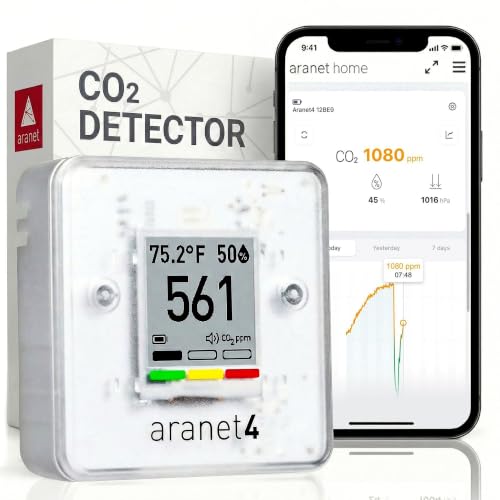
Products shown because their documented specifications fit this guide. Price and availability are on Amazon and can change.
Frequently Asked Questions
Is 1,000 ppm CO₂ dangerous?
No. Occupational exposure limits are 5,000 ppm over an eight-hour day. 1,000 ppm is a ventilation benchmark, not a health limit.
What percentage is 1,000 ppm?
0.1 percent. Outdoor air at 420 ppm is 0.042 percent. Exhaled breath is about 4 percent, or 40,000 ppm.
How long can a room stay at 1,000 ppm?
Indefinitely as far as safety goes. For comfort and concentration, most guidance suggests acting when a room sits above 1,000 ppm for more than an hour or two.
Affiliate disclosure: Akermin earns a commission from qualifying Amazon purchases made through links on this page. Our editorial picks are based on documented specifications and owner feedback, not commissions.