As an Amazon Associate, Akermin earns from qualifying purchases. Product links on this page are affiliate links.
Indoor CO₂ rises overnight because a bedroom with the door and windows closed has almost no air exchange, while the people in it keep exhaling about 0.3 liters of CO₂ per minute each. Over eight hours that is enough to take a typical bedroom from 500 ppm to 2,000 ppm or more. Opening the door, cracking a window, or running a bedroom extract fan is what brings the morning number down.
The arithmetic
A resting adult exhales roughly 15 to 20 liters of CO₂ per hour. A 12 m² bedroom with a 2.4 m ceiling holds about 29 m³ of air. Add 18 liters of CO₂ to 29,000 liters of air and the concentration rises by about 620 ppm per hour per person if nothing leaves the room. In practice the room leaks a little, so the real rise is slower, but the direction is obvious: two people in a closed room are adding more than 1,000 ppm per hour to a space that can only shed a fraction of that through gaps around the door.
The curve flattens as the night goes on, because the higher the indoor concentration, the more CO₂ escapes through every crack. A room settles toward a steady state where leakage matches production. In a tight modern bedroom that steady state can be 3,000 ppm; in a drafty old one it might be 1,500 ppm.
What a monitor shows
A CO₂ monitor left in a bedroom shows the same shape almost every night: a steady climb from bedtime, a plateau in the early hours, and a sharp drop when the door opens in the morning. The plateau level tells you how well the room ventilates. Compare nights with the door open and closed and the difference is usually a thousand ppm or more.
Why it matters
CO₂ at these levels is not harmful in itself. What matters is what it indicates: stale air, higher humidity, and a concentration of everything else that two sleeping people exhale. Studies that have manipulated bedroom ventilation report better sleep quality and next-morning alertness with more fresh air, with the effect appearing somewhere above 1,000 to 1,500 ppm. See what a good indoor CO₂ level is for the bands.
What actually fixes it
- Door ajar. The cheapest fix. Opening the bedroom door to the rest of the house typically halves the morning reading because the bedroom now shares the whole house’s volume.
- Window cracked. Even a few centimeters makes a large difference on a still night, more on a windy one. Trickle vents do the same job quietly.
- Extract fan or MVHR. Homes with mechanical ventilation should have a bedroom supply or extract. If the reading still climbs, the system is off, blocked or under-sized.
- Fewer people, bigger room. Obvious, but it explains why a child’s box room with two children can be the worst room in the house.
What does not fix it
An air purifier, a fan pointed at the bed or the air conditioning do not remove CO₂; they move or filter the same air. See does an air purifier remove CO₂ and does air conditioning reduce CO₂. Houseplants absorb a trivial amount; see can plants lower indoor CO₂.
Monitoring it
A battery-powered NDIR monitor on a bedside shelf, a meter or more from the pillow so breath does not inflate the reading, records the night curve. The best CO₂ monitors guide covers models with history charts. A caution: monitors that self-calibrate assume the room reaches outdoor air each week, which a closed bedroom never does. Open it up periodically or calibrate manually; see how to calibrate a CO₂ monitor.
Recommended Tools
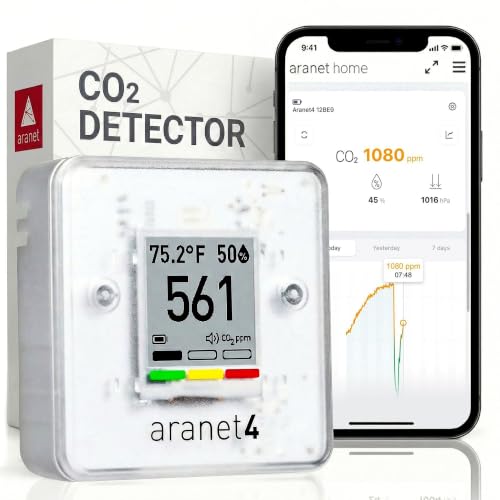

Products shown because their documented specifications fit this guide. Price and availability are on Amazon and can change.
Frequently Asked Questions
How high does bedroom CO₂ get overnight?
With the door and window closed, one sleeper typically reaches 1,500 to 2,000 ppm and two sleepers 2,000 to 3,000 ppm by morning. Small rooms and tightly sealed new homes go higher.
Does high bedroom CO₂ affect sleep?
Several controlled studies have linked bedroom CO₂ above about 1,000 to 1,500 ppm with poorer reported sleep quality and lower next-day performance. The effect is modest and not everyone notices it, but it is consistent.
Is it safe to sleep in 2,500 ppm CO₂?
It is not dangerous; occupational limits are 5,000 ppm over a working day. It is simply stale air, and most people sleep better with the door ajar or a window cracked.
Affiliate disclosure: Akermin earns a commission from qualifying Amazon purchases made through links on this page. Our editorial picks are based on documented specifications and owner feedback, not commissions.