As an Amazon Associate, Akermin earns from qualifying purchases. Product links on this page are affiliate links.
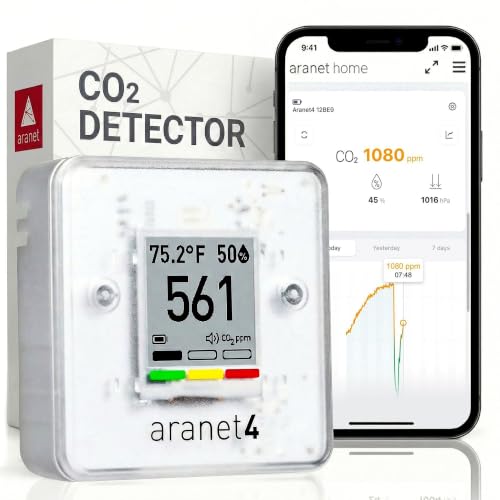
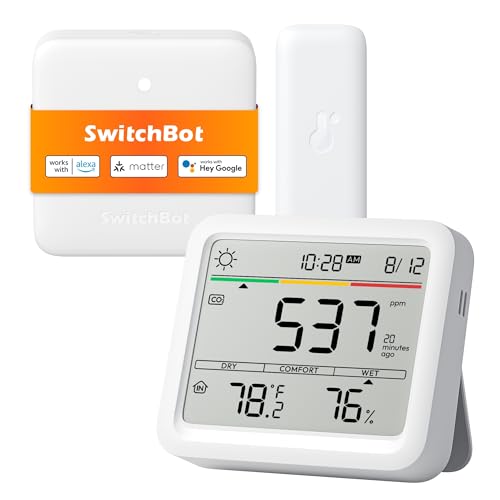
For pure local data review, the SAF Aranet4 Indoor Air Quality Monitor is the cleanest pick: the listing states a smartphone app that views and analyses up to 90 days of historical data from the meter, with user-friendly graphs, and an e-ink display that shows the current CO2 number without waking a phone. The SwitchBot CO2 Detector (Meter Pro CO2) is the better choice if you want the raw export habit built in, because the listing gives a stated ±50 ppm accuracy, a 400 to 9000 ppm range, a one second sampling interval and a 92 mm screen that shows CO2, temperature, humidity, time, date and comfort level at once. The Temtop M2000C 2nd with T1 Thermometer is the one to consider if you also need particulate data and a CSV file, since its listing states USB CSV export and PM2.5 and PM10 alongside CO2. The Qingping Air Quality Monitor Gen 2 covers the widest metric list, seven in total including noise and eTVOC, with a replaceable PM sensor and a 30 day app history.
What local data review actually requires from a CO2 monitor
The phrase local data review means you, not a cloud service, decide what the record contains and how long you keep it. That changes which specifications matter. A monitor can show a perfect current reading and still be useless for review if it keeps only a rolling hour in memory, or if the history lives behind an account you cannot export from.
Three things decide whether a monitor is reviewable. First, the logging window: how far back the stored history reaches. The SAF Aranet4 Indoor Air Quality Monitor states up to 90 days through its app. The Qingping Air Quality Monitor Gen 2 states 30 days. The Temtop M2000C 2nd with T1 Thermometer states data export but not a retention period. The SwitchBot CO2 Detector (Meter Pro CO2) states a sampling interval of one second but not a history length. Second, the export path: a CSV file over USB, as the Temtop M2000C 2nd with T1 Thermometer states, is the most portable; an app graph, as the SAF Aranet4 Indoor Air Quality Monitor and the Qingping Air Quality Monitor Gen 2 state, is easier to read but harder to move. Third, the sensor itself. Carbon dioxide in indoor air is measured with a non-dispersive infrared cell, usually shortened to NDIR. An NDIR cell counts how much infrared light is absorbed by the air sample, and the absorption is proportional to the number of CO2 molecules in the path. That is why NDIR is the standard method. The SwitchBot CO2 Detector (Meter Pro CO2) names a Swiss-made NDIR sensor explicitly. The SAF Aranet4 Indoor Air Quality Monitor, the Temtop M2000C 2nd with T1 Thermometer and the Qingping Air Quality Monitor Gen 2 describe CO2 measurement without naming the sensor type in the listing bullets.
For the wider question of what to log and how to keep it, see how to choose a CO2 data logger for long term monitoring.
The comparison table: what each listing publishes
| Feature | SAF Aranet4 Indoor Air Quality Monitor | Temtop M2000C 2nd with T1 Thermometer | Qingping Air Quality Monitor Gen 2 | SwitchBot CO2 Detector (Meter Pro CO2) |
|---|---|---|---|---|
| Metrics stated | CO2, temperature, relative humidity, atmospheric pressure | CO2, PM2.5, PM10, temperature, humidity | Temperature, humidity, CO2, PM2.5, PM10, eTVOC, noise | CO2, temperature, humidity, time, date, comfort level |
| History window | Up to 90 days in app | Not stated | Last 30 days in app | Not stated |
| Export method | App graphs | CSV via USB | App export, last 30 days | Not stated |
| CO2 range | Not stated | Not stated | Not stated | 400 to 9000 ppm |
| CO2 accuracy | Not stated | Not stated | Not stated | ±50 ppm |
| Sensor type named | Not stated | Swiss-made hygrometer for temperature and humidity | Not stated | Swiss-made NDIR |
| Display | E-ink, colour coded | Not stated | 4 inch IPS touchscreen, 254 PPI | 92 mm screen |
| Battery | Up to 4 years | Not stated | Not stated | Up to 12 months |
| Alarms | Optional buzzer | Not stated | Not stated | Sound, screen, app notifications |
| Connectivity | Smartphone app | USB | Wi-Fi 2.4 or 5 GHz | Alexa-enabled, hub required for app alerts |
The table is deliberately sparse in places. Where a cell reads Not stated, the listing genuinely does not publish that figure, and no reader should infer it from the others. A monitor with a stated 400 to 9000 ppm range and ±50 ppm accuracy, as the SwitchBot CO2 Detector (Meter Pro CO2) has, tells you more about its CO2 channel than a monitor that only says it measures CO2.
The four monitors, and what each one gives you to review
SAF Aranet4 Indoor Air Quality Monitor
The listing states a smartphone app for viewing and analysing up to 90 days of historical data, with graphs, and an e-ink display that keeps the current CO2 number visible without a phone. That combination, a long history window plus an always-on local readout, is what makes it the default for reviewing your own CO2 record.
Temtop M2000C 2nd with T1 Thermometer
The listing states CSV export via USB and monitoring of CO2, PM2.5 and PM10. If your review includes particles as well as carbon dioxide, and you want a file you can open in a spreadsheet, this is the bundle that names the export path explicitly.
Qingping Air Quality Monitor Gen 2
Seven metrics are stated, including CO2, PM2.5, PM10, eTVOC and noise, with a 4 inch IPS touchscreen at 254 PPI and a replaceable PM sensor. The listing states a 30 day app history and Wi-Fi connection on 2.4 or 5 GHz. Best for a broad picture rather than a narrow CO2 log.
SwitchBot CO2 Detector (Meter Pro CO2)
The listing states a Swiss-made NDIR sensor measuring every 1 second at ±50 ppm over 400 to 9000 ppm, three alarm methods, and a 92 mm screen showing CO2, temperature, humidity, time, date and comfort level. Strongest on stated sensor specification and on-screen density.
Reading the sensor claims: NDIR, accuracy and the resolution trap
Carbon dioxide readings are only as good as the cell inside. NDIR works by passing infrared light through a sample chamber and measuring absorption at the wavelength CO2 absorbs. The output is a concentration, not a proxy. Metal oxide sensors and estimated readings from volatile organic compounds are sometimes marketed as CO2 measurement, but they infer rather than measure, and they drift with humidity and with other gases. The SwitchBot CO2 Detector (Meter Pro CO2) is the only listing here that names the method, Swiss-made NDIR, and pairs it with a stated accuracy of ±50 ppm and a range of 400 to 9000 ppm. Those two numbers together are the most useful pair in this comparison, because they tell you both the smallest difference the device claims to resolve and the span over which the claim holds.
Watch for the resolution trap. A listing that quotes a very fine number without a range is often quoting display resolution, the number of decimal places the screen can show, not accuracy. A consumer CO2 monitor claiming 1 ppm accuracy would be making a claim that is implausible for the technology at this level, and it is more likely quoting the last digit of the display. None of the four listings here makes that claim, which is a point in their favour.
Temperature and humidity matter to CO2 review because the two are linked in the room, not because the sensor is confused by them. Warm, humid air is less dense, so a given number of CO2 molecules occupies a slightly different volume. More practically, humidity tells you whether the room is being ventilated with dry outdoor air, and temperature tells you whether the ventilation is also cooling the space. The Temtop M2000C 2nd with T1 Thermometer states temperature accuracy of up to ±0.5 degrees Fahrenheit and humidity accuracy of ±3 percent relative humidity for its separate indoor thermometer. That is a stated figure for a different device in the bundle, so do not apply it to the CO2 channel.
Getting the data out: apps, CSV and the one-second sample
A one second sampling interval, as the SwitchBot CO2 Detector (Meter Pro CO2) states, sounds like a lot of data. In practice, CO2 in a room changes on the scale of minutes, not seconds, because the driver is the balance between people exhaling and fresh air arriving. A one second interval is useful for watching a door open or a window close in real time on the screen. It is not the same as a one second log, and the SwitchBot CO2 Detector (Meter Pro CO2)’s listing does not state a history length, so treat the interval as a live response figure rather than a record depth.
For a record you can actually review, the export path is the deciding feature. The Temtop M2000C 2nd with T1 Thermometer states CSV export via USB, which is the most portable format: a plain text table any spreadsheet opens. The SAF Aranet4 Indoor Air Quality Monitor states a smartphone application for viewing and analysing up to 90 days of historical data, complete with graphs. The Qingping Air Quality Monitor Gen 2 states that historical data of the last 30 days can be checked or exported in the Qingping+ app. The SwitchBot CO2 Detector (Meter Pro CO2)’s listing does not state an export method. If your review means building a spreadsheet, the Temtop M2000C 2nd with T1 Thermometer is the direct route. If it means looking at a graph on a phone each week, the SAF Aranet4 Indoor Air Quality Monitor gives you the longest stated window.
There is a maintenance point nobody mentions. NDIR cells drift slowly as the lamp ages and the optics gather dust. Many monitors self-calibrate by assuming that the lowest CO2 reading they see over a period is fresh outdoor air at roughly 400 ppm. If the room is never ventilated to that level, the baseline creeps. The practical fix is to take the monitor outside or into genuinely fresh air periodically, or to follow the manufacturer’s calibration instruction. None of these four listings states a calibration procedure, so check the manual before you rely on a months-long record.
Where a CO2 monitor stops being the right instrument
Carbon dioxide is a ventilation indicator. It tells you how much exhaled air has accumulated, and by extension whether fresh air is reaching the room. It does not tell you about particles, and it does not tell you about combustion gases. If your concern is smoke, cooking fumes or fine dust, a CO2 number will look reassuring while the particle count is high. The Temtop M2000C 2nd with T1 Thermometer and the Qingping Air Quality Monitor Gen 2 include PM2.5 and PM10 alongside CO2, which is why they suit a broader review. For a dedicated particle job, see best air particle monitors.
CO2 monitors are also not safety devices for combustion. A monitor that reads CO2 does not detect carbon monoxide, which is a different gas produced by incomplete burning and is the one that kills. A carbon dioxide reading is not a substitute for a CO alarm, and none of these four listings claims to be one. If you are monitoring a garage, a boiler room or anywhere with a fuel-burning appliance, you need a dedicated CO alarm in addition, not instead.
Finally, a monitor is not an alarm in the regulatory sense. The SwitchBot CO2 Detector (Meter Pro CO2) states three alarm methods, sound, screen and app notification, but an alert on a phone is not the same as a certified alarm. Use these devices to inform ventilation decisions, not to satisfy a safety requirement. For bedroom-specific guidance, bedroom CO2 monitors covers the overnight case where the display brightness and the alarm behaviour matter more than the export format.
Recommended Tools


Products shown because their documented specifications fit this guide. Price and availability are on Amazon and can change.
Frequently Asked Questions
Do I need an app to review CO2 data, or can I read it on the device?
Both are possible. The SAF Aranet4 Indoor Air Quality Monitor, the Qingping Air Quality Monitor Gen 2 and the SwitchBot CO2 Detector (Meter Pro CO2) all have on-device displays, so you can read the current CO2 number without a phone. For history, the SAF Aranet4 Indoor Air Quality Monitor states up to 90 days in its app, the Qingping Air Quality Monitor Gen 2 states the last 30 days in its app, and the Temtop M2000C 2nd with T1 Thermometer states CSV export over USB. The SwitchBot CO2 Detector (Meter Pro CO2)'s listing does not state an export method, so its review value is mainly the live screen and the app alerts.
Is a one second sampling interval better than a slower one?
Not automatically. The SwitchBot CO2 Detector (Meter Pro CO2) states a one second measurement interval, which makes the live number respond quickly when you open a window. But room CO2 changes over minutes, and the SwitchBot CO2 Detector (Meter Pro CO2)'s listing does not state how long it stores history. A slower interval with a long stored history, as the SAF Aranet4 Indoor Air Quality Monitor states at 90 days, is more useful for review than a fast interval with no stated log.
What does NDIR mean and why does it matter?
NDIR stands for non-dispersive infrared. The sensor shines infrared light through the air sample and measures how much is absorbed at the wavelength carbon dioxide absorbs. Because absorption is proportional to the number of CO2 molecules present, it is a direct measurement rather than an estimate. The SwitchBot CO2 Detector (Meter Pro CO2) is the only listing here that names an NDIR sensor. The other three describe CO2 measurement without stating the sensor type.
Can I use one of these to check for carbon monoxide?
No. Carbon monoxide and carbon dioxide are different gases with different risks. A CO2 monitor measures exhaled air accumulation and ventilation, not incomplete combustion. None of these four listings claims carbon monoxide detection. If you have a fuel-burning appliance, you need a separate CO alarm.
Why do the listings not publish a CO2 accuracy figure?
Most consumer listings publish range and accuracy only when the manufacturer chooses to. The SwitchBot CO2 Detector (Meter Pro CO2) states ±50 ppm over 400 to 9000 ppm. The SAF Aranet4 Indoor Air Quality Monitor, the Temtop M2000C 2nd with T1 Thermometer and the Qingping Air Quality Monitor Gen 2 do not state a CO2 accuracy or range in their bullets. That does not mean the sensors are poor, but it does mean you cannot compare them on that basis, and you should not assume a figure that is not printed.
How often should I recalibrate a CO2 monitor?
None of these listings states a calibration interval or procedure. Many NDIR monitors self-calibrate by treating the lowest reading over a period as fresh outdoor air near 400 ppm. If your room is rarely ventilated to that level, the baseline can drift. The practical approach is to check the manual and, if the device supports it, expose it to genuinely fresh outdoor air periodically.
Affiliate disclosure: Akermin earns a commission from qualifying Amazon purchases made through links on this page. Our editorial picks are based on documented specifications and owner feedback, not commissions.