As an Amazon Associate, Akermin earns from qualifying purchases. Product links on this page are affiliate links.
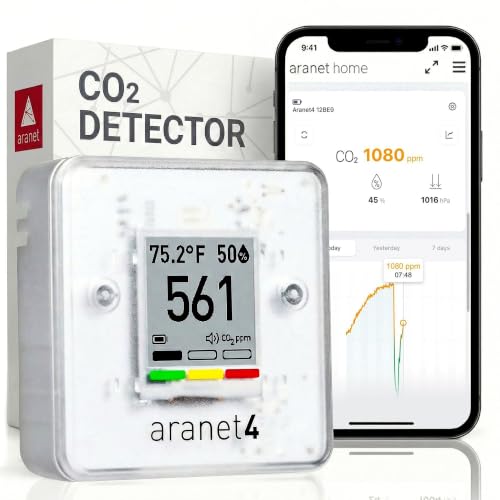
SAF · Aranet4 Indoor Air Quality Monitor, Wireless CO2 Detector for Home, Office
View on AmazonPrice and availability are shown on Amazon and can change at any time.
Verdict
The Aranet4 HOME does one job with unusual discipline: it measures CO₂ with a nondispersive infrared (NDIR) sensor, shows the number on an e-ink display you can read from across the room, and runs for years on two AA batteries. It does not measure particles or VOCs, it does not connect to Wi-Fi, and it is priced above most consumer CO₂ monitors. If CO₂ is the number you care about, and you want a monitor you can carry from room to room without thinking about charging, the documentation supports it as a first choice. If you want a whole-air-quality dashboard on a screen, it is the wrong product.
Who It Is For
- People who move a monitor between bedroom, office and living room and want the battery to be a non-issue.
- Teachers, clinicians and office managers who want a display readable at a glance without a phone.
- Anyone who wants to check another monitor against a well-documented NDIR reference.
It is a poor fit for someone who wants Wi-Fi alerts while away from home, or who wants CO₂, PM2.5 and VOCs in a single device. Our guide to choosing a CO₂ monitor for home use covers those alternatives.
Documented Specifications
| Item | Documentation |
|---|---|
| CO₂ sensor | NDIR (nondispersive infrared) |
| Other measurements | Temperature, relative humidity, atmospheric pressure |
| Display | E-ink, colour-coded status, prominent CO₂ number |
| Alerts | Colour indicator plus optional buzzer |
| Connectivity | Bluetooth to the Aranet Home app |
| Data history | Up to 90 days viewable in the app |
| Power | 2 × AA, up to 4 years depending on measurement interval |
| Origin | Made in the European Union |
Sensor and Accuracy
The manufacturer specifies an NDIR sensor. That matters because NDIR measures CO₂ by infrared absorption rather than inferring it from a VOC sensor, which is the method used by many cheaper “eCO₂” products. Owner comparisons published online consistently place the Aranet4 within a few tens of ppm of other NDIR instruments, which is in line with the stated accuracy class. Two practical points follow from the sensor design:
- The device supports manual calibration in fresh outdoor air. The manufacturer documentation describes the procedure, and it is worth doing when the unit is new and after any long storage. See how to calibrate a CO₂ monitor.
- The measurement interval trades response time against battery life. At the short interval the monitor tracks a room filling with people within a few minutes; at the long interval it is a trend logger. Pick the interval for the job.
Temperature and humidity are measured by a secondary sensor. Because the enclosure is small and passively ventilated, the temperature reading can run slightly above the room when the unit sits in direct sun or on a warm surface, which is normal for this class of device.
Display and Alerts
The e-ink display is the reason the battery lasts, and it is also the most practical feature. It holds the last reading without power draw, has no glow at night, and reads clearly in daylight. The colour-coded status (green, yellow, red) follows thresholds that can be adjusted in the app. The buzzer is optional and off by default, which is the right default for a bedroom.
App and Data
The Aranet Home app connects over Bluetooth and pulls the stored history from the device. It shows graphs of CO₂, temperature, humidity and pressure for up to 90 days and allows export. There is no cloud account requirement for the HOME model. The limitation is that the phone has to be within Bluetooth range to sync; if you want a monitor that reports to a dashboard while you are away, read the Aranet4 PRO review.
Strengths
- Documented NDIR sensor with manual calibration.
- Battery life measured in years rather than hours, so it is genuinely portable.
- Readable display that does not need an app to be useful.
- Long on-device history and export.
Limitations
- CO₂ only. No particulate or VOC sensing.
- Bluetooth only. No remote alerts without the PRO model and a base station.
- Higher price than most consumer CO₂ monitors with similar sensors.
How It Compares
The Airthings Wave Enhance also measures CO₂ on batteries and adds VOCs and pressure, but it has no numeric display and relies on the app. The Temtop C1+ is a lower-cost battery CO₂ monitor with a Bluetooth app but a shorter battery life. Qingping’s CO₂ monitor adds Wi-Fi at the cost of running mainly on mains power. The Aranet4 HOME wins on display readability, battery life and documentation; the others win on either price or sensor breadth.
How We Research
This review is based on the manufacturer’s published specifications and user documentation, the Amazon product listing, and patterns in owner reports. We did not run laboratory tests. Where a claim is the manufacturer’s, we say so. Related reading: how to check whether a CO₂ monitor uses a true NDIR sensor and how to read CO₂ ppm levels.
Recommended Tools


Products shown because their documented specifications fit this guide. Price and availability are on Amazon and can change.
Frequently Asked Questions
Does the Aranet4 HOME need Wi-Fi?
No. The HOME model uses Bluetooth only. Readings are stored on the device and synced to the phone app when it is in range. If you want cloud access or remote alerts, the Aranet4 PRO with an Aranet base station is the model designed for that.
How often does the Aranet4 update its reading?
The measurement interval is user-selectable in the app. Shorter intervals give faster response and shorter battery life; the longer interval gives the multi-year battery figure the manufacturer quotes.
Does the Aranet4 HOME measure PM2.5 or VOCs?
No. It measures CO₂, temperature, relative humidity and atmospheric pressure. For particles or VOCs you need a different or additional monitor.
Is the Aranet4 HOME accurate enough for ventilation decisions?
It uses an NDIR sensor with a manufacturer-stated accuracy in the ±30 ppm ±3% of reading class, which is the accuracy range that ventilation guidance is written for. It is not a laboratory reference instrument.
Affiliate disclosure: Akermin earns a commission from qualifying Amazon purchases made through links on this page. Our editorial picks are based on documented specifications and owner feedback, not commissions.