As an Amazon Associate, Akermin earns from qualifying purchases. Product links on this page are affiliate links.
Read a CO₂ level in four steps: first confirm the monitor is warmed up and calibrated (an outdoor reading of about 400 to 450 ppm proves it); second, confirm the placement gives a room reading rather than a breath reading (a meter or more from people, away from vents); third, look at the trend over the last 15 to 30 minutes, since the direction matters more than the number; fourth, apply the bands: under 800 ppm good, 800 to 1,000 acceptable, 1,000 to 1,500 ventilate, above 1,500 ventilate now.
Step 1: Is the monitor trustworthy right now?
- Has it been on for at least two to three minutes? Sensors read oddly during warm-up.
- Has it been in this room long enough to reach room temperature? See why sensors need time to stabilize.
- When did it last see fresh air? A monitor that has lived in a closed room for months may have drifted. Any reading under 400 ppm is a calibration fault. See how to calibrate a CO₂ monitor.
- Is it an NDIR monitor? Estimated eCO₂ values are not readings at all.
Step 2: Is it reading the room or a person?
Breath is 40,000 ppm. A monitor on the desk in front of you, or one someone just leaned over, shows a spike that fades in minutes. If the number jumped when someone approached, wait for it to settle or move the monitor. See why a CO₂ monitor spikes when people enter.
Step 3: Read the trend
The number tells you where the room is; the slope tells you where it will be. Most monitors show a history chart or at least the last hour.
| Trend | Meaning |
|---|---|
| Rising 50 to 100 ppm per 10 minutes | Occupancy exceeds ventilation; will pass 1,500 ppm within an hour |
| Rising slowly, flattening | Approaching steady state for this occupancy; the plateau is the room’s verdict |
| Flat | Ventilation matches occupancy at this level |
| Falling | People left or ventilation improved; the room is recovering |
| Sharp spike then fall within minutes | Breath near the sensor, or a door opened from a stuffier space |
Step 4: Apply the bands
| Reading | Band | Action |
|---|---|---|
| Under 800 ppm | Good | None |
| 800 to 1,000 ppm | Acceptable | Open a window if the room will stay occupied |
| 1,000 to 1,500 ppm | Poor | Ventilate; reduce occupancy if it keeps rising |
| 1,500 to 2,500 ppm | Very poor | Ventilate immediately; check the ventilation system |
| Over 2,500 ppm | Investigate | Sealed room, failed ventilation or a CO₂ source |
These are ventilation benchmarks, not health limits; see what 1,000 ppm means.
Worked examples
- Meeting room, 950 ppm, rising fast, meeting just started: open the door now; it will be at 1,500 in half an hour.
- Bedroom, 1,800 ppm at 7 a.m., falling since the door opened: normal overnight build-up; leave the door ajar tonight.
- Living room, 650 ppm, flat, three people: well ventilated; nothing to do.
- Office, 380 ppm: impossible; calibrate the monitor outdoors.
- Kitchen, 2,200 ppm during cooking on gas: run the hood; the reading is the hob, not the people.
The CO₂ level checker gives an interpretation for any reading and space type. For choosing a monitor whose readings are worth reading, see best CO₂ monitors.
Recommended Tools
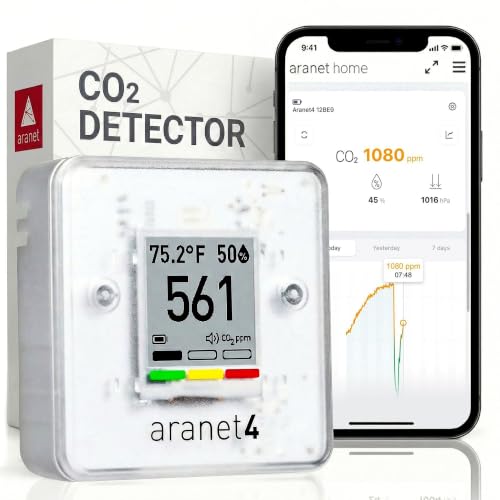
Products shown because their documented specifications fit this guide. Price and availability are on Amazon and can change.
Frequently Asked Questions
How long after switching on can I trust a CO₂ reading?
Give the monitor two to three minutes for the sensor to stabilize, and ten to fifteen minutes if it has just been moved into a room with a different temperature.
What is the most important thing to look at, the number or the trend?
The trend. A room at 900 ppm and rising 100 ppm every ten minutes needs action; a room at 1,100 ppm and falling does not.
What does a reading below 400 ppm mean?
The monitor needs calibrating. Outdoor air is about 420 ppm and no indoor reading is lower.
Affiliate disclosure: Akermin earns a commission from qualifying Amazon purchases made through links on this page. Our editorial picks are based on documented specifications and owner feedback, not commissions.
Related Guides

Temtop Handheld Particle Counter Review: Three Channels and No Published Flow Rate
A pump suction handheld particle counter reading 0.3, 0.5 and 1.0 micron channels alongside PM2.5, PM10 and TSP, with temperature and humidity sensors, 32 GB of internal storage and a 3500 mAh battery.
Read More→
VETOUCH Plug In CO2 Monitor Review: An Alarm the Bullets Never Define
A mains powered three in one monitor showing carbon dioxide, temperature and humidity on a 1.83 inch colour screen, with three brightness settings and a display that flips 180 degrees.
Read More→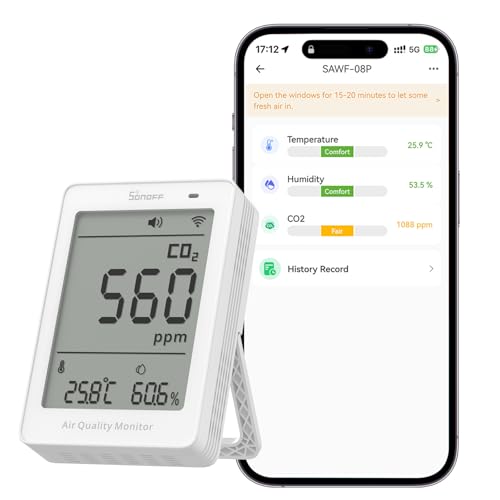
SONOFF AirGuard SAWF-08P Review: NDIR Accuracy Written as a Formula
A mains powered Matter compatible monitor showing CO2, temperature and humidity on one screen, with an NDIR sensor, 5 second updates and 12 months of history in the eWeLink app.
Read More→