Skip to content
AkerminMeasure. Monitor. Improve. Compare Products

Best Bluetooth Temperature Data Loggers for Laboratories: 7 Picks

A laboratory fridge or incubator needs a record you can defend months later, not just a live reading on a phone. Bluetooth loggers split into two families: cheap app-first sensors and calibrated compliance instruments. This page explains which is which.

  • Independent Research
  • Verified Specifications
  • Honest Recommendations

Measure It
Compare It
Buy Once

As an Amazon Associate, Akermin earns from qualifying purchases. Product links on this page are affiliate links.

Our Top Picks

This comparison was built from the manufacturer listing text supplied for each product. Every figure quoted in the picks, the table and the FAQ appears in that listing text. Where a listing does not publish a figure, the table says Not stated rather than supplying an estimate.

Best for compliance
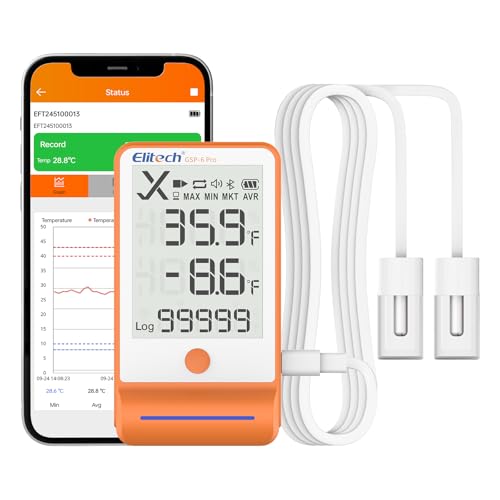
Elitech Bluetooth Dual-Probe GSP-6

Elitech Bluetooth Dual-Probe GSP-6

Calibration certificate, buffered probe and 100,000 point memory in one unit.

  • Listing states a pharmacy DDL with calibration certificate to auditor
  • Meets CDC and VFC requirements for vaccine storage
  • Buffered bottle contains 8ml propylene glycol to damp door-opening swings
  • Memory holds up to 100,000 data points; 3.3 inch display
View on Amazon Read Full Review→
Best dual probe
Elitech GSP-6 Dual Probe

Elitech GSP-6 Dual Probe

Two separable probes and a magnet for mounting inside a fridge.

  • Listing states CDC and VFC requirements and FDA 21 CFR Part 11 compliance
  • Built-in magnet mounts directly to a refrigerator
  • Separable probe avoids precooling after each move
  • Aimed at vaccines, blood products, pharmacies and cold chain
View on Amazon Read Full Review→
Best published accuracy
HOBO MX1101

HOBO MX1101

A long-standing logger brand with a stated accuracy figure and deep memory.

  • Measures -20 to 70 degrees Celsius with accuracy of plus or minus 0.21 degrees Celsius
  • Records 1 to 90 percent relative humidity with plus or minus 2 percent typical accuracy
  • 128 KB storage holds up to 84,650 measurements
  • Temperature and humidity in one unit
View on Amazon Read Full Review→
Best for ambient checks
Govee H5074

Govee H5074

A small temperature and humidity sensor with a two second refresh.

  • Swiss-made sensor stated, temperature accurate to plus or minus 0.54 degrees Fahrenheit and humidity to plus or minus 3 percent RH
  • Refreshes every 2 seconds
  • 20-day on-board data storage
  • CSV export of the last 2 years of data through the app
View on Amazon Read Full Review→
Best for transport
Freshliance BlueTag T100

Freshliance BlueTag T100

A tiny replaceable-battery logger with cloud upload and QR code reading.

  • Battery-replaceable, 1.25 inch mini size
  • Pairs with Tkeeper app over Bluetooth for configuration, graphing and PDF or CSV export
  • Data automatically uploaded to and stored in the cloud
  • QR code on the package can be scanned to read data without opening the container
View on Amazon Read Full Review→
Best two-pack
Freshliance BlueTag TH20

Freshliance BlueTag TH20

Temperature and humidity logging in a two-pack for fridges and incubators.

  • Bluetooth logger for temperature and humidity, not the WiFi version
  • Listing names refrigerator, freezer, wine cellar, warehouse, greenhouse, incubator, vaccine cabinet and laboratory
  • Pairs with Tkeeper app over Bluetooth
  • Multi-user cloud viewing and synchronisation stated
View on Amazon Read Full Review→
Best for shared access
Freshliance BlueTag TH100

Freshliance BlueTag TH100

A mini humidity and temperature logger with cloud sharing and QR reading.

  • Battery-replaceable, 1.25 inch mini size
  • Tkeeper app over Bluetooth for configuration, graphing, filtering and PDF or CSV export
  • Cloud storage of all data stated
  • QR code scan reads data without opening the container
View on Amazon Read Full Review→

Comparison Table

View Full Comparison→
PickTemperature accuracyHumidityMemoryCalibration statedApp
Plus or minus 0.3 degrees CelsiusNot stated100,000 pointsYes, certificate to auditorElitech iCold, ElitechlogView
Not statedNot statedNot statedCDC and VFC, FDA 21 CFR Part 11Not namedView
Plus or minus 0.21 degrees CelsiusPlus or minus 2 percent typical84,650 measurementsNot statedNot statedView
Plus or minus 0.54 degrees FahrenheitPlus or minus 3 percent RH20 days on boardNot statedGovee appView
Not statedNot statedNot statedNot statedTkeeperView
Not statedYes, accuracy not statedNot statedNot statedTkeeperView

Cells marked Not stated mean the listing bullets do not publish that figure. No value has been estimated.

How to choose a Bluetooth logger for a laboratory

Six decisions, in the order that matters when the record has to survive an audit.

Ask for the certificate first

If the record goes into a compliance file, the calibration certificate is the first question, not the last. Only P8 states one in its listing.

Match accuracy to the excursion you care about

A vaccine fridge with a 2 to 8 degrees Celsius band needs accuracy well inside that band. P3 publishes plus or minus 0.21 degrees Celsius; P1 publishes plus or minus 0.54 degrees Fahrenheit.

Decide whether you need a buffered probe

A bare probe alarms every time the door opens. P8's 8ml propylene glycol bottle damps those swings. If false alarms are already a problem, this is the fix.

Work out your logging interval against memory

Divide the stated memory by your interval to get the days before overwrite. P8 states 100,000 points and P3 states 84,650 measurements; the others do not publish a figure.

Check the battery arrangement

Replaceable cells, stated for P4, P7 and P10, mean the logger survives beyond one battery life. Sealed units become waste when the cell dies.

Treat the app as a tool, not the archive

If the long history lives only on one phone, it is one lost phone away from gone. Prefer units that state cloud storage or on-board memory you can export.

Frequently Asked Questions

View All FAQs→
Do I need a calibration certificate for a laboratory temperature logger?

If the record is used to demonstrate that stored material stayed within a specified band, an auditor will normally ask how the instrument was verified. P8 is the only pick here whose listing states a calibration certificate to auditor. The others publish accuracy figures or nothing at all, which is not the same as traceability.

Is Bluetooth good enough, or do I need WiFi?

Bluetooth is enough when somebody is on site to collect the data, and it is more reliable in a metal-lined fridge because there is no network to configure. WiFi or networked logging is better when nobody is present overnight or at weekends. Several picks here state explicitly that they are not the WiFi version, so read that line before buying.

What does the memory figure actually mean in practice?

It is the number of readings the logger holds before the oldest is overwritten. Divide it by your logging interval to get the days of coverage. P8 states 100,000 points and P3 states 84,650 measurements. P1 states 20 days of on-board storage, which is a much shorter buffer.

Can I use a cheap app-first sensor as my compliance record?

You can, but understand what you are relying on. On the small units the long history often lives in the phone app rather than the device, and no calibration certificate is stated. That is fine for watching a room. It is weak for a file that has to be defended months later.

Reviews

Elitech Bluetooth Dual-Probe GSP-6

Elitech Bluetooth Dual-Probe GSP-6 Best for compliance

The buffered probe is the detail that matters most in a laboratory fridge. A bare probe reads the air temperature, which drops every time the door opens and recovers within seconds. A probe sitting in 8ml of propylene glycol has thermal mass, so it tracks what the contents of the fridge are experiencing rather than what the air is doing. The listing states a range of -40 to 185 degrees Fahrenheit with accuracy of plus or minus 0.3 degrees Celsius, which is a published figure rather than a resolution claim.

The second detail is the calibration certificate. The listing states it is a pharmacy DDL with calibration certificate to auditor, and that it meets CDC and VFC requirements. That sentence is the difference between a logger you use to watch a fridge and a logger whose record you can hand to an inspector. The 100,000 point memory means you can log at a short interval for a long period without downloading, which matters when nobody is on site over a weekend.

Bluetooth is used for parameter setting, reading, report export and printing through the Elitech iCold app, and the listing also mentions Elitechlog software for further configuration. Treat the app as the configuration and retrieval tool, not the storage. If the phone is lost, the data is still in the logger.

Strengths

  • Calibration certificate stated in the listing
  • Buffered probe reduces false alarms from door openings
  • 100,000 point memory depth
  • CDC and VFC compliance stated

Limitations

  • Bluetooth only, no WiFi or network logging stated
  • App is required for configuration and export
  • Larger than the mini button loggers
  • No humidity channel stated
View on Amazon
Elitech GSP-6 Dual Probe

Elitech GSP-6 Dual Probe Best dual probe

The separable probe is a practical answer to a real problem. If the probe is fixed to the body, you have to let the whole unit come to fridge temperature before it reads correctly, which can take an hour. A separable probe lets you leave the probe in place and move only the body. The listing states the probe eliminates the need for precooling after each device movement, which is the same point in the manufacturer's words.

The magnet is the second practical detail. Laboratory fridges are steel, so a magnetic mount removes the need for brackets or tape, and it keeps the body out of the way of shelves. The listing states the unit is designed to meet CDC and VFC requirements and FDA 21 CFR Part 11 compliance, which is the language a regulated laboratory looks for.

What the listing does not publish is a memory figure, an accuracy figure, or a temperature range. If you need those numbers before purchase, ask the supplier, because this page will not invent them. The absence of a stated memory depth is the main reason P8 sits above it for compliance work.

Strengths

  • Separable probe avoids precooling delays
  • Magnetic mounting for steel fridges
  • CDC and VFC compliance stated
  • FDA 21 CFR Part 11 compliance stated

Limitations

  • Memory depth not stated in the listing bullets
  • Accuracy not stated in the listing bullets
  • No humidity channel stated
  • App required for setup and export
View on Amazon
HOBO MX1101

HOBO MX1101 Best published accuracy

The MX1101 is the pick when you want the specification on the page rather than in a support email. The listing publishes an accuracy of plus or minus 0.21 degrees Celsius in standard conditions, which is a tighter figure than most of the units here, and it publishes the humidity accuracy as plus or minus 2 percent typical in the normal range. It also publishes the memory as 128 KB holding up to 84,650 measurements.

That combination matters in a laboratory because the two numbers you are asked for most often are accuracy and logging capacity. Accuracy tells you whether the instrument can resolve the excursion you care about. Memory tells you how long you can leave it before the oldest data is overwritten. A logger with 84,650 points at a one minute interval covers roughly two months, which is a comfortable buffer for a monthly download routine.

The listing does not state a Bluetooth range, an app name, or a calibration certificate. The MX1101 is a monitoring instrument, not a compliance package. If your laboratory needs a certificate in the file, budget for calibration separately.

Strengths

  • Published accuracy of plus or minus 0.21 degrees Celsius
  • Humidity channel included
  • 84,650 measurement memory stated
  • Wide -20 to 70 degrees Celsius range

Limitations

  • Calibration certificate not stated in the listing
  • Bluetooth range not stated
  • App name not stated
  • No buffered probe option stated
View on Amazon
Govee H5074

Govee H5074 Best for ambient checks

The H5074 is a room sensor rather than a laboratory instrument, and it should be bought as one. The listing states a Swiss-made sensor with temperature accuracy of plus or minus 0.54 degrees Fahrenheit and humidity accuracy of plus or minus 3 percent RH, refreshing every 2 seconds. Those are reasonable figures for ambient monitoring of a lab bench area or a storage room, and the refresh rate is fast enough to see a door opening in the graph.

The memory arrangement is the part to understand. The listing states 20 days of on-board storage, and a CSV export of the last 2 years of data through the app. Those two sentences describe different things. The 20 days is what the device itself holds. The 2 years is what the app has accumulated on the phone. If the phone is replaced or the app data is cleared, the longer history goes with it. For a laboratory record, that is a fragile arrangement.

Bluetooth range is stated as 262 feet with no obstacles, which in a building with walls will be much less. The listing also notes it is not the WiFi version, so there is no remote access when nobody is on site.

Strengths

  • Fast 2 second refresh
  • Humidity as well as temperature
  • CSV export stated
  • Small and unobtrusive

Limitations

  • Only 20 days of on-board storage
  • Long history depends on the phone app
  • No calibration certificate stated
  • Bluetooth only, not the WiFi version
View on Amazon
Freshliance BlueTag T100

Freshliance BlueTag T100 Best for transport

The T100 is built for the moment a shipment arrives. The listing states the data is automatically uploaded to and stored in the cloud, and that anyone can scan the QR code on the package with the app to read and synchronise the monitoring data without opening the container. That is a genuinely useful workflow for a laboratory receiving temperature-sensitive reagents, because it lets a receiving technician confirm the transit record before the box is opened and the cold chain is broken.

The replaceable battery is the second practical point. A sealed logger has to be thrown away when the cell dies, which is wasteful for a device you may use on hundreds of shipments. The listing states the battery is replaceable and the unit is 1.25 inches, small enough to sit inside a small insulated box.

What the listing does not publish is an accuracy figure, a temperature range, a memory depth, or a calibration certificate. For transport documentation that is often acceptable, because the question is whether the shipment stayed within a band, not whether the reading is traceable to a national standard. For a laboratory fridge record it is not enough.

Strengths

  • Cloud storage stated
  • QR code reading without opening the package
  • Replaceable battery
  • Very small 1.25 inch body

Limitations

  • Accuracy not stated in the listing bullets
  • Memory depth not stated
  • No calibration certificate stated
  • App and account needed for full function
View on Amazon
Freshliance BlueTag TH20

Freshliance BlueTag TH20 Best two-pack

The TH20 covers both temperature and humidity, which matters in a laboratory for incubators, environmental chambers and sample storage where humidity drift can matter as much as temperature. The listing names laboratory explicitly among the intended uses, alongside incubator and vaccine cabinet, so it is aimed at this category rather than adapted to it.

The two-pack is the reason to consider it. Laboratories rarely have one fridge; they have a bank of them, and buying a pair gets you two monitored locations for less than two separate purchases. The multi-user cloud arrangement means a second person can check the same record from their own phone, which removes the single-phone dependency that the small Govee unit has.

The listing states it is not the WiFi version, so there is no remote access without a phone in Bluetooth range. It also does not publish an accuracy figure, a memory depth, or a calibration certificate. Treat it as a monitoring and alarm aid, not as the compliance record.

Strengths

  • Temperature and humidity in one unit
  • Two-pack covers two locations
  • Laboratory named in the listing
  • Multi-user cloud viewing stated

Limitations

  • Accuracy not stated in the listing bullets
  • Memory depth not stated
  • No calibration certificate stated
  • Bluetooth only, not the WiFi version
View on Amazon
Freshliance BlueTag TH100

Freshliance BlueTag TH100 Best for shared access

The TH100 is functionally the same instrument as the T100 with a humidity channel added, and the listing text is nearly identical. If you are choosing between them, the decision is whether you need humidity. For a laboratory incubator or a sample room, humidity is often the second variable that matters, so the TH100 is the more useful of the two.

The cloud arrangement is the same: data is automatically uploaded and stored, and a QR code on the package can be scanned to read the record without opening the container. That is convenient for shared laboratory use, because any technician with the app can pull the record rather than chasing the one phone that was paired.

The listing does not publish an accuracy figure, a memory depth, a temperature range, or a calibration certificate. The 1.25 inch body and replaceable battery are stated. As with the other Freshliance units, this is a monitoring tool for the bench and the loading dock, not a traceable instrument for a regulatory file.

Strengths

  • Temperature and humidity
  • Cloud storage and QR reading stated
  • Replaceable battery
  • Small 1.25 inch body

Limitations

  • Accuracy not stated in the listing bullets
  • Memory depth not stated
  • No calibration certificate stated
  • App required for all configuration
View on Amazon

Buying Guide

Short answer: For regulated laboratory storage, P8 is the strongest pick because the listing states it ships with a calibration certificate and a buffered probe, which is what an auditor asks for. P2 is the alternative where a dual probe and magnetic mounting matter more than the certificate. P3 is the pick when you want a long-standing logger brand with a published accuracy figure and deep memory rather than an app ecosystem. The small app-first units, P1, P4, P7 and P10, are useful for walk-in monitoring and transport, but none of them publishes a calibration certificate, so they are not the right instrument for a compliance file.

What Bluetooth collection actually changes

A data logger has two jobs: record, and hand the record over. Bluetooth changes only the second job. Instead of plugging a cable into a laptop or pulling a USB stick, you stand near the unit with a phone and the app pulls the readings across. In a laboratory that is a real convenience, because fridges are often stacked, cabled and awkward to reach, and because the person collecting the data may not be the person who set the logger up.

The trade is that Bluetooth is a short-range radio. The listings here quote figures like 262 feet with no obstacles, which in a building with steel doors and insulated panels will be far less. That is why the collection routine matters more than the radio. If you walk the same route every Monday morning and pull each logger as you pass, Bluetooth is fine. If you need the data at your desk while the fridge is two floors away, Bluetooth is the wrong transport and you want a networked logger instead. Setting up long term environmental data logging covers the routine side of this in more detail.

Calibration certificates and what they are not

An accuracy figure and a calibration certificate are different things, and laboratory buyers mix them up constantly. The accuracy figure, such as plus or minus 0.21 degrees Celsius for P3 or plus or minus 0.3 degrees Celsius for P8, tells you how close a reading is likely to be to the true value. A calibration certificate tells you that a specific instrument was compared against a reference and that the comparison is documented. The first is a specification. The second is evidence.

Only P8 states a calibration certificate in its listing, described as a pharmacy DDL with calibration certificate to auditor. P2 states CDC and VFC requirements and FDA 21 CFR Part 11 compliance, which is a regulatory claim rather than a certificate. The remaining picks publish accuracy figures or nothing. If your laboratory quality system requires documented verification, budget for calibration on the units that do not include it, and check whether the unit can be adjusted afterwards. A logger that cannot be trimmed after calibration is a logger you replace rather than correct.

Memory depth, logging interval and the overwrite problem

Memory depth is the specification most often ignored until it bites. A logger holds a fixed number of readings. When it is full, it either stops or overwrites the oldest data, depending on the model. Neither behaviour is a problem if you download on a schedule that keeps ahead of the limit. Both are a problem if you do not.

The arithmetic is simple. Divide the stated memory by your logging interval. P8 states 100,000 points, so at a one minute interval that is roughly 69 days. P3 states 84,650 measurements, roughly 59 days at the same interval. P1 states 20 days of on-board storage, which at a one minute interval would be far fewer readings than the app’s two year history suggests, because the two year figure describes what the phone has accumulated rather than what the device holds. That distinction is worth reading twice. How often environmental sensors should record data walks through the interval decision.

The app dependency nobody mentions at purchase

Every Bluetooth logger here needs an app to configure it, read it and export a report. That is fine until the app changes, the phone is replaced, or the person who set it up leaves. The listings that state cloud storage, such as P4, P7 and P10, reduce that risk because the record is not only on one handset. The listings that state on-board memory, such as P8 and P3, reduce it in a different way, because the logger itself is the archive and the app is only the window.

The weakest arrangement is a long history that lives only in the app on one phone. P1 states a CSV export of the last 2 years of data to the phone, which is convenient and also a single point of failure. For laboratory work, decide before purchase where the record will live after the download, and make sure the export format, usually CSV or PDF, is one your record system accepts. How to choose a temperature and humidity data logger goes through the export question in more depth.

Where a Bluetooth logger stops being the right answer

A Bluetooth logger is the wrong instrument in three situations. The first is when nobody is on site to collect the data. Bluetooth has no way to reach you, so an overnight excursion is discovered the next morning rather than at the moment it happens. If that delay would ruin stored material, you need a networked logger with alerts, or a separate alarm.

The second is when the record has to be traceable and the unit has no calibration path. A monitoring sensor that tells you a room was warm is useful. It is not evidence that a regulated storage condition was maintained. The third is when the environment is beyond the instrument. A logger rated for a domestic fridge is not the right tool for a cryogenic freezer or an oven, and the listing ranges here top out well below those extremes.

Finally, remember that a logger is not an alarm. It records what happened. If a door is left open at midnight, the graph will show it and nobody will know until the download. Where that matters, pair the logger with an alarm rather than asking the logger to do a job it was not built for. Temperature and humidity data loggers for cold storage covers the alarm side of the same decision.
How We Research

This comparison was built from the manufacturer listing text supplied for each product. Every figure quoted in the picks, the table and the FAQ appears in that listing text. Where a listing does not publish a figure, the table says Not stated rather than supplying an estimate. Products in the supplied set that are not Bluetooth temperature loggers for laboratory use were excluded: P11 is a four-channel thermocouple meter with USB export and no Bluetooth, and P5, P6, P9 and P12 duplicate other entries in the set or repeat the same listing text, so writing about them separately would have padded the list without adding information. No laboratory testing was performed and no measurements of our own are published.

Read our full review methodology→