Best Borescopes for Aircraft Maintenance: Compact Articulating Picks for Cylinders and Turbine Checks
Cylinder checks on a piston aircraft and visual checks of turbine blades both call for a slim, steerable camera that records what it sees for the logbook. None of the consumer units here state any aviation certification; they are compact articulating borescopes whose manufacturers name aircraft inspection among their uses. This guide compares what the listings state about probe size, articulation, recording and heat warnings.
Independent Research
Verified Specifications
Honest Recommendations
Slim and Steerable
Record for the Log
No Cert Stated
As an Amazon Associate, Akermin earns from qualifying purchases. Product links on this page are affiliate links.
Our Top Picks
These borescopes were compared on stated probe diameter, articulation type and range, side lens, screen, recording with audio, temperature warnings and battery, all taken from manufacturer listings. We did not run laboratory tests or image comparisons, and no listing here states an aviation or NDT certification; figures are the manufacturers' own and blanks are marked as not stated.
Best Overall
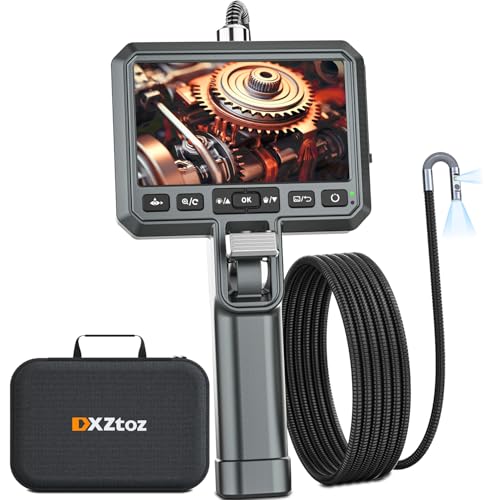
DXZtoz Dual-Lens Articulating Borescope for Aircraft and Automotive Inspection
A 0.25 in probe that steers 210 degrees and switches to a 90 degree side camera.
0.25 in probe with two-way 210 degree articulation and a one-button 90 degree side camera
5 ft probe, seven LEDs, IP67 waterproof
5 in 1080P screen with 10x zoom; photo and video with sound to an included 32 GB card
Aluminum thumb-stick control stated at 10,000-plus rotations; front-exit cable; screen bracket; 3000 mAh for 5 to 6 hours
All figures are taken from the manufacturers' Amazon listings at the time of research. No listing states an aviation, FAA or NDT certification; suitability for a given inspection is set by the maintenance manual and the inspecting mechanic. Where a listing gives no value the cell reads Not stated.
How to Choose a Borescope for Aircraft Maintenance
Four checks decide the purchase:
Probe Fits the Port
3.9 mm passes any spark plug port with room to steer; 0.25 in fits most and allows a side camera; 6.2 mm suits larger access ports.
Steering for the Geometry
A cylinder wall wants a side lens or a tip that bends 180 degrees or more. Blade edges want four-way control so the cable never has to rotate.
Record With Narration
The DXZtoz units and the TF600 record video with sound, which puts the finding and the explanation in one file for the record.
Heat and Recovery
A temperature warning protects the camera in a warm engine. A magnet and hook, stated on the DXZtoz dual-lens, recover a dropped fastener before it becomes foreign object debris.
Are these borescopes approved for aircraft inspections?
No listing here states any aviation, FAA or NDT certification. They are consumer and light-industrial articulating videoscopes whose manufacturers name aircraft engines among their uses. Whether a given visual check can be done with one is set by the maintenance manual, the inspection requirement and the certificated mechanic or inspector signing the work, not by the camera.
Which probe size fits a piston aircraft cylinder through the spark plug port?
All of the probes here are named for the job by their manufacturers: 3.9 mm on the Teslong TF600, Teslong TD500 and DXZtoz AGC900D, 0.25 in on the DXZtoz dual-lens and Dearsee, and 6.2 mm on the Ralcam. The slimmer the probe, the more room the tip has to bend inside the chamber to view the walls and the valve faces.
Is a side lens or four-way articulation better for looking at a cylinder wall?
Both work; they differ in how. A 90 degree side camera, as on the DXZtoz dual-lens, views the wall square-on with the tip straight, which is gentle on the mechanism. Four-way articulation on the TF600 or Ralcam bends the single forward camera toward the wall, which also reaches the back of a valve. Two-way units rely on rotating the cable for the second plane.
Why does a temperature warning matter on an aircraft borescope?
Because a cylinder that was running an hour ago is still warm, and a slim probe has no thermal mass. The Dearsee states an alarm at 75 C and a shutdown at 80 C, the Ralcam a warning at 90 C or above, and the DXZtoz 3.9 mm describes its probe as heat-resisting to 60 C. The Teslong and DXZtoz dual-lens listings state no warning, so let the engine cool first.
Can the video from these borescopes go into a maintenance record?
The DXZtoz dual-lens, DXZtoz 3.9 mm and Teslong TF600 record video with sound to a 32 GB card, and the Ralcam supports a 32 GB card, so a narrated clip can be copied to a computer and attached to the work order. Whether the record accepts video is a matter for the operator and inspector; the camera only makes the file.
Reviews
DXZtoz Dual-Lens Articulating Borescope for Aircraft and Automotive Inspection Best Overall
The DXZtoz dual-lens unit is the pick for aircraft work because it combines the two things a cylinder or blade check needs most: a tip that steers and a side camera that does not. DXZtoz states a 0.25 in probe with two-way 210 degree articulation and a one-button switch to a 90 degree side camera, so a cylinder wall can be viewed square-on without bending the tip against it, and the manufacturer names head gasket, cylinder wall and piston ring wear, valve carbon and turbocharger damage as targets.
The recording side suits a logbook. A 5 in 1080P screen with 10x zoom feeds photo and video with sound to an included 32 GB card, which the listing pitches as before-and-after evidence for clients. Seven LEDs light the 5 ft IP67 probe.
The control is described as an aluminum dual-path thumb stick, patented and rated for 10,000-plus rotations, with a front-exit cable and a screen bracket for hands-free viewing. A 3000 mAh battery is stated at 5 to 6 hours. No certification is stated; the inspecting mechanic decides whether it meets the task.
Teslong TF600 3.9 mm Four-Way Articulating Borescope Best 4-Way Articulation
The TF600 is the borescope for a mechanic who needs to look in every direction from inside a small port. Teslong states a 3.9 mm tip driven by a joystick through 360 degrees of turn and 210 degrees of bend, which is the full four-way range that lets the camera look back at the plug port it entered or trace a blade edge without rotating the cable.
The screen is the largest in this group at 6 in and 1280x720, backed by a 6000 mAh battery, and the probe is rated IP67 with an aerospace-style connector. A 32 GB card records JPG stills and AVI video with audio from a built-in microphone, so a narrated clip of a cylinder check can go straight into the record. A hard case and a 12-month warranty are stated.
The listing gives no cable length and no runtime in hours, states no temperature warning, and names automotive engines rather than aircraft as its example. It also has no side lens; the four-way tip does that job, at the cost of a more delicate mechanism that must be straightened before withdrawal.
Strengths
Four-way 360 degree turn and 210 degree bend at 3.9 mm
DXZtoz AGC900D 3.9 mm Articulating Borescope for Aircraft and Automotive Inspection Best Value
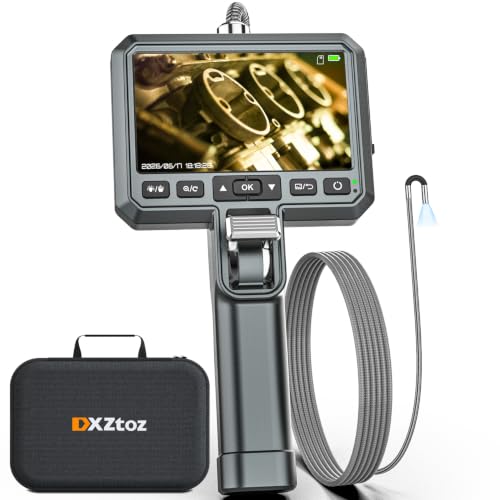
The DXZtoz 3.9 mm is the lower-cost aircraft pick because it keeps the recording and screen of the dual-lens model on the slimmest probe in the group. The manufacturer states a 3.9 mm (0.15 in) stainless steel probe with two-way 220 degree articulation and says it handles 30% more tight inspection tasks than its 8.5 mm and 6.5 mm versions, naming aircraft and automotive engines, robots and 3D printers.
Optics are specified more fully than most: a focal range down to 1 cm, described as close enough to examine cylinder walls, pistons and valve cracks, and 10x zoom on a 5 in IPS screen with six adjustable LEDs. Photos and video with sound record to a pre-installed 32 GB card for download to a computer.
The 5 ft stainless probe is described as heat-resisting to 60 C and 60% more wear-resistant than a general gooseneck cable, and it is rated IP67. A 3000 mAh battery is stated at 5 to 6 hours and charges from a power bank. It has no side lens and no four-way steering, and like every unit here, no certification is stated.
Short answer: the DXZtoz dual-lens articulating borescope is the aircraft pick because a 0.25 in tip that bends 210 degrees and switches to a 90 degree side camera covers cylinder walls, valve faces and blade edges while recording narrated video; the Teslong TF600 is the choice when a 3.9 mm tip has to steer in every direction, with four-way articulation, an IP67 probe and a 6-inch screen; and the DXZtoz AGC900D 3.9 mm is the value pick that keeps close focus, 10x zoom and card recording on the slimmest stainless probe. None of the three states an aviation certification.
What aircraft work asks of a borescope
Two jobs account for most borescope use around light aircraft. The first is the cylinder check on a piston engine: through the spark plug port, looking at the cylinder walls for scoring and glazing, the valve faces and seats for burning and carbon, and the piston crown for damage. The second is a visual check of compressor or turbine blades on a turbine engine, reached through an access port, looking for nicks, cracks and erosion along the leading edge. Both need a slim, steerable probe, good close focus and a way to record the finding. The borescope buying guide covers the general choices; the manufacturers of every unit here name aircraft, engine cylinders, turbine blades or airframe structures among their uses, which is why they are on this page and not the general one.
Certification: what these listings do not say
None of the six listings states an aviation, FAA or NDT certification, and this guide makes no claim that any of them satisfies a particular inspection requirement. They are compact articulating videoscopes in the consumer and light-industrial class. Whether a specific check can be done with one is decided by the maintenance manual, the inspection program and the certificated mechanic or inspector who signs the work. What the listings do state, and what this page compares, is probe size, steering, recording and heat handling.
Probe size and steering for the two jobs
The probes here are 3.9 mm on the Teslong TF600, Teslong TD500 and DXZtoz AGC900D, 0.25 in on the DXZtoz dual-lens and Dearsee ZX2-D1, and 6.2 mm on the Ralcam M5, which also states a replaceable snake tube in different sizes. Steering splits three ways. The TF600 and Ralcam are four-way: the TF600 states a 360 degree turn with a 210 degree bend, the Ralcam a 360 degree four-way system on a stainless joystick. The DXZtoz dual-lens adds a 90 degree side camera to a 210 degree two-way tip, which is the most direct way to view a cylinder wall square-on. The DXZtoz 3.9 mm (220 degrees), Dearsee (180 degrees) and TD500 (angle not stated) are two-way only and rely on rotating the cable for the second plane. The articulating borescope guide and the joystick borescope guide compare the mechanisms in more depth.
The limits: probe diameter, waterproof rating and heat
Three limits apply across the group. Diameter trades against capability: the 3.9 mm probes carry six LEDs and a single forward camera, the 0.25 in DXZtoz fits a second lens and seven LEDs, and the 6.2 mm Ralcam fits a replaceable tube. Waterproofing is IP67 on every probe here except the TD500 3.9 mm, whose listing gives no rating; that matters for fuel tanks and wet airframe cavities. Heat is the limit the listings treat most differently. The Dearsee states an alarm at 75 C and a shutdown at 80 C, the Ralcam a warning at 90 C or above, and the DXZtoz 3.9 mm describes its probe as heat-resisting to 60 C. The Teslong units and the DXZtoz dual-lens state no warning. In every case the engine should be cool before the probe goes in, and an articulating tip should be straightened before it comes out. The slim-probe borescope guide covers the mechanical fragility of tips at this size.
Recording, zoom and recovery
Recording is where these units earn a place in a hangar. The DXZtoz dual-lens and 3.9 mm units and the Teslong TF600 record video with sound to an included 32 GB card, so the mechanic can narrate a finding as it is framed; the Ralcam supports a 32 GB card; the TD500 ships with a card installed; the Dearsee listing does not state recording. Zoom is stated at 10x on both DXZtoz units, 8x on the Dearsee and 4x on the Ralcam, and the DXZtoz 3.9 mm states focus down to 1 cm. Two accessories matter more around aircraft than elsewhere: the DXZtoz dual-lens ships a magnet and hook for recovering a dropped fastener, which is a foreign object debris problem if it is left, and its screen bracket frees a hand. The Ralcam states a detachable 5000 mAh battery and 180 degree image flip.
Related guides
The 5-inch screen guide and the main best borescopes guide in this cluster cover the larger general-purpose probes for airframe cavities and ducts where slimness is not the constraint.
How We Research
Products were compared on manufacturer listing text: probe diameter, articulation type and stated range, side lens, screen size and resolution, recording and audio, temperature warnings, battery and stated runtime, and included accessories. Owner feedback was reviewed for recurring reports of articulation wear and image quality in dark cylinders. We did not run laboratory tests or image comparisons and publish no measurements of our own. No listing states an aviation certification and we make no claim about regulatory acceptance. Amazon data supplies images, availability and links only.
A handheld thermal camera with a 160 by 120 infrared detector, a 320 by 240 enhanced image, 40 mK sensitivity, a focus free 40 by 30 degree field of view, a 25 Hz refresh rate and still JPG image capture.
A non contact infrared thermometer for electrical, mechanical, HVAC and automotive surfaces, with dual rotating lasers that mark the edges of the measurement area, minimum, maximum, difference and average readings, and an IP54 rating.
A pinless non invasive moisture meter that reads up to three quarters of an inch into a surface, with scales of 0 to 53 percent for softwood, 0 to 35 percent for hardwood and relative readings on wallboard, drywall and masonry.